
Holistic Review: Total fanwank, but of the very best kind — at least until the last 10 minutes, when it takes a couple of narrative turns that I personally just can't appreciate.
After the débacle of last year's three-part finale, I think it's fair to say that some of us in fandom approached this year's finale with a little trepidation. Roni even asked me recently, "Just...tell me the finale was well written!! Not a repeat of last year...right? *tries to look hopeful*" which was generally my concern too, going into it. This trepidation was not helped at all by the Daily Star article from 8 October 2007 that I mentioned in my review of Partners in Crime, which I can now quote in full:
Doctor Who bosses are set to call back FOUR of the Time Lord’s favourite assistants – including Billie Piper – for a sensational showdown. The old cast members will be reunited to help the Doc fight evil Dalek creator Davros in an explosive finale to the next series. Leading the way in the line-up will be Billie (Piper) as Rose Tyler along with the rest of the Tyler family; they will hook up with the TARDIS traveller's latest assistants Martha Jones and Donna Noble. Also on hand to help out the Doc will be his old companion Sarah Jane Smith as well as Torchwood boss Captain Jack Harkness. Even the Time Lord’s dog K-9 will make an appearance. The TV source said: "This is the daddy of all shows. The writer Russell T Davies really wants to pull out all the stops for the finale next year."
You can just imagine fandom's reaction to this frankly unbelievable-sounding tabloid claim. Eight past characters (little did we know that was only the start!) being thrown in the pot together to battle Davros and the Daleks?! It sounded like the makings of a bad piece of fanfic (and probably one in which they were all saved at the last minute by a brilliant young writer named Mussel B Wavies, who everybody adored and Jack snogged repeatedly). Considering the source, I certainly assumed (and somewhat hoped) that it was all just made up to boost sales of the tabloid. The problem was, several of these elements — particularly Lis Sladen's return — had been rumored for some time before the article was published, so it wasn't like this was coming completely out of the blue. And if it was true, then it had the potential to be either really cool, or hide-your-face-in-shame embarrassing, and I know which one Roni and I were afraid we were going to get. Back on April 2, David Tennant told the BBC's magazine Ariel that the finale would be the "biggest, boldest, maddest, saddest, most exciting story we've ever done." My reaction at the time was: yeah, you probably would've said that about the series three finale, too, and look how that turned out.
I was therefore very relieved to be able to reassure Roni that the finale actually was well-written, and David Tennant hadn't really been exaggerating much. And not only that: it does an unbelievably good job of balancing this huge cast of returning guest stars. (My trust in RTD is somewhat restored; if he can pull this off, then he's more talented than I've been giving him credit for.) Even more: it's a lot of fun.
In the end, The Stolen Earth and Journey's End are mostly memorable for the fun of watching all of the tenth Doctor's companions banding together in a single story. Just as it was fun to watch Rose meet Sarah in School Reunion, Martha meet Jack in Utopia, and Donna meet Martha in The Sontaran Stratagem, here the fun is multiplied by... well, dozens. The fun of all these first contacts is compounded by the fact that we're also watching a lot of characters reunite, like Rose and Sarah, Martha and Jack, and — most crucially — Rose and the Doctor.
As the returning monsters of this continuity-fest, of course we have to have the Daleks, making their first and only appearance in season four. It's really cool to watch them gliding around their Crucible, giving orders and generally seeming completely in control. These Daleks are made out to be an extremely credible threat, particularly after the Doctor's very spooky comment that they're experts at fighting TARDISes. I didn't know you could fight TARDISes, much less destroy them! It's weird to think that we really haven't seen the Daleks this much in control since The Parting of the Ways, which is why it feels so neat to see them acting like a well-oiled conquering army again. And speaking of things we haven't seen in a while, hello Supreme Dalek, looking all fancy in your red paint job and sticky-out handle thingies. It both looks and sounds great. I love the shot of all the Daleks chanting "Daleks are the masters of Earth!" (as always, Nicholas Briggs does a stellar job with their voices) and it's pretty impressive watching them exterminate an entire house. Of course, here it looks like they really have been destroyed for good, finally, although... not every living creature on board the Crucible and its ships was killed when the Doctor-clone self-destructed all the Daleks, and the one particular living creature I'm thinking of has been known to make miraculous escapes in the past...
This time, the Daleks are joined by Davros, their creator and ubiquitous presence in all Dalek stories from 1974 through 1988. Now, fandom has often been of a divided mind about Davros, on one hand loving him (particularly in Genesis of the Daleks, arguably the only story in which his presence really makes sense) and on the other, feeling as though his presence reduces the Daleks from cunning schemers to nothing more than grunts with guns. Given the ethos of the revival, that the Daleks should be powerful adversaries in their own right as in the days of old, I was a little bit perplexed that they should want to bring Davros back. But what Russell T Davies did was a masterstroke: he doesn't bring back the Dalek empire in which they all kowtow to Davros, he brings back the one from Revelation and Remembrance of the Daleks, in which some Dalek factions are loyal to him and others aren't. I've always liked the idea that the Daleks sort of resent feeling dependent on Davros, and would exterminate him in a heartbeat if they didn't occasionally have need of him and his genius, despite how devoted he is to them. Davies brings that very interaction to life beautifully here, as we learn that although Dalek Caan rescued Davros, and he sacrifices his own flesh to build a new Dalek army, they essentially lock him in the basement and get on about their business by themselves. Even better, the moment that something goes wrong, the Dalek Supreme immediately blames Davros for the mistake, forcing him to go on the defensive and practically plead for his life, just like in the olden days.
That's another great thing about this story. Given its clear love for the past, it hasn't given us a completely new take on Davros (as it did with the regenerated and wildly out-of-character Master); it's given us a Davros that is identical to the smallest detail to the one we used to know. His voice is the same, his chair looks and sounds the same, and they've even remembered that his hand was destroyed in 1984, and replaced it with a new metal version that fires electrical bolts just like he did in Revelation. Utterly fantastic. We never exactly learn why Davros appeared to have been reduced to nothing more than a head by 1988's Remembrance of the Daleks, but maybe that was just an illusion anyway. In the few areas where they've made subtle changes, they've improved on the old Davros: the shining example of this is his mask, which on first glance looks just the same as his old mask, but upon further inspection is far more gruesome, as Davros looks more obviously skeletal than ever before. And his glowing blue eye has a lot of interesting detail. This is a wonderful thing, because — as with the Sontarans — Davros' first mask was by far the best, and subsequent versions often looked rather sillier. But, unlike the Sontarans, here the production team have even excelled that first mask. I'm just in total awe, and very very impressed. (The only thing that I'm disappointed about is that they didn't make his tongue black and slimy!)
This is a good point to mention that before the episode aired, I was largely able to avoid spoilers for it. In fact, up until I saw Turn Left, I had managed to avoid knowing even the name of the first episode in the two-parter. I figured, if they've been keeping it secret for this long, there must be a good reason! (I assumed it would be something along the lines of The Return of Davros!) I was hoping that I'd be able to wait until the credits came on before I found out what it was called. Sadly, I didn't quite make it; I was foolish enough to check out the Doctor Who Magazine group on Facebook, and saw the episode name in the title of one of the discussion posts. Then, of course, DWM 397 arrived and exposed me to a whole host of spoilers that I had managed thus far to avoid: the basic plot of the first episode, as well as spelling out exactly who was in the cast. Jackie and Mickey were confirmed, and I was surprised to learn of Penelope Wilton's involvement... and, finally, I learned who exactly was playing Davros. Part of me had been holding out hope that they were bringing Terry Molloy back, and I have to say that I wasn't super-thrilled with Out of the Rain, so I was a little skeptical about Julian Block's casting. But he was a perfect choice: clearly his brushing-up on Michael Wisher's performance was a very wise move, because — unlike with the Master — I utterly believe that this is the exact same Davros we've always known. His delivery isn't quite as nuanced as Michael Wisher's, but he's every bit as good as Terry Molloy (I love his matter-of-fact delivery of "The reality bomb", and his screechy "Detonate the reality bomb!"; and Davros' madness is nicely portrayed as he cackles about the bomb's effects). In particular, I always loved the way that Wisher gingerly flicked the switches on his chair without using his fingertips, and Block has that movement, and Davros' shaky hands, down perfectly. (I think that, for the first time, I'd actually like to see Davros return someday.) I'm delighted that Davros actually recognized Sarah, and referenced the fact that she was there when he first created the Daleks. That's just beautiful, and so fulfilling.
That's one of the big things about this two-parter... it has so many little fan-pleasing references of that sort. For example, the theory that a TARDIS usually requires six pilots to fly properly is finally made canon, and we learn what happened with Jackie's baby. One of my absolute favorites was the moment where the Doctor and Rose recognize Eve Myles from The Unquiet Dead; it's the sort of thing fans have been theorizing about ever since she was re-cast in Torchwood, and now we finally have an answer to that question. I can imagine people getting all hot under the collar about how the revival is starting to disappear up its own backside just like the JNT era, but I love it, and I have a feeling that I'm far from alone in that.
Most of my fascination with this episode, of course, comes with seeing so many beloved characters making return appearances. Chief among them must be Rose, who finally gets to reunite with the Doctor. In a lot of ways, Rose is the heart of this episode, which is partly about her quest to find the Doctor again (although, given the vast number of other characters that need attention in the storyline, that emphasis gets buried a little bit). When Rose is unable to connect with the others on the subwave network, it's almost as frustrating for us as it is for her, although of course if she were able to interact with them, it would have robbed her actual reunion with the Doctor of a lot of its emotional impact. So when they finally do reconnect, post-almost-regeneration, and Rose finally gets to give the tenth Doctor a huge hug again, it's a wonderful, wonderful moment for both of them, as well as for the audience. It's rather charming that the Doctor ends up paired with Rose for the majority of the second part — one last adventure for the both of them. (And Donna, partnered with the Doctor's identical clone, doesn't suffer from this plot development at all.) As I said last time, I suspected that Rose would want to continue travelling with the Doctor again; she never comes right out and says that here, but she very definitely indicates that she wants to stay in her original universe, presumably so that she can at least be near him and still visit from time to time. But what I don't get — well, one of a couple of things that I don't get — about this scenario is that Rose doesn't seem to be particularly worried about whether or not her father gets to come with them. I assumed that she would at least ask the Doctor if they could pick up her dad and, ah, the dog, and their belongings, before moving back home... but she seems to be surprised that he's even brought them back to Pete's World at all.
I've certainly missed Billie's acting, so I thoroughly enjoyed watching her re-inhabit Rose this season. I really dig the way Billie strolls casually away from the explosion behind her, without even flinching; clearly she's been watching The Greatest Show in the Galaxy. It's so good to see her radiant smile again, shown here most prominently when she and the Doctor are running to meet one another. I've quite missed her "screeching-to-a-halt" acting, which she makes look so very natural, both when she sees the Dalek aiming at the Doctor, and again when the TARDIS dematerializes at the end. Rose is still getting a sort of crazy delight out of their madcap adventures ("Daleks! Ha!"), which is nice to see. I also loved the shot of Rose blinking against the light of the Doctor's regeneration, and the way she delivers "Shut up!" And I really must admit, I was a little dismayed by her hairstyle in Turn Left (the pulled-back bangs looked rather unflattering), but her straight shoulder-length hair here looks fantastic. Billie is a real champ for agreeing to come back and do an arc this season, and I'm so very glad that she did.
Yay, Lis Sladen! As much fun as it's been watching her in The Sarah Jane Adventures, nothing can quite compare to seeing Sarah and the Doctor interact. Sarah gets quite a strong storyline, too, particular as she hunts down the Doctor and manages to escape the Daleks' reality bomb. I love the moment when it appears that, despite being the only one without a gun, she's become the leader of Mickey and Jackie's group. Seeing Sarah crouched behind a car, peering around the side, it felt like no time at all had passed since her era in the TARDIS. (I'm reminded of the time DWM contrasted a photo of her from Downtime with a photo from The Android Invasion, both of which featured her hugging a wall and peering around the corner. Unfortunately I can't find either of these photos online, to show you the similarity with this scene, so unless you've seen them, you'll have to imagine it for yourself!) And I must say that, given my sadness over the impossibility of Rose ever looking Sarah up from her parallel universe, it's quite lovely to find out that they have actually been able to reunite now. I wonder if Sarah ever knew that Rose had been lost (like a moon of Poosh)? The one moment in the story that I find frustrating for Sarah is when the Daleks turn on her in her car, and instead of doing anything productive, she just apologizes and surrenders and cowers and waits to be killed. I don't know what I wanted her to do in that situation (short of whipping out a Dalek-killing gun from the glove compartment, or disabling them with a credit card, a bit of string and a wedge of lettuce) but I wish she'd been a little less... wimpy. Ooh, ouch. At any rate, it's delightful to see her reunite with Mickey, and get to meet Jackie. I love her delivery of "Too many guns!" followed by the pointed head gesture toward Luke. Lis said after School Reunion that she thought it would be her last appearance in Doctor Who... well, duh, of course not. We love you, Lis. The silly lady has said the very same thing after this story, to which I scoff and say, "As if!" I'm sure we'll see you again soon, Lis, and I'm looking very much forward to it.
It's always a joy to have John Barrowman back in Doctor Who, and here we get the best of both worlds... Jack as the leader of Torchwood, and Jack as the Doctor's companion. The word that comes to mind when I think of Jack is "reliable" — he's come such a long way since his con-artist days, and here as always, he shows a lot of leadership, courage and resourcefulness. It's terribly clever of him to get himself exterminated and incinerated, knowing that he'll be able to sneak away from both perfectly alive (although I am a little surprised that he's able to survive the incinerator — I suppose he gets out before the incinerating starts, but otherwise you'd think it would be a little difficult to come back to life after being turned into ashes. See the Nightmare Cafe episode "Dying Well is the Best Revenge"!) It's kind of a bummer that Rose never seems to find out why Jack can't die; this is one of the few fan-pleasing references that RTD actually didn't include, and I highly suspect that one was scripted and filmed, but ended up on the cutting room floor. I hope they have a lot of good deleted footage on the DVD set.
Martha gets reunited with Jack and Donna here (it's nice that she and Jack have been keeping in touch), although sadly she doesn't get much in the way of being introduced to any other characters. She never really gets to meet Sarah, and the only interaction she has with Rose is an astonished "Oh my God. He did find you!" which is a little underwhelming compared to the sort of jealous first meeting that I was expecting. Well, Rose does get a jealous "Who's she? I wanna get through!" when Jack sees Martha on the subwave network, but that doesn't really count either. (Nevertheless, this is the only fan-moment where I think Russell really dropped the ball, only because it was such a major theme of series three; nearly all the other exchanges we were expecting or hoping for are in here.) I love the fact that she's really learned from the Doctor, and rather than just following orders blindly, she thinks through the consequences and also tries the Doctor's methods first: contacting the enemy and giving them a chance to back down peacefully. Lovely! On my most recent viewing, I also finally noticed the excited little grin that Freema gives to camera as Martha helps to fly the TARDIS — very cute! Apparently Martha's year of walking the Earth really left an impact on her; where previously she liked to wear her maroons and her purples, these days she seems to prefer all-black. I think I do like her slicked-back hairstyle, though. It's like her old "up and spiky" hairstyle, but more controlled.
Along with Rose, we've got Mickey and Jackie dropping in from the parallel universe. (I was hoping for Pete too, but I'm happy that we at least got a reference to him.) It's absolutely lovely to see them both again, with Noel Clarke and Camille Coduri reinhabiting their old characters with ease. Neither one gets a ton to do, save rescuing Sarah from the Daleks, but I'm still enjoying Mickey's rougher gun-toting personality, and Jackie gets a very nice scene in which she refuses to abandon a fellow human in need, nearly gets herself disintegrated as a result, and then apologizes to her before escaping, presumably because she wasn't able to save her as well. (I really thought Jackie was a goner, especially once the countdown got to zero!) I like that while Sarah stands and watches sadly, Mickey can't stop pacing in frustration. From the end of the story, it looks as though we can expect to see Martha and Mickey joining Torchwood as regulars next year. While on one hand I love this idea — it certainly makes sense in Martha's case — on the other hand, I find myself wondering if Naoko Mori and Burn Gorman were written out in order for the production team to bring these two on. While I'm not going to argue with the logic of swapping out Owen for Martha, killing Tosh and giving us Mickey in her place strikes me as no big upgrade. Yes, I like Mickey a lot more these days, but not that much.
An even more pleasant surprise is the return of Penelope Wilton as my beloved Harriet Jones, last seen in disgrace as the Doctor caused the downfall of her government. To my delight, here she is given the opportunity to explain and redeem herself. I cheered when she first introduced herself as "Harriet Jones, former Prime Minister" and I was surprised to find that I really thoroughly enjoyed the replay of that little joke (the "Yes, I / we know who you are" punchline being done here by Martha as well as the Daleks). It's nice that, even after long considering the Doctor's response, Harriet still stands by her actions — and, as she points out, she was right that the human race needed to learn to defend itself in case the Doctor ever failed to show up. I'm a little sad that Harriet was brought back only to sacrifice herself for the world, without even getting to see the Doctor again, but at least the Doctor learned what she did for him, and what a way it is to go. And I love the revelation that Wilf voted for her; that just feels right. This was a lovely bit of closure for a character that I personally liked and admired a great deal.
We also have an impressive roster of crossover characters — from Torchwood, Eve Myles appears as Gwen and Gareth David-Lloyd as Ianto, and from The Sarah Jane Adventures, we have Thomas Knight as Luke. It's a pleasure to welcome Myles back to the Doctor Who fold, seeing as how she was part of the first truly successful story of the revival, and I absolutely love that they brought that fact up. Although she and David-Lloyd don't get a ton to do either, mostly being trapped in the Hub for the entirety of the second episode, they have some nice scenes, and I was really impressed with Myles' very intense, realistic battlecry as she fires a machine gun at a Dalek. Nice! And that time-lock is a pretty neat device too, even if it does come out of nowhere. Knight is likewise limited to brief appearances, but he too gets to contribute to the plot, and really that's the fun of this story. Not everyone has to have a major part; it's just fun to have cameos by a number of series and franchise characters. Dear K-9 also falls into this category. Thanks to the news report cited above, I had been expecting K-9 to pop up, but when time passed and he never appeared, I started to wonder if maybe the article had got it wrong on one count, and began despairing that he might not actually show up after all. When he finally materialized toward the end, it made me whoop with joy! Can we please get him into SJA full-time next year? I loved John Leeson's happy delivery of "The process is simple!" There's also a nice look in on Anjoa Andoh as Francine Jones, who gets to play "relieved" this year instead of "critical and bitter", which is a pleasant change. UNIT gets a few more scenes here, thanks to Martha's involvement, and there are also some very nice namechecks for Rhys, Maria and Clyde (although, rather rudely, as per television convention, Gwen doesn't actually say 'bye' to Rhys before she hangs up!). It's a big old nostalgia trip!
Sylvia and Wilf get to do double-duty in this story: they're the incumbent companion's family members, but they're also representatives of the "average person" caught up in the Daleks' scheme. Bernard Cribbins continues to shine brightly as Wilf. He cleverly comes up with the paintgun idea to try to blind the Daleks (shame it doesn't work), he finally snaps and forces Sylvia to confront what's been happening with Donna (although it seems a bit unfair to accuse her of being wilfully blind when they've been deliberately hiding the information from her all this time), and his final scene with the Doctor is beautiful. Again I found myself wishing that he would join the TARDIS crew, and this time, for a moment, I thought it might actually happen. Still, it wasn't meant to be, but I suppose Donna needs him far more than the Doctor does. And it's nice that he'll be watching out for the Doctor on his quiet stargazing nights. Let's hope we get a guest appearance by Bernard Cribbins again in future; he's certainly popular enough with fandom for it to happen!
After last week's story, I was really hoping that this two-parter would finally open Sylvia's eyes to how wonderful her daughter is. And that does happen to a degree, but we never get a moment where she sees Donna doing something heroic with her very own eyes; she just hears about it from the Doctor. What's nice is that when Sylvia fiercely sticks up for her daughter, the Doctor points out that maybe Donna needs to hear that sort of thing from Sylvia herself once in a while. If Donna's lack of self-worth, and presumably her awkwardness around men, comes from the fact that her mother has been beating her down emotionally for her entire life, then maybe if Sylvia finally opens up to her and becomes more caring, that will help Donna better herself just as she did around the Doctor. It's hard to say if this will happen, though. Rather than taking the Doctor's words to heart, Sylvia just seems to be angry that he would dare to tell her how to raise her child... so time will tell (maybe) if things actually change in the Noble household. And if we never cross paths with Sylvia again, then I will now praise Jacqueline King and say thanks for a year of excellent work, bringing to life such a dislikeable-yet-heroic woman, despite apparently being an extremely nice woman herself!
Among the many minor characters, Lachele Carl as news reporter Trinity Wells looks great with her new curly 'do. It's a trip to see Richard Dawkins in Who (too bad Lalla Ward didn't get in on the action! She could've hovered in the background and waved...) and although I have no idea who Paul O'Grady is, I found him very funny. Kelly Hunter, as the Shadow Architect, makes a striking figure with her albino features and regal bearing, and she was a lot of fun to watch. I really thoroughly enjoyed Valda Aviks as the German woman; of the minor characters, I think she gave the most memorable performance, managing to be slightly creepy and menacing but also conveying the woman's desperation and humanity. Beautiful job. Shobu Kapoor turns in a sympathetic performance as the Scared Woman, also giving Jackie some nice material. And I liked Elizabeth Tan as Anna Zhou and Michael Price as the Liberian Man, Martha's two Osterhagen cohorts; Tan, in particular, delivers her lines with a great frightened intensity.
Oh, David Tennant. When Billie Piper was playing Rose, I wanted her to stay in the role for two-and-a-half to three years, and I was crushed when she dashed my hopes by leaving after two. With David Tennant, my goal has always been at least four years. Three just didn't seem like enough, but after four years, I would feel like he had given it a really good run. Five, of course, would be brilliant, and anything beyond that is icing on the cake; I'm in no hurry to see him leave. Thankfully, Tennant apparently isn't in any hurry either (although recent news reports are suggesting that he was originally thinking of departing after next year's specials, but that makes very little sense). RTD had me worrying this year, with that stupid and meaningless prophecy of Ood Sigma's ("I think your song must end soon."), the fact that the cast list for this story looked like they were assembling the tenth Doctor's swansong, and the servant telling Donna that she was sorry for the loss that was yet to come (which could have been interpreted as foreshadowing a regeneration).
Tennant has wisely kept people guessing about exactly how long he'll stay in the role, because it keeps interest high, but it surely was frustrating not to know for sure! With all that uncertainty lingering in the back of my mind, the cliffhanger to The Stolen Earth was incredibly intense, because I couldn't imagine how they could possibly get out of it... and if they weren't planning on getting out of it, then I was going to have to learn to live with a new Doctor. The "To. Be. Continued!" titles should have been groan-inducingly cheesy, but I was worked up into such a state that it genuinely made it worse. Given how very much I was on the edge of my seat, it just came across as frustrating in the very best way. I had to release the tension by going "Noooo!" and stomping my hands and feet! And the wait for the next week was almost unendurable. I knew I could look online for spoilers, but I really do love the uncertainty, so I resisted. What kept me going was the thought that surely they wouldn't bother putting Doctor Who effectively on hiatus for a year, if not to give David Tennant a break to do Hamlet before resuming production for another couple of years. Besides, there hadn't been any hard rumors of a replacement for David Tennant, unless you count the usual bookies taking bets. (I wonder who gets paid if there's no regeneration at all? Only the bookies, presumably!) And I felt reasonably sure that, as popular as the tenth Doctor is, they weren't going to give him an "oh, and oops you're dead" swansong in which he regenerates from something as trivial as a random hit from a Dalek. There was also a news item about filming for the Christmas special — I managed to stay unspoiled about the enemy until I saw a rather-too-informative article link (http://www.southwalesargus.co.uk/news/swanews/display.var.2188951.0.cybermen_invade_newport.php) in Wikipedia — which reported Tennant being on-set, so I took strength from that too. But that was just one scene, and it featured the parallel-universe Cybermen... so couldn't it be possible that it was all a hoax, to try to fool the public into thinking that Tennant was continuing? But that would seem like an awfully expensive hoax. (Besides, the tenth Doctor still has to fight the Zygons, given that they're Tennant's favorite monster. I'll bet you dollars to doughnuts we get them in series five. The timing just feels right!)
I was, therefore, extremely relieved when the Doctor siphoned off the remaining regenerative energy at the start of Journey's End. Ordinarily I'm sure I would have scoffed at that plot element, it reeking of a Davies ex machina explanation that we never even knew was possible, but I've discovered that I have a lot of forgiveness in me for any plot device at all that keeps a beloved character from buying the farm. Mickey and Jackie materialize around Sarah's car just in time to destroy the Daleks? Fine, as long as they do it before Sarah gets fried! The dimensional jump devices have to wait 30 minutes to recharge? Fine, just so long as they do it in time to save Jackie! The Doctor's hand regenerates into a whole clone? Fine, as long as he can rescue Donna and the TARDIS! Sheesh. Future writers, take note: this is how to keep me from criticizing your storyline! At least in this case, we have a relatively good explanation for why the Doctor's never been able to halt a regeneration before. At any rate, now I can say THANK YOU! to David Tennant for sticking around; three years definitely hasn't been long enough, and I can't wait to get another year-plus-change of his fantastic performances. And bravo to Davies for scripting unquestionably the best cliffhanger of the revival so far!
Tennant is great here in his dual role. He makes the two Doctors verrrrrrry slightly different; this is most notable when Davros activates the reality bomb. The real Doctor is mouth-frothingly horrified, whereas the clone Doctor just looks sort of fascinated by what's happening. The distinct impression is given that the Doctor has a sense of ethics above and beyond that of a human being (the clone-Doctor being willing to destroy the entire Dalek army, cf. Donna's willingness to drown the vespiform), which is interesting given that it's precisely because of Donna's strong sense of morality that she's such a useful moral compass for the Doctor. Even once she becomes essentially another version of the Doctor, Donna isn't willing to do anything rash without consulting the "real" Doctor first, whereas the half-human clone goes right ahead and does whatever he thinks is right. It's also lovely that, even after all he's been put through and accused of, the real Doctor upholds his ideals and is not only enraged when he finds out that his clone has wiped out every single Dalek, but he also tries to rescue Davros from his burning shop. (LOL! I mean ship! I can't bear to correct that typo. "Hello, welcome to Davros' Cutesy Cupcakes and Viral Capsules Emporium.") This is a wonderful, truly Doctorly moment. In general dialogue terms, I love his delivery of "Blimey." (very understated!), and I note with great respect that he is able to pull off the line "I have only one thing to say to you. Bye!", which a year ago, John Simm would have made excruciatingly embarrassing. As the clone-Doctor, he and Catherine Tate get some of their best-ever scenes together, both of them chattering at one another a mile a minute and being thoroughly entertaining. Tennant is amazing at rattling off the Doctor's dialogue, and the two of them bounce off one another so well. I like the maroon shirt that the clone-Doctor wears; it goes well with his blue suit! Plus, if I remember rightly, Tennant becomes the first Doctor since Pertwee to get a nude scene (in appearance if not in actuality), and fandom's bound to go bananas over that!
All my love to Catherine Tate for her performance here and throughout the year. Much as I thought the gap year would help keep David Tennant around, I was also hoping that it would be an irresistible lure for Tate, who could use it to take a year off from the show and then come back for one more year. Given how many hints we've had that she wouldn't be sticking around beyond the finale, and despite my attempts to steel myself for her departure, I was still holding out a lot of hope that she would decide to come back next year. I was really hoping we'd get Donna in this year's Christmas special, instead of the third guest-companion special in a row. (I really want a regular companion to look forward to in next year's specials, not the Doctor travelling solo.) Sadly, it was not to be, so instead I just have to lavish praise on Catherine Tate for all the wonderful work she's done this year. Donna started out as a Teganesque bellower whose proactive personality was in danger of being overshadowed by her bossy, aggressive nature. But thanks to her characterization this year, and to Tate's sensitive and nuanced performance, somewhere around the second quarter of the season, Donna made it up to my companion toplist. I have so thoroughly enjoyed Donna for a number of reasons: her unromantic friendship with the Doctor, her ability to snap the Doctor out of his lofty moments and force him to acknowledge the smaller picture, her refusal to let him impress her with fancy words when he could just speak plainly ("Oi, don't get all spaceman. What does it mean?"), the fact that she admires and deeply cares for the Doctor but is not in awe of him, her refusal to be intimidated or cowed by anyone, and the fact that she has grown into a woman who is passionate about helping people in need. It's like she's channeled all that angry and determined intensity into her compassionate side. I could just cry for the wonderfulness that is Donna Noble. She ticks all of the best companion boxes while still managing to be a unique character, whereas Rose, Martha and certainly Astrid sometimes felt like they were cut from a template or pressed out of a mold. What I've recently realized is that Donna does not most resemble Tegan, or Leela, but Barbara: she reasons with the Doctor, and pleads humanity's case, and refuses to let him ignore the smaller picture, especially when she thinks he's being heartless. And she can be rather bull-headed at times. I think it was Martin Anderson's review of Silence in the Library that made me realize the similarity. So really, it's no wonder I've taken such a shine to her, given that two of the three companions that she reminds me of are already among my very favorites.
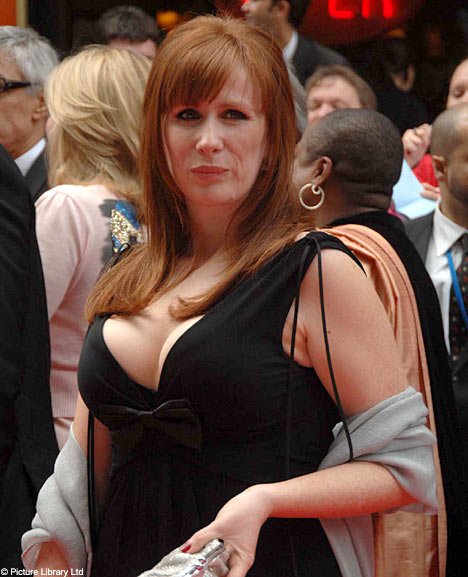
As a slightly unrelated comment, this flush of love for the character recently led me to join the Catherine Tate fan page on Facebook, which featured as its main picture this photo, from Tate's appearance at the 2007 BAFTA awards. It would not be entirely untrue to say that my jaw hit the floor when I saw it. I mean, I always knew that Tate had certain assets, but neither her sketch show nor Doctor Who put them on display (apparently Tate's preference, which makes me admire her even more). Doctor Who, in particular, has always given her fairly modest blouses or jackets to wear. But knowing what I know now, it just reinforces my opinion that it was a little unfair of the program to depict Donna as the sort of woman who would never stand a chance at distracting a guard with her feminine wiles. Just once, I would like to have seen Donna get the chance to vamp it up a little — not in an exploitative way, mind you (although maybe there's no non-exploitative way to ask an actress to pretend to be a lusty vixen), but as a chance to point out that Donna is an attractive woman who most certainly is not a hopeless case with the opposite sex. (At least Steven Moffat gave her a virtual-universe husband, but the whirlwind nature of that romance left something to be desired in the believability stakes.) I didn't want to believe it at first, but at this point, it's hard to ignore the show's implications that Donna is unattractive... I mean, for goodness' sake, Lance only married her so he could feed her to a giant spider, and she's apparently the one woman in the universe that Jack Harkness will not flirt with! But I think she's lovely, so there! Having said that, the other part of me totally respects and admires the show for not turning its female leads into eye candy of the Peri-drowning-in-a-bikini sort. And Donna's forceful attempts at flirting are really pretty cute. (I think what they were probably trying to portray is that Donna is terribly awkward at flirting and also a bit pushy about it, which gives the impression that she's desperately man-hungry, so it has exactly the opposite effect than she's hoping for... but since they never make that explicit, it comes across instead as a comment on her attractiveness in general.)
In this story specifically, I have to gripe a bit and say that Donna was kind of underused (understandably, given how many characters there were to write for). She pretty much just hangs around the TARDIS the whole time, excepting their little jaunt into the Shadow Proclamation, until she's finally let out at the very end, just in time to save the day. Still, in all that time, she does get some very nice things to do, and she gets the best character development out of anyone, including the Doctor himself. Long gone are the days of Oblivious!Donna and Slow!Donna; here, she's the first one to remember that Miss Foster and Lucius mentioned that the Adipose breeding planet and Pyrovillia had both been lost. (I noticed this at the time, too, and wondered if it might be more than coincidence, but only briefly. By the time the Lost Moon of Poosh came up, I'd forgotten all about this thread, and the reference went completely past me.) She's the first to race back to the TARDIS once the Doctor comes up with a solution. She refuses to let the Doctor give up on the hunt to find the Earth, at least until she realizes that there really is nothing they can do. When the Doctor-clone is felled before he can use the gun on Davros, Donna races in to help without hesitating, even though she has no idea what to do. I love the fact that Donna completely gets the Doctor's quest to find Rose; she's not jealous or insecure, nor has she ever been (except possibly with River and all her hint-dropping?); she totally supports him in it. Donna has somehow managed to have a great rapport with all of the Doctor's previous companions (although she doesn't really get to share any scenes with Sarah); even Rose, the jealous one, jumps immediately to her defense when the Supreme Dalek dumps the TARDIS into the core of the Crucible. (Well, I suppose a life-or-death situation trumps jealousy anyway, but you know what I mean.) I also like the fact that Donna is apparently a new kind of companion: one who was fated to meet the Doctor, with the timelines (and Dalek Caan) manipulating her into just the right position. I was a little skeptical of this claim in Turn Left, but here it makes more sense; it's certainly true that it was a remarkable coincidence for Donna to park her car right where the TARDIS was going to land.
Tate has some great line deliveries that I'll quote below. I love her little smile when the Doctor compliments her before they leave the TARDIS, and the mounting frustration on her face as the clone-Doctor has realizations and goes "ohhh!" but doesn't tell her anything right away, and especially the hilariously dubious look on her face when Davros threatens her. The end of the story is where Catherine Tate really gets to shine. When Donna is given a Time Lord mind, her version of the Doctor is full of warmth, compassion and playfulness, which I adore. I think that playfulness is a characteristic that we haven't ever really seen in the Doctor before, except maybe with Troughton, but not to this degree. I get a total thrill out of watching Donna effortlessly manipulate the Daleks' machinery, sending them into wibbly fits. She proves herself to be fully equal to David Tennant at reeling off technobabble or engaging in ultra-high-speed conversations, which is so much fun to watch! And she channels Tennant excellently on lines like "Oh yes!", "Molto bene!" and "Ha!" (in fact, during all her scenes as the Doctor-Donna, Tate delivers all her lines as though the Doctor were speaking with Donna's voice — it's brilliant.) I love the fact that, by the end of the story, Donna has gone from believing that her skills are worthless to seeing them as a total asset.
I've been worried that, as with Bonnie Langford, maybe I was part of a minority in fandom who loved Donna Noble so thoroughly. After all, she's hardly all sweetness and light (which I guess should be a good thing, since that's exactly why I do love Mel and why many other people do not), and I've read a fair number of online reviews by people who just can't seem to see past The Catherine Tate Show (which, of course, they hated). It's been a great surprise and a relief for me that all my DW-viewing friends claim to love Donna too, and I'm not the only person who has put her on their companion toplist.
But this leads me into the Bad Things section of my review. I considered making it another Things I Hate list, but that's a little unfair. Last year, we were presented with plot details that were so idiotic that I felt insulted as an audience member. This time, the only problems I have are that I personally don't like the narrative decisions that Davies made, but I'm willing to believe that there are people out there who loved them. So, these problems are mine and mine alone (well, probably not mine alone — since everyone else I've talked to so far agrees with me — but I'm not going to claim that they're universally bad decisions, like I did last year). There are two of them, with a third that is highly suspect. I'll start with the least offensive first:
If a detail like the particulars of Davros' plan is the only thing that I really have against an episode, I'm mostly willing to overlook it, as long as it's not so flawed that it seriously impedes my ability to focus on the story. But when the final two codas are heavily marred by one stomach-turning moment and one cruel bit of scripting, I find it hard to overlook. For me, this story was riding very high (not "classic" high, but "totally enjoyable" high) until the last 10 minutes, and then someone yanked the fun out from under my feet, and the very end of the story crashed and burned and took my sense of joy with it. Ending on a double-downer is not the way to make me appreciate a story, and I came out of this one with a very sour taste in my mouth. Unfortunately, that's now the lasting impression that I have of Journey's End. It's a great story, but the ending kind of totally ruins it for me. Now, if Steven Moffat ever figures out a way to undo the damage that RTD has done, and if, please please please God if, he ever restores Donna's memory (and gets her back in the TARDIS with Sally???), then all will be forgiven and I'll cheerfully overlook the incestuous kiss. (see above, re: how writers can get on my good side.) But given how firmly RTD has shut the door on the possibility of that ever happening, and the likelihood that Moffat will want to forge his own path, I somehow don't see the show ever going down that road. Which means that, not only have I had to say goodbye to Donna for now, there's also practically no chance of her ever coming back for a guest appearance, unlike practically everyone else in the revival. Wound, meet salt. Lots and lots of bitter, bitter salt.
If it were not for those two or three things, I would have the greatest of praise for Russell T Davies this week. Mind you, The Stolen Earth and Journey's End aren't quite the same caliber as Turn Left, and certainly not as great as Blink, but they do a whole lot of things right. They're extremely fast-moving episodes; even at 60 minutes long, Journey's End flew by. And given the dangerously large guest cast, Davies handles them amazingly well; everybody gets a significant role to play in the plot, and not just once. The fact that I have at least one paragraph to write about each of them frankly amazes me, when some weeks I don't even have all that many noteworthy thoughts about even David Tennant's performance. One thing that I love about this story is that it works on several levels. On one level, it's just an action story: the Daleks conquer the Earth and kill people, and the Doctor blows the Daleks up. On another level, it's a fan love letter that brings lots of favorite characters together so that we can see how they interact. On the next level down, it's the story of two companions: Rose's quest to find the Doctor again, and Donna meeting her destiny. Then, on the deepest level, we have an exploration of the Doctor's character; Davros is very clever in trying to achieve not just a physical victory, but also a moral one, as he forces the Doctor to confront just how violent he really is, both directly and indirectly. It's so true that while the Doctor claims to be nonviolent, he certainly does use weapons from time to time (as the good folks at Androzani like to remind him whenever he gets too high-and-mighty about it), and even worse, he often lets other people do the dirty work for him. He absolutely cannot refute the fact that while Davros is responsible for creating the Daleks, the Doctor took an ordinary journalist and shopgirl and mechanic and medical student and temp, and made them into people who are willing to fight and kill. True, they're fighting and killing for the side of right and good, but the fact remains that the Doctor and his companions will resort to violence when they need to, so they can't really claim the moral high ground. This is a wonderfully difficult issue and it's fantastic to see it addressed so directly. (It was also a key plot element in Head Games, but that's a novel I'd kind of rather forget entirely.) What's also nice is that Davies subtly points out the fact that Davros isn't entirely correct; yes, the Doctor has fashioned these people into fighters, but he has also taught them strong ethical lessons. Although Martha possesses the Osterhagen Key and could destroy the Earth, she gives the Daleks a chance to surrender first; likewise, Sarah and Jack possess a weapon that could blow up the entire Crucible, but they too give Davros the opportunity for a peaceful resolution before resorting to such methods.
Of course, I'm aware that I'm being unusually forgiving about these episodes, given that they do contain a lot of deus ex machina type devices; Gray, for example, being a computer scientist, apparently found the subwave network extremely hard to swallow. This is another example of a case in which my lack of specialist knowledge leads me to cheerfully accept what I don't understand; true, I did find it a bit suspicious/convenient, but when the end result is that Harriet Jones gets to talk to Martha, Jack and Sarah, I can let it slide. I suppose I'm like the Gods of Ragnarok: if you entertain me, I'm willing to overlook your minor flaws, but if your act is slightly dull, I start to nitpick and fire electrical bolts at you. Well, maybe not the last one. Maybe. *narrows eyes and looks at RTD* Still, I must also praise Davies for his clever shaking-up of the "arc word" tradition this year. I like this approach far more; it's more subtle and rewarding to have little hints dropped in each episode that contribute to the overall arc in small ways. We've heard about lost planets and disappearing bees and relevant technology and Donna's destiny and gotten glimpses of Rose in every episode up to the finale, and here they all come together in one pretty satisfying resolution. I like it a lot, and I hope this becomes more of a trend in future seasons.
I criticized the last cliffhanger this year, by Steven Moffat, and I wasn't all that keen on Helen Raynor's Sontaran cliffhanger either (impotent Doctor is overwhelmed and distracted from saving Wilf), but this one, man! It makes up for both of the previous two. It does this, of course, by playing the biggest card in the deck, and then having to backpedal and desperately figure out a way to un-play it, buuuuuut it's so incredibly dramatic and such a mean, sneaky trick on the audience (in a good way) that I can easily forgive it. (...I'm saying that a lot!) The whole pre-regeneration scene is pretty awesome, with Jack and especially Rose knowing what's about to happen, and Donna freaking out. And then we get the cliffhanger itself, which is practically unbearable, as I've already discussed! Andrew and I spent the whole week debating what might possibly happen, how RTD might get himself out of the situation, and, if worst came to worst, how sad we would be to lose David Tennant. When next Saturday finally arrived, though, we weren't there to see it: because it was the July 4th weekend, and there are no good fireworks around Ann Arbor (and Andrew had never seen a proper fireworks show anyway), we decided to take a road trip down to Columbus to catch the biggest fireworks show in the Midwest. (Which turned out to have been held on the 3rd, explaining why the whole town seemed deserted when we got there, but that's another story.) Ordinarily we'd both have been quite happy to wait and catch part two upon returning home, but given (a) the intense nature of the cliffhanger, (b) the increasing likelihood that we'd be exposed to actual spoilers, and (c) our desperation to know who, if anybody, was getting written out... it was time for desperate measures. Irritatingly, the hotel wouldn't allow me to download torrents onto my laptop, but Andrew was clever. He established a connection to his home computer, downloaded it there, and then transferred it to his laptop. Unfortunately, this took about 12 hours longer than we'd expected, and when the file finally arrived — just before we had to leave on Sunday — it turned out to have been corrupted in the transfer, like Miss Evangelista but way more annoying. The picture kept pixellating, or worse, freezing and skipping, which made it all but unwatchable. So, we stayed glued to his laptop screen just long enough to find out that Tennant was still Tennant and nobody was dead yet (PHEW!), and when it froze again after Rose's "You're still you?", we gave up and waited on the rest until we got back to Ann Arbor. (Thankfully, the file was just fine on his home computer, so we wasted no time sitting down in rapt attention to watch the rest of it!)
During the week-long break, Andrew and I weren't the only ones discussing the resolution! I don't recall seeing this much buzz from the British press since the series first launched three years ago, so even if the regeneration was nothing more than a publicity gimmick, it was a totally successful one. (After all, the episode ended up in the number one slot for the first time ever in the history of Doctor Who, which is a pretty awesome achievement.) I don't know if an actual regeneration would have the same effect, because everyone would probably have already been spoiled on the identity of Tennant's replacement and would therefore be expecting it, but this was quite a flurry of theories and rumors and speculation. After the two-parter aired, I've never had as many friends e-mail me to ask my thoughts about the episode and share their own as I did after this one. (So far, most seem to agree with me — fantastic all around, except for that kiss and what they did to Donna.)
It's also worth talking about spoilers for a moment. This season finale was an interesting mix of total secrecy and massive spoilers. The only one that I heard, really, was the big one about Davros and all the companions, which turned out to be true. But Gray and Andrew both heard what seemed like pretty massive spoilers. The one Gray hinted to me about while we were watching Silence in the Library turned out to be completely untrue. After watching the finale, he e-mailed me: "About five episodes into the season, I read that Donna was going to become the next Turlough, meaning that she was going to betray the Doctor in some way and become one of the big baddies at the end of the season. She was going to begin to despise the Doctor for his ability to decide the fate of millions, as if playing God, and become acutely aware of the death that follows in his wake (certainly a theme of the entire new series). I didn't think you would be much in support of this, since Donna is a favorite, but I really liked the idea of having a sinister, rogue companion again. I absolutely hated it as a child, though — Turlough was very difficult for me to stomach — but it does make for compelling drama. Anyway, none of that happened. I suppose, in Turn Left, the time bug teamed with her to become a pretty big baddie, but not quite in the way that I had read." After the first half, meanwhile, Andrew read a theory on the blogs at the Guardian website that the Doctor would regenerate, but the energy would spill over into the hand, which would turn into a full-grown clone of Tennant, and the tenth and eleventh Doctors would fight the Daleks together. He didn't tell me much about this at the time, except to say that he'd heard that the hand might be important (apparently, it was deliberately placed in shot three times during the first episode, which people took — quite rightly, as it turns out — to be significant). He filled me in on this theory after we'd watched the first couple of badly-encoded minutes and assumed it was no longer a possibility; we were quite surprised, therefore, when the hand actually did turn into a clone later in the story. There's also the matter of Jenny; she's not an actual spoiler, because I for one never heard any concrete rumors (is that an oxymoron?) that she would be in the finale, but hands up who among us were expecting her to return? I find this rather cool: now she's just out there, as a potential recurring character whenever anyone cares to pick up the plot thread. (and hopefully, at some point, someone will!)
Now this, I think, is a proper Graeme Harper story. His direction really lifts the action and he demonstrates a lot of flair. Among his many great shots: Rose zapping into existence carrying a biiiiiiig gun, Rose revealed behind a blazing Dalek shell, Rose spotting the Dalek as she runs toward the Doctor (do we have a theme here...?), Martha with her hand outstretched to keep her mother at bay, Donna moving toward the TARDIS door as it shuts in her face, Jack winking at the Doctor after being exterminated, the nighttime racking shot on the castle in the distance, and I like the way he cuts to Martha appearing in the Nuremberg forest. He does a great job directing the sequence of Donna screaming in the TARDIS as various roundels and console bits explode; we know something good is about to happen, but we don't know what, and the excitement is almost palpable. The effects folks contribute some pretty incredible shots too, including the planets visible in Earth's sky, the Hub dialling the Doctor's mobile number and transmitting it into space, the gruesome physical effect of Davros' skeletal chest, the TARDIS being dragged away by the Daleks' temporal prison, the TARDIS falling into the heart of the Crucible and bobbing in the energy, the regenerative energy enveloping Donna, the Doctor and Rose testing the limits of their holding fields, the Crucible exploding, and the TARDIS dropping the Earth off by the moon again (let's hope they got the alignment just right!). Harper and the effects team both deserve praise for the shot of the TARDIS dropping through the floor of the Crucible; that was a truly shocking moment, flawlessly done. In other effects work, the retro-style Dalek saucers look fantastic as they glide over the city, and the glowing columns in the Dalek Crucible are very cool. There are only two effects in the entire story that I'm not 100% in love with. First: when Davros is tapping his metal fingers on his "desk", his ring finger doesn't quite want to align, instead pointing inwards a bit, so it looks obviously like a prosthetic (which it would be for him anyway, so it's not a big problem). Second: why, when people are getting dissolved by the reality bomb (which is in itself a cool effect), do most of them stand there stiffly with their arms out from their sides? It doesn't look like it hurts them at all; they all appear to be in a very calm trance! (And I do wish we could see some kind of "beam focusing" effect from the 27 planets, rather than just seeing them all glow with energy.)
Murray Gold acquits himself well here; although quite a bit of the score is re-used (notably when Martha enters Osterhagen Station 1 and when the prisoners are marched into the reality bomb testing room, although I actually really like the re-use of the Ood song as the TARDIS tows the Earth back home), we have some very nice musical moments when Davros first appears, when the Earth is calling the Doctor, when the planets materialize around the TARDIS as it follows the telephone signal (I like the magma-lit one that must be Pyrovillia), when the TARDIS crew marches out onto the Dalek Crucible, when Donna sees the hand glowing, the entire final scene after the TARDIS materializes in the Dalek Crucible, and when Wilf says goodbye to the Doctor at the end. Overall, a really nice job, so congrats Murray: you ended this year in style, and had a pretty good innings this season! In other sound effects, there's a very nice touch in that you can faintly hear the UNIT men's screams as Martha teleports away, and I love the familiar-sounding klaxon that goes off when Donna powers down the reality bomb.
Minor points:
Donna: "Thing is, Doctor. No matter what's happening, and I'm, I'm sure it's bad, I get that. But... Rose is coming back. Isn't that good?"
Sarah: "Oh, I wish you'd stop giving that fanfare."
Jack: "Ianto! Time and a place!"
Ianto: "It is funny, though."
Rose: "Right! You two! You can put that stuff down, or run for your lives. D'you like my gun?"
Jack: "Oh, I met a soldier in a bar. Long story."
Ianto: "When was that?"
Jack: "Strictly professional."
Shadow Architect: "Who is the female?"
Donna: "Donna. I'm a human being. Maybe not the stuff of legend, but every bit as important as Time Lords, thank you."
Doctor: "Donna, come on, think, Earth, there must've been some sort of warning. Was anything happening back in your day, like electrical storms, freak weather patterns in the sky...?"
Donna: "Well, how should I know? ...Um, no, I don't, I don't think so, no."
Dalek: "My vision is not impaired."
Wilf: "Do you wanna swap?"
Wilf: "The last time she phoned, it, it was from a planet called Midnight, made of diamonds."
Sylvia: "What the hell are you two on about?"
Wilf: "Look, she's out there, sweetheart! Your daughter. She's travelling the stars with that Doctor, she always has been."
Sylvia: "Don't be ridiculous."
Wilf: "Oh, come on, open your eyes! Look at the skies, look at, look at the Daleks! You can't start denying things now!"
Doctor: "I came here when I was just a kid, 90 years old."
Rose: "She can't hear me, have you got a webcam?"
Wilf: (indicating Sylvia) "No, she wouldn't let me, she said they're naughty."
Jack: "All the same, might I say, looking good, ma'am."
Sarah: "Really? Ooh!"
Harriet: "And Martha Jones, former companion to the Doctor."
Rose: "Oi, so was I!"
Followed by this one. But... how does she know? She'd never heard of Sarah before she met her, and Sarah was before her time. I guess she assumes that because Martha's a young woman, she must have joined the Doctor after Rose left...? Come to think of it, how does Rose know that the Doctor has a cell phone on the TARDIS? And even if she does, how did she find out the number (which used to be Martha's)? (Oh, I see - maybe she's talking about her attempts to contact the Doctor via various assorted monitors?)
Martha: "But I've been trying to find him. The Doctor's got my phone on the TARDIS, but I can't get through."
Rose: "Nor me, and I was here first."
Donna: (looking coy and hungry) "And who's... he?" (she points to the screen)
Doctor: "Captain Jack. Don't. Just... don't."
Donna: "It's like an... outer space Facebook."
Doctor: "Think, Donna, when you met Rose in that parallel world, what did she say?"
Donna: "Just... the darkness is coming."
Doctor: "Anything else?"
Donna: (looking past him) "Why don't you ask her yourself?"
Doctor: "I'm sorry. It's too late. I'm regenerating."
Donna: (as Rose hugs the Doctor in relief) "You can hug me if you want."
Jack: (laughs politely)
Donna: "No, really, you can hug me."
Donna: "It's you!"
clone-Doctor: (proudly) "Oh yes."
Donna: (glances downward, and looks quickly away) "You're naked!"
clone-Doctor: (realizing) "Oh yes..."
Donna: "Is that what Time Lords do? Lop a bit off, grow another one? You're like worms!"
Doctor: "But then you touched it. Wham!"
Donna: (gasps loudly!)
Doctor: "Shhhh!"
clone-Doctor: "I grew out of you! Still, could be worse."
Donna: "Oi, watch it, spaceman!"
clone-Doctor: "Oi, watch it, Earth girl! Ooh! I sound like you. I sound all... all sort of... rough."
Donna: "Oi!"
clone-Doctor: "Oi!"
Donna: "OI!"
clone-Doctor: "Spanners! Shhhh."
Donna: "But why me?"
clone-Doctor: "'Cause you're special."
Donna: "Oh, I keep telling you, I'm not."
clone-Doctor: "No, but you are. ...Ohh. You really don't believe that, do you? I can see, Donna. What you're thinking. All that attitude, all that lip, 'cause all this time, you think you're not worth it."
Donna: "Stop it."
clone-Doctor: "Shouting at the world, 'cause no one's listening. Well, why should they?"
Donna: (quietly) "Doctor? Stop it."
clone-Doctor: "But look at what you did."
Jack: "Good to see ya! And that's beefcake."
Mickey: "And that's enough hugging."
Doctor: "What? Who invented that?! Well — someone called Osterhagen, I suppose."
Davros: "Impossible. That face... after all these years..."
Sarah: "Davros... it's been quite a while. Sarah Jane Smith, remember?"
Davros: "Oh, this is meant to be. The circle of time is closing. You were there on Skaro at the very beginning of my creation."
Davros: "The man who abhors violence, never carrying a gun. But this is the truth, Doctor. You take ordinary people and you fashion them into weapons. Behold your children of time, transformed into murderers. I made the Daleks, Doctor. You made this."
Davros: "The Doctor, the man who keeps running, never looking back because he dare not, out of shame. This is my final victory, Doctor. I have shown you yourself."
Doctor: "Donna, you can't even change a plug!"
Donna: "Do you wanna bet, Time boy?"
Donna: "Well, don't just stand there, you skinny boys in suits. Get to work."
Donna: "Aaaand spin."
Dalek: (spinning uncontrollably) "Help me. Help me."
Donna: "Aaaand the other way."
clone-Doctor: "But that's brilliant!"
Doctor: "Why did we never think of that?"
Donna: "Because you two were just Time Lords, you dumbos! Lacking that little bit of human, that gut instinct that comes hand-in-hand with planet Earth. I can think of ideas you two couldn't dream of in a million years. Oh, the universe's been waiting for me!"
Albino Servant: "You are something new."
Donna: "Not me. I'm just a temp. Shorthand, filing, hundred words per minute. Huh. Fat lot of good that is now. I'm no use to anyone."
Doctor-Donna: "Did I ever tell ya, best temp in Chiswick? Hundred words per minute?"
Sarah: "Good to see you again!"
Rose: "Yeah, you too!"
Sarah: "So there's three of you?"
Rose: "Three Doctors?"
Jack: "I can't tell you what I'm thinking right now."
Davros: "I name you forever! You are the Destroyer of Worlds!"
Doctor: "Jack, what's her name?"
Jack: "Gwen Cooper."
Doctor: "Tell me, Gwen Cooper, are you from an old Cardiff family?"
Gwen: "Yes, all the way back to the 1800s."
Doctor: "Yeah, I thought so. Spatial-genetic multiplicity."
Rose: "Oh, yeah!"
Doctor: "Yeah, it's a funny old world!"
Sarah: "No no no, let me! K-9, out you come!"
K-9: "Affirmative, mistress!"
Sarah: "You know, you act like such a lonely man, but look at you. You've got the biggest family on Earth."
Jackie: "I was pregnant, do you remember? Had a baby boy."
clone-Doctor: "Aw, brilliant. What'd you call him?"
Jackie: "Doctor."
clone-Doctor: (concerned for the poor child) "Really?"
Jackie: "No, you plum. He's called Tony."
Donna: "You know, you could fix that chameleon circuit if you just tried hotbinding the fragment links and superceding the binary binary binary binary binary binary binary binary binary binary binary binary binary binary binary — (she gasps!) I'm fine!"
Donna: "Shall we? Charlie Chaplin? Charlie Chester, Charlie Brown — no, he's fiction. Friction, fiction, fixing, Nixon, Rixton, Brixton..."
Donna: "I want to stay."
Doctor: "Look at me. Donna, look at me."
Donna: "I was gonna be with you forever."
Doctor: "I know."
Donna: "Rest of my life. Travelling, in the TARDIS. The Doctor-Donna. Oh. Oh my god. I can't go back. Don't make me go back. Doctor. Please. Please, don't make me go back!"
Doctor: "Donna. Oh, Donna Noble, I am so sorry. But we had the best of times. The best. Goodbye."
Donna: "No. No. No, please. Please. No. No! No!"
Sylvia: "But the whole world's talking about it. We travelled across space!"
Doctor: "It'll just be a story. One of those Donna Noble stories, where she missed it all again."
Wilf: "But she was better with you."
Sylvia: "Don't say that."
Wilf: "No, she was!"
Doctor: "I just want you to know that there are worlds out there, safe in the sky because of her. That there are people living in the light, and singing songs of Donna Noble, a thousand million light years away. They will never forget her, while she can never remember. And for one moment, one shining moment, she was the most important woman in the whole wide universe."
Sylvia: "She still is. She's my daughter."
Doctor: "Then maybe you should tell her that once in a while."
Donna: "Susie Mayor wouldn't lie. Not unless it was about calories! Ha ha ha!"
All in all, The Stolen Earth / Journey's End makes a great end to the season. It's so much fun to see all our favorite characters back (including a perfect revival of Davros), and the story as a whole is a lot of fun and never ever boring. And we still have David Tennant! If it weren't for those two plot elements I object to, this would be riding very high. I don't find the ending to be tearjerking, though; for me, tearjerking things usually involve emotional fulfillment or realization or confession... this is having something precious stolen away, and I just find that heartbreakingly sad. So, a very fond farewell, Catherine Tate — you just don't know how much I'm going to miss you.