

Holistic Review: Fear permeates every second of Pyramids of Mars as the Doctor struggles to defeat one of the most powerful adversaries he's ever faced, though the story's atmosphere of dread is lightened by sunny location filming, an intriguing historical setting, and a hefty dollop of humor.
Doctor Who is often discussed in terms of eras, divided either by Doctor or executive producer. Either way you slice it, general consensus is that the golden age of at least the classic series, and quite possibly its entire run to the present day, was the Philip Hinchcliffe years (1974 to 1977, seasons 12 to 14) during Tom Baker's run as the most iconic Doctor of all time. That era yielded numerous classic stories, but arguably its most acclaimed year was season 13, with Tom Baker and Lis Sladen at the height of their partnership, battling adversaries inspired by classic horror films. And of the stories in season 13, the one with the most widespread and exuberant acclaim surely must be Pyramids of Mars. Other stories have been voted as better overall, and there are others that I personally prefer, but Pyramids of Mars is quite possibly the golden story from the golden season in the golden era of Doctor Who.
Why? Well, gosh. Where do we even start?
How about the story's atmosphere? That's a complex topic, because what makes Pyramids of Mars so atmospheric is a combination of several elements, but their contributions to the story can't be overstated.
For starters, the setting is classic. There's something so quintessentially Doctor Who about an isolated stately home in the countryside. We'll have another one later this season in The Seeds of Doom, maybe two if you count Solon's castle from The Brain of Morbius (though describing the wasteland of Karn as "countryside" is a bit of a stretch). Because Pyramids of Mars is set almost exclusively on and around the old priory, it makes especially good use of every part of the location: the sumptuously-decorated interior rooms, the imposing stone exterior, the courtyard, the sunny and green English woods twittering with birdsong, and the small lodge on the grounds. Thus there's a real sense of place about Pyramids of Mars, a feeling that this grand old estate is a lived-in home, which was probably ever so pleasant for quiet nights in, and summery woodland strolls, back when times were good. The house even provides an unexpected link to UNIT, when we learn early on (in a nice bit of foreshadowing) that UNIT HQ was built on the site of the priory after it burned to the ground. Because Professor Scarman's manor is located deep in the woods — and becomes even more isolated as the story progresses — the cast of characters is limited, and it's obvious that no help will be coming. (Though even if help did arrive, there's nothing any human being could do to stop the evil brewing within the house.)
Along with its geographical setting, Pyramids of Mars derives loads of period atmosphere from its historical setting, though interestingly, aside from the marconiscope, Pyramids of Mars mainly accomplishes this through background details, like the clothing and furnishings, and the level of available technology (rifles and oil lamps and gelignite and suchlike). There's no reason why Pyramids of Mars couldn't have been set in contemporary times, though the plot's use of radio waves might have presented a small hurdle, but situating the story in 1911 provides lots of opportunities to add welcome dashes of historical color. It's also perfectly timed with the golden age of pyramid exploration, set only 11 years before the tomb of Tutankhamun was excavated, which of course brings to mind the legendary curses said to befall those who would open the pharaohs' tombs. (Pyramids of Mars does not, however, touch on the practice of scientific looting, bringing back valuable and sacred artefacts to colonial countries ostensibly for study and display, though it could certainly be interpreted as a critique against this practice.)
The third important element of the story's atmosphere is its memorable incidental score by Dudley Simpson, which is superb from its very first notes to its very last. This surely must be one of his finest for the series, as it constantly reinforces the tension while occasionally working in subtle Middle Eastern themes. The unsettling, and at times discordant, cabinet organ music is a particular hit, and hearing it evokes Pyramids of Mars instantly. My other favorite musical moments throughout the story come as Scarman enters Sutekh's inner chamber, as the projection of Sutekh fades away inside the TARDIS, the chimes as the Doctor and Sarah help an injured Warlock away from the house, the surprisingly menacing rattles as the Doctor carries Warlock into the woods, the disconcerting gurgling moans (and more rattling!) as the poacher Clements spies on the mummy in the rabbit trap, the sound effect as Clements hurls a stick against the disruption barrier, as Clements runs away from a pursuing mummy, and as the mummies renew their pursuit of Clements. I mean, it would be in serious contention for Simpson's all-time-best score, if not for City of Death.
Fourth, and by no means least, is the interweaving of an ancient-Egyptian cultural influence throughout the story's plot and design, which is a most peculiar fit with the 1911 English countryside and with the further addition of a Martian plot thread — as Laurence says, disbelievingly: "Yes, but... Egyptology and Mars?" — yet that unorthodox amalgamation is what makes Pyramids of Mars such a perfectly unique story. In its very first scene, as Scarman breaks into the tomb, a wall smoothly slides open in a way that no ancient-Egyptian wall should ever behave, and it's that unexpected contrast that's so frightening. The suggestion that the ancient Egyptians regarded the Osirans as gods, when their war with Sutekh spilled over onto the Earth, is brilliant — as the Doctor says, "The whole of Egyptian culture is founded upon the Osiran pattern." — though it does veer uncomfortably close to that old "primitive non-white cultures couldn't have been technologically brilliant; they must've learned from aliens" chestnut. (In contrast, we do have the frightening moment when the Eye of Horus inside the tomb glows red, and the locals flee in terror. Observing this behaviour, Scarman smugly calls Ahmed a "superstitious savage!" but as subsequent events prove, they were the smart ones.)
In Sutekh — said to have inspired Set, the ancient Egyptian god of violence and disorder — Doctor Who presents us with probably the most powerful villain that the Doctor has ever faced. For the majority of the story, Sutekh is immobile, transfixed to his throne and incapable of even the slightest movement; yet still, directing events from afar, he poses an enormous threat to the Earth. And from the moment Sutekh and the Doctor meet in person, it's obvious that the Doctor is hopelessly outmatched, with Sutekh able to destroy him, or torture him for eternity, without even moving a muscle. His powers are unimaginably formidable: while imprisoned, he can read thoughts, possess people mentally, even "shred the nervous system into a million fibers", as he so evocatively puts it; and once freed, he possesses an unelaborated ability to eradicate all life throughout the universe. And I really appreciate that the story even takes a moment to explain to us just why Sutekh wants to destroy all life (and why he himself is exempt from this vendetta): it's because he fears the existence of a living creature that might be able to defeat him. (Apparently the universe contains some terrifyingly competent grass.)
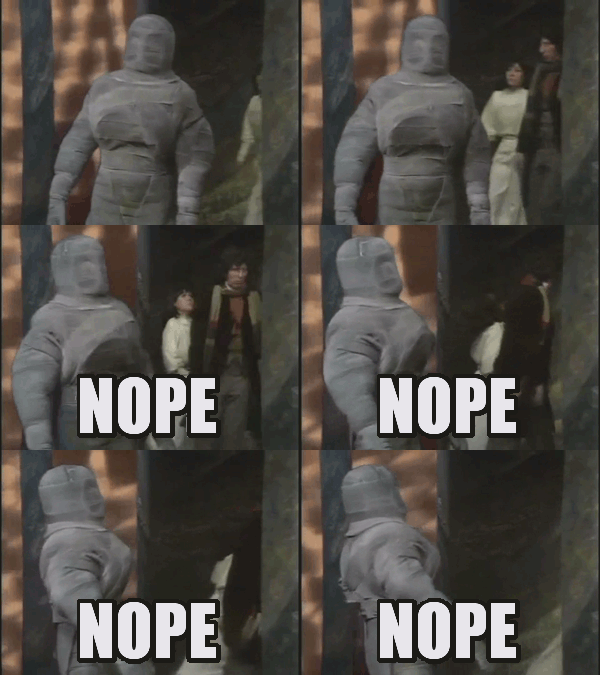
Sutekh's servants, the lumbering grey robot mummies, are another of Doctor Who's most memorable monsters, striking fear into the hearts of children for generations. This is especially impressive given that, if you consider them dispassionately, the mummies really aren't all that scary. They're not actually monsters, they're just mindless robots, obeying commands and murdering only when they're ordered to. Yet for such a simple monster, they have a dramatic impact. Their design is certainly a huge factor; drawing on classic mummy imagery is a surefire hit, and we don't realize they're robots to begin with, so the impression really is of desiccated corpses stalking the woods. Plus, the specific design of Sutekh's robot mummies is beautifully stylized; their concave eyes and stomachs make an immediately recognizable silhouette. (I'm also very fond of the gold-banded accents on their Martian counterparts, the guardians of Horus.) Perhaps partly due to their wide shoulders and powerful hips, the mummies move in a side-to-side swaying fashion that should look ungainly and awkward, but actually comes across as menacing. (And it's clearly a conscious choreographed decision rather than an inherent restriction of the costume, because the Doctor-in-mummy-bandages walks normally.) That's partly due to the fact that, as robots, they're implacable: once they've been put onto your scent, they never slow down and they never give up. Your only hope is to somehow elude them and hope they give up the chase, or else one swing of their powerful arm (or the slow advance of their throttling hands) will quickly end your life. For me (and, I suspect, many others), the moment that establishes them as a truly terrifying menace is when they finally catch up to the poacher, after pursuing him through the woods and to the lodge. Rather than shoulder-chopping him or strangling him, the mummies decide to stand on either side of him, and crush him (or at least his windpipe) between their sharply-angled breastplates. This could easily have come across as hilarious, with the potential to be either cheesy or mildly erotic (if not both), but because the story plays the moment completely straight, in keeping with Pyramids of Mars' serious tone, it doesn't. Not only is it a brilliant, inventive use of the mummies' unusual costume design, it's visually horrific and extremely memorable.
Because of Sutekh's menace, and the unimaginable consequences should he free himself, Pyramids of Mars feels absolutely doom-laden right from the start, as if a dark cloud is hovering over the entire story. Thankfully, the script and the direction and the music all work in concert to bolster this sense of unease; even most of the humor is rather dark. In conjunction, they give Pyramids of Mars a sense of foreboding that's rare among Doctor Who stories. It doesn't hurt that, in keeping with the Hinchcliffe era, Pyramids of Mars is frequently terrifying, most definitely to kids but even as an adult. When we discover that Scarman isn't really Scarman any longer, when everyone finds themselves trapped within a nearly-impenetrable barrier pursued by monsters, and when we witness the victims' mounting terror as they realize they can't escape their fate, the tension squeezes the audience like a vice. The deaths of both sympathetic and unsympathetic characters, in particular, are milked for every ounce of fright allowable in a children's program... and perhaps, if Mary Whitehouse were the judge, even beyond.
Along with the story's atmosphere and memorable adversaries, Pyramids of Mars is also blessed with an interesting, quickly-moving plot. What I love about Pyramids of Mars is that it avoids a couple of major problems that have undermined other stories: it's not at all padded, nor does it rely on thwarting all of the good guys' plans in order to bolster the threat posed by the bad guys. In contrast, Pyramids of Mars keeps the plot momentum building throughout, by structuring it around one-upmanship: every time Sutekh scores a victory, the Doctor figures out a new way to undo his plans (and vice-versa), which keeps the mummies busy while continually wrong-footing Sutekh, who wasn't expecting any resistance at all. First the Doctor jams Sutekh's control signal, then deactivates the deflection barrier, before finally blowing up the rocket, each challenge greater than the last. But even the Doctor's ultimate sacrifice — giving his life in order to trap Sutekh in his tomb permanently when the missile is destroyed — comes undone when Sutekh realizes that, rather than torturing and murdering him, if he puts the Doctor under his thrall, he can use the TARDIS to send Scarman directly to Mars and destroy the Eye of Horus without needing the missile. It's a satisfying, tightly-plotted progression of constantly-shifting goals, because every new move in their battle is logically motivated by, and grounded on, the foundation that the script has already established.
Then, in episode 4, the plot changes tack, presenting the Doctor and Sarah with a fun series of challenging puzzles to solve as they race to stop Scarman from destroying the Eye of Horus which keeps Sutekh imprisoned, which gives them numerous opportunities to showcase their playful partnership. Naturally this appeals to me greatly — yet again, it reminds me of TV Ontario's Read All About It, which I adored as a child — but not just because it resembles a quest plotline. I absolutely love the way the script delineates a difference between the approaches used by Sutekh and the Doctor: Sutekh solves problems by scanning the technology (ie, using the hi-tech equivalent of brute force), whereas the Doctor solves them with his wits. This enables the Doctor to champion the power of mathematics and logic, in keeping with his earlier discussion of science when examining the marconiscope. In the same vein, the Doctor's ultimate solution for defeating Sutekh, while not at all foreshadowed, is frankly brilliant, making use of actual science in the speed of radio waves. (The only downside is that Sarah has to ask for a retroactive explanation: "Look, I know that's the time control from the TARDIS, but what did you do?")
In this most foreboding of stories, Tom Baker delivers a powerhouse performance as a somber, cranky fourth Doctor. Right from the start, he's in a brooding mood, lost in his memories and uninclined to indulge Sarah's sense of humor. As the story progresses, he remains in a humorless temperament, intensely focused on the bigger picture, and short-tempered toward everyone, frequently snapping at poor Laurence in particular. This glowering disposition culminates in the fantastic scene in which Sarah chides him for his apparent lack of compassion, which highlights the Doctor's alien nature more strongly than ever before. The Doctor is ordinarily a deeply compassionate person, but when the scale of the problem is this vast and this grave, he has no time to deal with puny human emotions.
Even before the Graham Williams era, it's rare to see the fourth Doctor not clowning around, but his dramatic lack of lightheartedness really underscores just how serious is the threat posed by Sutekh. Among his fantastic deliveries: "Did we?", his impatient "Machines!", his knowing "Well?" to Sarah, "You are a twisted abhorrence!", "Come on, come on!" as they race toward the Eye of Horus, his most excellent gurning as the Doctor struggles in the grip of the time-space tunnel, the way he continues to sway forward just after the Doctor has emerged from the time-space tunnel in Sutekh's antechamber, his strangled scream as Sutekh seizes him in the Green Eye-Beams of Torture, his attempt to struggle against being forced to kneel (a truly iconic pose: teeth bared in a grimace of agony, one hand clutching his head while the other extends helplessly toward Sutekh), and his zombified acting (with eyes rolled back into his head) when the Doctor is in Sutekh's thrall.
Pyramids of Mars is a rare and shining example of a story that makes excellent use of the companion throughout its runtime. As a result, Sarah Jane Smith is at her most capable here. She doesn't get to use her journalistic instincts, as such, but Holmes and Griefer make up for that omission by granting her two skills that we never knew she had: not only is she knowledgeable about Egyptian mythology, Sarah is a sharpshooter with a rifle. Does this new skill in marksmanship really make sense, given what we know of Sarah's background? Nah. Is it almost too awesome for words? YES!!! Sarah is as cool as a cucumber as she lines up her shot, and as confident in her ability as she is about her success, and I absolutely love it. As weird as it always is to see Doctor Who celebrating guns, this is one of my all-time-favorite companion moments.
Nor is it the only fantastic plot contribution that Sarah gets to make. She fetches help for the injured Warlock, she helps get the unconscious Doctor to safety, she finds the vital gelignite, and she recreates the Doctor's mummy disguise. At the end of part two, Sarah even gets a moment of physicality, when she fights Laurence off so that she can activate the etheric impulse projector to block Sutekh's control beam. At the cliffhanger's resolution, she doesn't hesitate to follow the Doctor's instructions precisely, scooping up Namin's discarded ring and ordering the mummies back to their base, thus saving all of their lives with her swift action. Given that she doesn't hesitate in locating the ring, and correctly uses it to control the mummies, this scene reinforces the impression that Sarah is super-capable.
As with the Doctor, Pyramids of Mars is a more serious outing for Sarah too. She starts off the story in a delightfully lighthearted mood, and she makes occasional jokes throughout, but as events grow more serious, so too does her demeanour. She's all business in the sharpshooting scene I mentioned above, and just after Laurence's death (and the Doctor's evident callous disregard, or so it seems to her, for the man's life), she's in no mood for his puns.
My only objection to Sarah's role in the story is the otherwise-superb scene in which the Doctor reveals what 1980 will be like if they don't stop Sutekh. Truly, it's a stunning moment, since — like Sarah — we assume that if we know 1980 exists, then we know Sutekh doesn't destroy it. Much is discussed in Doctor Who about fixed points in time and the inability to change history, but, unless you count Inferno, this is the first (and only) time that we actually witness what would happen if the Doctor assumed that trouble would sort itself out. So the scene is fantastic and much-needed, but I dislike the way the script gets us there: it seems extremely out-of-character for Sarah — the Doctor's best friend, who's always right by his side, eager to pitch in and stop the bad guys — to suggest that they just leave. Especially with a villain of Sutekh's power about to arise. I wish, instead, that they'd framed it less as her requesting to leave, and more as her wondering what would happen if they left. That one tiny change would've completely erased my objection.
This is another story in which Lis Sladen turns in a performance that is beyond faultless, with so many sublime line deliveries that it would take me paragraphs to list them all. So instead, along with the two scenes I've quoted above, I'll be highlighting my favorites in the 'minor points' section below; they're so wonderful that they each deserve to be celebrated. But I'll also briefly mention the look of horror on her face after the projection of Sutekh fades away, "Uh-huh" when confirming that she's a journalist, "We're trapped!", her frantically whispered "Hiding!", "We've got to go back.", her gasp of pain after "Doctor, what's happened?" as a mummy restrains her, "I thought you'd become a zombie, like Scarman.", "What?!" on the Doctor's 1666 revelation, and she does a great fall to the floor when the mummy unceremoniously drops her.
Of course, part of the reason why season 13 is considered to be such a shining jewel in the crown of Doctor Who is the exquisite double-act of the fourth Doctor and Sarah. Pyramids of Mars is officially their second story as a two-person team, but it's their first story in filming order, and already their partnership is setting the bar for what an ideal Doctor/companion relationship might look like, after six stories of polishing their rapport in the wonderful company of Ian Marter. By this point, Baker and Sladen are bouncing almost effortlessly off one another, and their real-life camaraderie translates exquisitely to film. Plus, without Harry around to rub her the wrong way, Sarah seems to be letting her hair down more, and just having fun adventuring with the Doctor. I've often thought what a shame it is that Sarah's outspoken feminism seems to get worn away along with her sharper edges, as if the character can't be likeable and fun and stand up for women's rights. But it now occurs to me that maybe there's actually a good reason for that: Sarah has always had a tendency to get prickly when she feels people (usually men) are belittling her, infantilizing her, or otherwise not taking her seriously, especially if the discrimination is obviously gender-based. After The Time Warrior, once she trusts the Doctor, she's almost never snappish with him, though in Pertwee's final season, she gets plenty of opportunities to lecture pompous men (like General Finch) or pep-talk downtrodden young women (like Queen Thalira). But throughout season 12, it's been almost exclusively Harry Sullivan who brought out her spiky side, when his old-fashioned gentlemanly personality manifested in chivalry which Sarah found unnecessary and insulting. The fourth Doctor, in contrast, is never chauvinistic toward Sarah; in fact, many reviewers have commented, about this story in particular and their partnership in general, that the Doctor treats Sarah as an equal. It doesn't matter to him that Sarah's some 700 years younger than he is, or an Earthling from a primitive society, or that he's so much more knowledgeable and universe-wise than she is, much less that she's a woman. He trusts her implicitly, and values her help and skills. Now that she's finally, exclusively, in the company of someone who truly values her, and she doesn't feel the constant need to defend her own capability and stand up for female equality — now that she's free from having to deal with constant microaggressions by dismissive men and even her trusted friends — it's no wonder that she's able to relax and allow her true sunnier personality to re-emerge. This increasingly joyous disposition is especially well-timed: in Pyramids of Mars, where it's the Doctor who's in a prickly mood, Sarah's empathy and warmth becomes an important asset to humanize his distant alien nature, in much the same way as other companions have managed to soften their respective grumpy Doctors.
A major feather in the cap of Pyramids of Mars is that the guest cast is absolutely dazzling, surely among the best ever assembled for the series.
I mean, what new superlatives can be invented to further describe Gabriel Woolf? Words simply cannot do this performance justice. All the best elements of Sutekh's character are present in the script, but it's Woolf's utterly mesmerizing vocal performance that brings to life every twisted facet of Sutekh's personality. It's undeniably thanks to him that Sutekh is considered one of the all-time great Doctor Who villains... and we never even see Woolf's face! For that matter, we don't see Sutekh at all until part three, yet his presence looms large and foreboding throughout the story. Woolf's vocal performance, crisply enunciated with an almost sensual breathy purr, clearly suggests Sutekh's cruel amusement, his utter confidence in his power, his icily calm demeanor, his detached feeling of superiority, and above all, his lust for pain and destruction. It's largely a testament to Woolf's performance that his scenes with Baker at the start of part four are so intensely rivetting, even though they consist of almost nothing but dialogue (and some light torture) for nearly 5 solid minutes. (And aren't we all curious to know what the connection is between Sutekh and the Beast from The Impossible Planet? There must be one, even aside from the fact that they're both cited as being the Whoniverse "literal antecedent" of Satan, and that they're both voiced by Woolf.) I could cite every line, but my favorites of his deliveries include: "Interference. Interference!", "It has been deactivated.", and "It may have some use."
As Marcus Scarman, Bernard Archard gives a masterclass in "possessed Doctor Who acting". For the majority of the story, Scarman is firmly under Sutekh's thrall, but enough of Marcus' personality remains — and, at times, escapes — that you can understand why Laurence was reluctant to believe him dead. In those moments, Archard gives such a creepy performance as an intelligence inhabiting a body that is not its own, sifting through the host's memories and attempting to suppress any vestiges of his original personality. Witness the way he remembers the name "Warlock", forcing it out with evidently great effort, followed by the way he looks at Warlock's hand as if it's some alien thing on his shoulder. His performance is superb, my favorite moments being his scream of pain when Sutekh invades his mind, "I am the servant of Sutekh; he needs no other." (chilling!), that arched eyebrow on "Where is the other Scarman, Warlock?", and the way he holds the coordinate selector by its ends.
But even up against performances as memorable as these, my favorite guest star in Pyramids of Mars, hands-down, is Michael Sheard as sweet, caring, empathetic inventor and scientist Laurence Scarman, grieving and in denial over the loss of his brother. As much as I've always loved Sheard in The Invisible Enemy, it's his performance in Pyramids of Mars that sets the benchmark for Doctor Who guest actors. In fact, I'd go so far as to say that Laurence Scarman is one of the classic series' best-ever guest characters, and that this performance rightfully propelled Michael Sheard to the toplist of fans' most beloved guest stars. It's by far Sheard's best of many roles in the series, as he breathes total life into every one of Laurence's movements and inflections. Thanks to his kind eyes and gentle mannerisms, Laurence is so very relatable, and precisely the sort of character that makes the audience root for them, in this case hoping desperately that he'll manage to survive to the end. When we first meet him, Laurence seems wary and confrontational, clearly suspicious of the Doctor's stated intention to investigate in lieu of the police, but to his credit, the moment the Doctor demonstrates knowledge to back up his expertise (and Sarah's wild story about being from the future), he almost instantly becomes a trusting and valued ally. Mind you, that knowledge also seems to trigger an instant existential crisis. Poor Laurence, clearly frightened and out of his depth, and finding no solace in the standoffish Doctor, seemingly clings to Sarah as an oasis of calm. He so desperately wants to understand what the Doctor and Sarah are talking about, but he's brimming with grief, and the Doctor doesn't take the time to break things down to his level of understanding, so he lags behind them, confused and hurt, eventually just trying to summon up the energy to keep going. It's really no surprise that he seizes every last scrap of hope that Marcus might still be alive, simply subsumed rather than devoured by Sutekh's control. (After all, the Doctor only says that Marcus "became subject to Sutekh's will", which — despite the Doctor's claim that Marcus the human no longer exists — implies mind-control or possession rather than death.) Because the script, and Sheard's performance, has laid so much groundwork in developing Laurence as a sympathetic character, his attempt to stop Sarah from jamming Sutekh's control signal, though deeply ill-advised, comes across as totally understandable — because Laurence realizes that the Doctor's plan will irrevocably kill his brother — rather than a deliberate attempt to betray the Doctor by sabotaging his plans. Happily, Laurence isn't portrayed purely as a grieving millstone around the Doctor's neck; he also contributes to the solution, when he suggests blowing up the rocket, and points the Doctor in the direction of Clements' gelignite stash. Because we're so invested in the character, it's all the more tragic when sweet Laurence is killed; blessedly, though we may only have shock value to thank, we're spared having to witness Laurence's final moments at the hands of his own beloved brother. Loved Sheard's delivery of "May I?" as the Doctor offers to let him look around the TARDIS, his piteous "What does that mean?", "Mars?" as the mention of the planet has clearly penetrated his fog of grief, "No, but I believe Clements had a store.", more piteousness on "You think I'll let you down again, don't you?", and his excited-then-uncertain "Marcus! ...Marcus?"
The word that immediately comes to mind to describe Dr Warlock (Peter Copley) is 'formidable'. This is a man who brooks no disagreement, and if he were facing down anyone other than the servant of Sutekh, no doubt he'd put the fear of God into them with his righteously indignant lecture about improperly assuming control over Scarman's house. Even 'demand' is not strong enough a term to describe how Warlock obtains an audience with Namin; he just storms right into the house and seizes it. He proves himself to have a keen logical mind and investigative nose, talents that would likely have endeared him to both the Doctor and Sarah had they been able to join forces. But all that changes when Scarman summons a walking mummy to end his life: Warlock's temper and stubbornness melt away before our eyes, as he's confronted simultaneously with an impossible horror and his own impending mortality. Warlock's pitiful screams and cries for help are that much more awful from such a strong character. Loved Copley's delivery of "For heaven's sake, Marcus, what's wrong with you?"
Despite being a character who barely interacts with any other members of the guest cast, poacher Ernie Clements makes quite an impression, thanks in large part to George Tovey's pitch-perfect weaselly-but-brave performance, and to the character's important role in fleshing out the plot. Poor Clements becomes the "doomed everyman" of the story, through whose exploits we begin to truly understand the impact of Sutekh's plans. When Sutekh erects a forcefield around the priory, Clements — who was illegally poaching rabbits on Scarman's land — gets stuck inside the barrier, trapped with no escape, and constantly pursued by murderous mummies intent on wiping out all the humans. It's Clements' attempts to fight back, by shooting at the mummies and even at the possessed Marcus Scarman, that demonstrates their invulnerability. And it's Clements' oh-so-memorable death scene that truly hammers home just how deadly the mummies can be. Doomed though he is, Clements does manage to save the lives of the Doctor, Sarah, and Laurence, when his well-aimed shot — just in the nick of time — distracts Scarman at the very moment when he's about to discover their hiding place. Tovey is superb in the part, a convincing blend of terrified and brave, and he does a fantastic job of miming the deflection barrier.
Poor little Collins! Pyramids of Mars certainly has more than its fair share of sympathetic doomed characters, doesn't it? In his brief screentime, Michael Bilton plays Scarman's kindly butler as appropriately cowed-but-resentful, chafing under Namin's restrictive control and fiery temper, but unable to extricate himself from the situation.
Peter Mayock has probably the least complex character to portray — Ibrahim Namin is little more than a mindlessly-devoted minion of Sutekh, which is regrettable given that he's also the only notable ethnically-Arab character among the main guest cast, and portrayed as an "untrustworthy foreigner" stereotype to boot — but Mayock portrays him as a formidable minor villain, and gives the character some depth of personality when Namin seems not just frustrated by interruptions but weary as well. Much credit to Mayock for making the no-doubt-polystyrene sarcophagus lid look genuinely heavy as he shifts it. I also really liked the way Namin's whole body tenses in devout terror as he allows his eyes to alight on Scarman's masked face, and his anguished death screams are unnerving. (Plus he wears a fez, and as we all know, fezes are cool.) I do wonder, though, why exactly is Namin devoted to Sutekh? Was he part of some underground cult dedicated to Sutekh's worship? How did he find out that Sutekh was returning? Inquiring minds want more backstory.
Vic Tablian has literally only a single line as Ahmed, a local assistant at Scarman's Egyptian dig. Though it would've been nice for Ahmed to have a more heroic role in the plot, I take comfort that he did at least try to prevent the arrogant Scarman from making such a monumental mistake. And to their credit, on this occasion the production team did cast a more ethnically-appropriate actor (Tablian being Armenian by descent, and born in Jerusalem).
Pyramids of Mars is quite an effects-heavy story, and impressively, they're almost all superb. Beginning with the standalone effects, probably my favorite effect in the entire story is the bullet hole un-forming as Marcus turns around; it's probably a simple film-reversal effect, but it's spliced in seamlessly. (Or did Archard walk backwards away from the window so that the entire sequence could be reversed? But his gait looks so natural!) Likewise, there's an amazing effect at the story's end of Scarman crumbling to dust (though, in the fade from Archard to the prop corpse, his arms don't line up quite right), especially the way the outline remains after the dust vanishes. And the shot of Scarman's head being replaced by Sutekh's green-eyed jackal is absolutely freaky.
Turning to the 'themed' effects, I'll go chronologically, and first give highest praise to the billowing-steam effect related to anything that emerges from Sutekh's time-space tunnel. There's a frankly amazing effect, when Scarman first walks out of it, of his feet steaming as they touch the carpet. (Eagle eyes can spot the outline of at least one of the footprints where he's meant to step, but it's subtle enough that it's very easy to overlook.) Likewise, there's a horrible shot of Namin's shoulders smoking as Scarman kills him, and I can't imagine how they realized the effect of the target-coordinate cylinder steaming (and sizzling, eeyurgh) as Scarman takes it out of the transmat corridor.
Next, the deflection barrier, which really isn't an effect at all in most cases! But the shot of Clements hurling a stick which bounces off the barrier is pitch-perfect, and Baker mimes it beautifully as he taps it with a stick (matched to perfection by the accompanying sound effects).
There's some great CSO in the story too: I absolutely adore the multicolored time-space tunnel, so reminiscent of the Colin Baker era title credits, and the way that parts of the sarcophagus light up with a wavy blue glow when Scarman communicates with Sutekh. The effect of Scarman zooming up the time-space tunnel and then stepping out of the sarcophagus is cleverly managed using a cutaway and a hollow prop. (Alas, the same effect doesn't work quite as well with the coordinate cylinder, which enlarges to almost Scarman's height as it nears the priory end of the tunnel, though in actuality it's nowhere near that big.) Plus one other noteworthy CGI effect, which I'll mention when we get down to the set-design section.
On the 'props' front, it's very cool to get a glimpse of the mechanical innards of a servicer mummy. I also love the translucent pyramid prop in the courtyard, on its glossy black platform, which looks indistinguishable in its model form from the full-size original. A minor but irksome prop issue, however, shows up on the Decatron crucible: the two switches are positioned on a silver band which looks fine from a distance, but up-close is clearly a wrinkled strip of duct tape nooooooooooooo!!! I know you can do better than that, props team!
Finally, the story's superb model work: the desolate thunder-blasted landscape outside the TARDIS in alt-1980, the line of six doors in the Martian pyramid opening to reveal the TARDIS at the other end, and the absolutely flawless model shots of the glass pyramid exploding and the priory burning.
I do, however, have to wag my finger at one tiny effect that I absolutely can't stand: when Sutekh sends the Doctor's TARDIS key through the time-space tunnel. The effect of it floating over to Scarman's hands would be absolutely fine if they had let the key dangle naturally rather than hoisting it up on either side, if the key didn't keep bouncing up and down as it floats along, and if, when it falls into Scarman's hands, they had let the ends of the chain drop. As the effect stands, the presence of wires is all too apparent, even though the wires themselves aren't visible. (There's also a moment, after Scarman forces the Doctor and Sarah into the TARDIS, when the interior console-room doors fail to close simultaneously; but that's such a common problem, not only in Doctor Who but other programs, that it's easy to overlook!)
I also need to take a moment to praise the makeup team for their work on Bernard Archard, whose pale skin (even down to his hands) and red-rimmed eyes immediately conveys the impression of a malevolent zombie. It's a similar palette and style to the makeup that would later be used for the possessed victims of the Mara, and it's similarly effective here. They also give Baker a wonderfully subtle sheen of sweat after he returns from the tomb in Saqqara under Sutekh's control.
Sutekh's costume is great, particularly his imposing black mask with its glowing green eyes and red cobra detailing. I feel like I should find his pool-noodle shoulders to be funny rather than scary, but he is Sutekh SO THEY ARE AUTOMATICALLY SCARYYYY.
All of the period costumes, too, are superb, but I reserve especial praise for Sarah's elegant white-lace dress. (I love the touch that it used to be Victoria's, though we certainly never saw Victoria wearing anything like it after her first story! Presumably she got tired of wearing modern clothing every now and then.) Amazingly, like Mel's dirt-repellent white leggings in Time and the Rani, Sarah's dress doesn't get dirty from crouching in the mud. That's some quality Edwardian construction right there! It really was quite amazing timing though, that Sarah picked it out right before a trip to 1911. Imagine if she'd tried to wear it around Devesham! (Incidentally, if you're curious, Trystan Bass at Frock Flicks wrote a superb article about the historical accuracy of this dress.)
The sets for Pyramids of Mars are equally fantastic. Yet again, the BBC demonstrate that they can construct and dress a stately home like nobody else. The organ room is absolutely gorgeous, with its twisted wooden columns and parquet floors and intricately-carved trefoil arches, dominated at one end by the 14-pipe cabinet organ and at the other by a towering sarcophagus from Scarman's expedition, flanked by a library of bookshelves. I especially love the gilt stencil detailing, including stylized flowers on the priest-hole wall, and what seems to be a Gothic window, discreetly placed behind the sarcophagus in the organ room and in the hallway by the main door. That interior hallway — with its hunter-green walls and inlaid wooden doors, decorated with lush ferns and an old wooden chest — is sumptuous, whereas the disused hallway in the sealed wing is suitably dingy, with cobwebs fluttering in the corners (and, inexplicably, great piles of dust all over the floor; did Scarman also ship home a few cartloads of the Western Desert?). Even the storage room is artfully cluttered with gilded sarcophagi and crates with Arabic labelling. The sarcophagi are all gorgeously painted, particularly the multicolored one in the storage room, and the organ-room sarcophagus / time-space tunnel with its clever blue-striped headdress, which comes to life with CSO shimmers.
The lodge, in contrast, is much more homey, with faded wallpaper and oil lamps and knickknacks adorning the mantle and hutch. Appropriately, there's even a rifle mounted on a set of antlers over the fireplace! (which comes in very handy for the plot.)
I love the walls of Sutekh's chamber, riotously painted in overlapping streaks of pink, purple, and blue. At least it would be something pretty to look at for eternity. The Martian-pyramid sets are glorious; while the paint-daubed walls, reminiscent of Sutekh's chamber, aren't anything particularly special, the copper panels with undulating lights surely must be one of the series' best-ever uses of CSO.
As for the TARDIS, the gleaming white console room plays a lovely role in the story, but it's a shame that the bottom-mounted door hinges are so visible throughout the TARDIS scenes in part one, with the entire panel lifted off the floor to accommodate them. I don't remember ever noticing them in any other Doctor Who stories? Now I need to go back and rewatch all the early Tom-Baker-era TARDIS scenes, of which there are actually very few; until it returns in The Invisible Enemy (by which time this problem is resolved), the all-white version of the console room only appears here and in Planet of Evil, which uses narrower angles so that the massive hinge isn't visible (though you can tell that the panel isn't flush with the floor).
I haven't been wild about Paddy Russell's direction in her other Doctor Who stories, but Pyramids of Mars is a perfect example of the right script and the right director bringing the best out of one another. My goodness, Russell doesn't set a foot wrong in this story. My absolutely favorite shots: the Doctor helping Sarah out the window, then ducking under all the other windows (especially the way Sladen ducks at the last second); Sarah peering up from behind the leaves as the mummy stalks past; the funny shot of an evidently-uncomprehending mummy whose foot is caught in a rabbit trap, which quickly turns serious when it figures out how to break itself free; a pair of mummies clomping tirelessly through the woods after Clements, at what seems like breakneck speed (at least for them); and the low angle as Sarah discovers the box of blasting gelignite. She also includes some lovely reveals: the first shot of a mummy as Namin uncovers it (punctuated by a dramatic burst of music), the appearance of not one mummy but three in the organ room, steam wafting up from Namin's body as the Doctor and his friends peer through the door, and the angle on Scarman as he's revealed to be the man underneath the dark robes (punctuated by yet another dramatic burst, this time from that self-playing organ). I also really loved her establishing shots of the archaeological dig (though presumably lifted from some pre-existing footage); the Doctor standing somberly in the console room; the gorgeous close-up of Lis Sladen staring in horror at the projection of Sutekh's jackal head; the fantastic shot of the sarcophagus slightly wobbling in the mirror's reflection as Namin plays the organ; the very creepy shot of the sarcophagus lid opening from the inside; Scarman mentally ordering the mummies to "seek, and kill!" while framed by the broken window; and the Doctor falling to his knees as Sutekh forces him to kneel.
However, I have to ding Russell for allowing one of my biggest pet peeves. When Scarman responds to Sutekh's inquiries about the Doctor's attempt to block his cytronic control, the camera is located slightly to his right. But when we cut to the POV of Sutekh's monitor, the camera angle remains the same, with the monitor frame simply superimposed over our current off-center view of Scarman. So instead of Scarman facing the camera, it looks like he's talking to someone who's standing to the left of the sarcophagus. The same camera-angle issue recurs later, when Scarman prepares to take the coordinate cylinder to the war missile.
Pyramids of Mars is such a classic story that I've commonly shown it to newbie friends. After I showed it to my buddy Andrew in 2004, he ranked it a 4.5 out of 5 overall (with the highest sub-scores reserved for Sarah and Sutekh), which wasn't quite in his highest echelon, but a solid score nevertheless. (Then again, of the 13 stories he'd seen at the time, none of them ranked lower than a 4, even Timelash. Which just goes to show that he was destined to be a Doctor Who fan.) In November 2009, I showed it to my friend Jon, whose previous tolerance for classic Doctor Who had been a single episode, max; but he made it through three parts of Pyramids of Mars. We never quite got around to watching part 4, but I don't think that was because he disliked it, so I called that a win. (The "pillow mummies" did make him laugh though.)
My friend Nancy and I watched Pyramids of Mars as part of the Doctors Revisited series on BBC America, on 11 May 2013. This was still early in her explorations of classic Who; aside from whatever she'd seen on PBS as a kid, she'd only watched the three previously-featured stories in the Revisited series (The Aztecs, Tomb of the Cybermen, and Spearhead from Space) plus The Krotons (because she was really curious about Zoe). Overall, this one seemed to be new to her; the only flash of familiarity she mentioned was the shot of the Doctor and Sarah jumping out the window, but evidently I had loaned her this story (along with Robots of Death) several years previously, on learning that it was one she thought she might have seen as a child, so I don't know which viewing she was remembering. Happily, she really liked it! I'll be quoting several of her reactions in the 'minor points' section, but my favorite was that the design of the mummies, with their "triangular boobs!", made her laugh, and she was horrified (in a 'did they really just do that?!' kind of way) when the mummies later used their deadly boobs to kill poor Clements. (Incidentally, she later claimed that she "knew he was a poacher!" England is just lousy with poachers, according to Nancy.)
The following year, on my third visit to Hong Kong, my cousin Gray took me along to his weekly Eclectic Movie Night at the Hong Kong Brewhouse, mostly attended by expats from the UK, Australia, and New Zealand, along with some Hong Kong locals. At each meeting, one of the regular attendees would take turns putting up four films for a group vote, and as it happened (or maybe by design), the date of my visit — Sunday, March 9, 2014 — was Gray's turn, and he decided it was going to be a Doctor Who night. So, instead of playing movie trailers, he played four trailers from the Tom Baker era: The Ark in Space, Pyramids of Mars, The Robots of Death, and Horror of Fang Rock. Ark was the only story to get a mere 1 vote from the room (the only trailer Gray could find was a slow, non-flashy, original 1970s one), whereas Robots and Fang Rock got 5 votes apiece. Pyramids of Mars, however, swept the room with 12 votes out of about 25. (He had found a much more dynamic trailer from TARDISElliott Productions that grabbed their interest!) To quote my journal, "It was fun — people laughed at the right spots, and at the special effects; I'd never thought of the shot of Sarah and Laurence hiding in the chest as funny, but the audience sure did! I even got the sense that they found some scenes to be tense, which was great." I mean, you never know with classic Who and modern audiences, right? I wish I could recall whether any of them had seen it before; surely some of them must have!
Minor points:
Sarah: "I've just told you. I found it, back there in the wardrobe. Why, don't you like it?"
Doctor: "Victoria wore it. She travelled with me for a time."
Sarah: "Well, as long as Albert didn't wear it. Oh, come on, Doctor! That's worth a smile, surely? What's the matter? You should be glad to be going home!"
Doctor: "The Earth isn't my home, Sarah. I'm a Time Lord."
Sarah: (mock-reverently) "Oh, I know you're a Time Lord."
Doctor: "You don't understand the implications. I'm not a human being. I walk in eternity."
Sarah: (laughing) "What's that supposed to mean?"
Doctor: "It means I've lived for something like 750 years."
Sarah: "Oh, you'll soon be middle-aged!"
Doctor: "Yes! About time I found something better to do than run round after the Brigadier."
Sarah: "Aw, come on, if you're tired of being UNIT's scientific advisor, you can always resign!"
Sarah: "No, not that, I — I mean the thing!"
Sarah: "No, Doctor, don't! Whatever it was, I know it was totally malevolent."
Doctor: "I understood the property was for sale. No?"
Sarah: "Doctor, listen, I saw a mummy! A walking mummy!"
Doctor: "Mummies are embalmed, eviscerated corpses. They don't walk."
Sarah: "But this one did!"
Sarah: "My companion? Oh, that's just the Doctor."
Sarah: "Yes. Sorry!"
Laurence: "That, sir, is a marconiscope. Its purpose —"
Doctor: "— is to receive radio emissions from the stars!"
Laurence: "I see."
Doctor: "I'm sure you don't, but it's very nice of you to try."
BECOME PARENT (good advice for some, Horus, but not all)Who's to say that Horus didn't have something very important to communicate to the people of Earth about one of these topics, huh? (If only "DEBASE MYSELF" and "RESCUE SUTEKH" would have fit the pattern, ha! But at least we have MEAGRE INSECT.)
BEHAVE MYSELF (hear that, Sutekh?)
DELUXE BICEPS (what Pex has, allegedly)
DESIRE OBJECT (could you be a little more specific?)
FELINE ZYDECO (they fall asleep halfway through the song)
FEMALE VIXENS (what about the male vixens?)
LEGUME BAKERY (mmmm chickpea flour)
MEAGRE INSECT (in my presence, you are an ant!)
PENILE COVERS (typically recommended, context-dependent)
PEYOTE BAGELS (the perfect choice before an early-morning trip)
REBUKE ALIENS (and stay out!)
RESCUE GAZEBO (here it comes to save the day!)
SEDUCE ALBERT (as long as it's not Victoria!)
SEWAGE EXPERT (hey, there's a companion type we haven't had yet)
SEXILE VOYEUR (sorry, you only get to watch the door)
Doctor: "If I'm right, the world is facing the greatest peril in its history."
Sarah: "Hey, wait for me!"
Doctor: "No. The forces that are being summoned into corporeal existence in that house are more powerful and more dangerous than anything even I have ever encountered. Stay here."
Scarman: "I bring Sutekh's gift of death to all humans."
Scarman: "I bring Sutekh's gift of death to all humans."
Doctor: "I'm sure you don't, but it's very nice of you to try."
Laurence: (re: priest hole) "It isn't very large, I'm afraid."
Sarah: "No, well, he is, though, so come and give me a hand."
Scarman: "I came to find the other Scarman."
Warlock: "The other... You mean your brother, Laurence?"
Scarman: "The human."
Laurence: "A priest hole."
Doctor: "In a Victorian gothic folly? Nonsense."
Doctor: "It takes a being of Sutekh's almost limitless power to destroy the future."
Doctor: "Stay here!"
Laurence: "I believe Clements had a store."
Doctor: "Clements?"
Laurence: "The poacher. I, I heard him 'fishing' only a few nights ago."
Laurence: "Wouldn't it be better to —"
Doctor: "No it wouldn't!" (muttering to himself) "If I go after Sutekh, Sutekh will kill me... the missiles are aimed..." (to Laurence) "Wouldn't what be better?"
Laurence: "Wouldn't it be less risky simply to blow up the projectile?"
Doctor: (points to canopic jar) "Door." (holds up sonic screwdriver, and grins) "Key!"
Sarah: "No, didn't think it could be."
Doctor: "Are you going to help, or are you just going to stand there and admire the scenery?"
Sarah: (glancing at his soles) "Your shoes need repairing. And I actually wasn't admiring the scenery, I was waiting for you to tell me what to do."
Doctor: "Deactivating a generator loop without the correct key is like repairing a watch with a hammer and chisel. One false move, and you'll never know the time again."
Sarah: (rummaging around in a cupboard) "Ah! This looks like it!"
Doctor: "Eh?"
Sarah pulls a moldy cardboard box out of the cupboard, and tosses it to the Doctor below her.
Doctor: (quickly catching it) "Aah!"
Sarah: "Well, what's the matter? Not enough?"
Doctor: (with extreme deliberation) "Sweaty gelignite is highly unstable. One good sneeze could set it off."
He delicately sets it down, while Sarah watches.
Sarah: (hesitates) "Sorry. Heh."
Doctor: "No sign of any detonators or fuses?"
Sarah: (looks) "Nope... nope. Nothing else." (trying) "Perhaps he sneezed!"
The Doctor glares at her, unamused.
Laurence: (shows him a framed photograph) "Look! You and I, when we were boys."
Scarman: "Laurence... M– Marcus."
Laurence: "That's right! You do remember!"
Scarman: "I was... Marcus!"
Laurence: "You still are! Now, let me help you."
Scarman: (struggling) "No, I am Sutekh!"
Laurence: "No, no, you went to Egypt, and, and fell under some sort of mesmeric influence, that's all!"
Scarman: (regaining certainty) "Sutekh the Great Destroyer! Sutekh the Lord of Death! I am his instrument!"
Laurence: "Now that's all nonsense! You are Marcus Scarman, professor of archaeology, Fellow of All Souls, member of the roy—"
Scarman: (dashing the photograph out of his hands) "What do you know of Sutekh? Where are the others?"
Laurence: "Others?"
Scarman: "You are being helped. Sutekh has detected an alien intelligence amongst the humans here."
Laurence: "Do you mean the Doctor?"
Scarman: "Doctor?" (he seizes Laurence's arm)
Laurence: "Aah! Marcus... your hands...!"
Scarman: "What is he? What is he?"
Laurence: "Marcus... please..."
Doctor: "I shall mingle with the mummies, but I shan't linger."
Doctor: (swathed in mummy bandages) "How do I look?"
Sarah: "It must've been a nasty accident."
Doctor: "Don't provoke me."
Sarah: "I hit it! I know I hit it!"
Sutekh: "Identify yourself, plaything of Sutekh."
Doctor: "You use your powers for evil."
Sutekh: "Evil? Your evil is my good. I am Sutekh the Destroyer. Where I tread, I leave nothing but dust and darkness. I find that good."
Sutekh: "My mind is in yours."
Doctor: (goes to press the button, then pulls back) "Ohhh..."
Sarah: "Well... what are you waiting for?"
Doctor: "That's too obvious."
Sarah: "What is?"
Doctor: (indicating the button) "That is."
Sarah: "Well, a door handle usually is."
Doctor: "Not in a jail."
WHAT THE DOCTOR SAYS ABOUT THE OSIRANS: "They had dome-shaped heads, and cerebrums like spiral staircases."
WHAT ANDREW HEARD ABOUT THE OSIRANS: "They were dumb s***heads."
Doctor: "If I were to ask your fellow Guardian the question, which switch would he indicate?"
The righthand Guardian points vaguely in the direction of both switches.
It's rare to find a Doctor Who story in which every element is nearly flawless, but thanks to Robert Holmes, here we have one. The regulars are interestingly characterized, the adversaries are more threatening than ever, the guest stars are sublime, the plot is well-structured, the effects are superb, the music is catchy, and the direction is memorable... Pyramids of Mars fires on all cylinders.