Holistic Review: Masque veers between exciting and slow, but its low points are glossed over with an entertaining approach and loads of sunny Italian atmosphere.
There's one thing about this story that I unreservedly love above all others: the title. Maybe it's because I've always harbored a secret fondness for the letter Q, but I think this title is just smashing, and it always starts me off in a good mood when I get ready to watch this story. It's sort of indicative of my feelings about this story as a whole: there are times when it's not one hundred percent engaging, but there's just something about it that makes it consistently enjoyable.
I think a large part of that impression is due to three factors: location filming, set design and costuming. All three are just superb. I've got a great fondness for the location filming now, because back in the summer of 2000 I took a trip to Wales with my mother, and along the way I made sure we stopped off in Portmeirion. I have to say that Masque doesn't really do it justice - the pictures we developed (from our personal cameras, mind, nothing spectacular) were riotous with hot pink, robin's-egg blue and emerald green. If you wanted to set a story someplace summery, there's not much better than Portmeirion. So it's kind of a shame that they had to cover up or cleverly avoid some of the most beautiful spots. Nevertheless, the little bits that they show are just beautiful and make the Italian setting that much more convincing. All the scenes set in the forest around Portmeirion (which I must admit I did not try to track down) are lovely, too. I wonder how many orange trees they had to bring in!
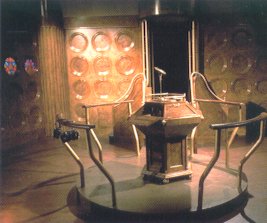
As for set design and costuming, overall I can't say that any of them jumped out at me as being truly spectacular. But all of it is of a very high quality; both the sets and costumes look elegant, sumptuous and detailed. That, combined with the location filming, gives the whole story a very rich feel, and makes it automatically interesting. There are a few things in this category that I want to single out, though. First is the new TARDIS set; while I don't like it as much as the original, and I'm glad it was only used briefly, I absolutely love the concept of there being more than one console room, and this one is a very nice contrast to the original. In particular, I'm very fond of the brass railings around the console (which get used nicely here when Sarah topples over and has to cling to them) and the new exit, with steps up to a darkened corridor. I'm also inordinately fond of the wine pitcher that Federico uses - something about the combination of gold and glass is really attractive. I wonder if you can buy pitchers like it anywhere. Hieronymous also gets to use a cool spinning iridescent silver star to hypnotize Sarah. A lovely Christmas ornament it would be. As for costuming, I think my favorite is Federico's really nice hat. Wouldn't be caught dead wearing it, but it's beautiful.
Of course, a pretty location and nice sets wouldn't add up to a hill of beans if the plot or acting were terrible. Happily, both of those are pretty good, which I think is why Masque is consistently enjoyable rather than just having of bright spots. The court intrigue is well-done, but somewhat irrelevant; the best part of the plot is unquestionably the Mandragora Helix that drives the whole thing. I'm a little torn about how exactly to evaluate it, though. On one hand, so much about it seems to be unexplained. It's said to be able to inhabit the stone of the entire temple, but it seems to be confined to the altar. When the Doctor enters the temple the first time, it shows him circular patterns and building façades, but it's never explained what these are. And the next time he enters the temple, he stands on the very spot where the Helix said that only Hieronymous could stand without being killed, but the Doctor suffers no ill effects. And overall, its exact threat is never made real. We know it's going to turn mankind into sheep, but how exactly is it going to do that? Is it planning to take over everyone's minds, one by one? (in which case, how?) Or is it just going to kill everybody who doesn't worship Demnos, as its behavior during the masque would seem to indicate? It makes it a little harder to take it seriously. On the other hand, this lack of explanations actually makes the Helix even more effective because it retains its mystery, and thus seems truly alien and frightening. Again, it adds to the atmosphere of the story, so ultimately I think it's successful.
In the acting area, everybody puts in a very good performance. I'm highly partial to both Gareth Armstrong as Giuliano, and Tim Piggott-Smith as Marco, for different reasons. They work very well together, Marco's hotheadedness complimenting Giuliano's thoughtfulness. Armstrong gives a more nuanced performance, and comes across as very likeable. It's also quite amazing how quickly Giuliano comes to trust the Doctor, which also makes him a more sympathetic character. He's got a nice combination of innocence and intelligence. Armstrong actually has really good chemistry with everyone - from his tense feuding with Federico (who, amazingly, he seems to still love on some blood-kin level - witness the momentary look of grief on his face when he learns that Federico is dead) to his friendly rapport with Sarah, his respect for the Doctor and his deep friendship with Marco. Piggott-Smith, meanwhile, is a little less subtle, but this actually succeeds in conveying Marco's fierce loyalty to Giuliano quite well. (And I'm not the only one to idly wonder if the two of them were very good "companions" indeed! Either way, it's nice to see such a strong bond of friendship portrayed in Doctor Who.) Plus, his hair actually looks real. (no disrespect intended to the wigs worn by Armstrong and Jon Laurimore - they're quite nice and very effectively fifteenth-century.) The performance which, although not my favorite, may well be the "star" performance of the show, is Norman Jones as the supremely creepy Hieronymous. He is perfectly cast - just look at the way his eyes show a steely gleam, a lust for power and a slightly crazed madness all at once. You never doubt for a moment that Hieronymous is a complete believer of the powers of both astrology and Demnos (or Mandragora), that his loyalty ultimately belongs to them alone, and that he would do anything to defend them. Given that he also voiced Mandragora (I think? - or is it Peter Tuddenham?), I assume we have him to thank for the creepy booming laugh when the TARDIS dematerializes from the Mandragora Helix.
It's a bit of an odd story for Tom Baker and Elisabeth Sladen, though. They're as wonderful as always, but unfortunately their wonderfulness gets a little diluted. For Baker's part, the Doctor is scripted as practically subdued - he cracks relatively few jokes, and for the most part stays serious during the whole adventure. Where this worked extremely well in Pyramids of Mars, because his mood reflected the seriousness of the threat, it's not quite as effective here. Although the Mandragora Helix clearly poses a very definite threat to the Earth indeed, the Doctor's mood doesn't seem to be directly related to it, so he comes off as just a less jovial version of our usual Doctor. Not that it's a bad thing - it's kind of nice to see him in a non-hyperactive mood every once in a while. Sladen fares less well because the story just isn't really scripted to accommodate her. She gets captured almost as soon as they leave the TARDIS (more on that later) and spends all of the first three episodes escaping and getting captured again (first by the Brethren, then by Federico). In all that time, her only outing occurs when she's hypnotized to kill the Doctor (which is, admittedly, a pretty fun bit - especially the way she smiles innocently as she advances on him - but it's not exactly Sarah's finest hour). As always, she does get some great moments. I really enjoy her impressed tootle on the recorder when the Doctor raises the lights in the console room (and who knew Lis could play the recorder, either?), and the two of them get a great scene together in episode four, when Sarah gives the Doctor an immediate answer to his thinking-out-loud math problem, then decides he's too busy to bother hanging around, and goes off to the corner to have a read. (Although one wonders how she managed to get anything out of the book, if she didn't understand Latin. Maybe it had pretty pictures.)
It's interesting, then, that Masque tends to avoid the problem that plagues a lot of stories. Usually, a story starts out strong, with very promising plot elements appearing throughout part one, but by the final part it's run out of steam and the ending just fizzles away. Here, the first three parts are basically runaround, and it isn't until we get to part four that everything suddenly jumps into high gear. Finally, the Doctor's ambling around isn't just vaguely random wandering - he's actually got a purpose, and the whole palace is rushing around trying to get things done too. Sarah, finally neither incarcerated nor mentally hijacked, gets a chance to be her usual bubbly self. And the plot generally moves along at a nice clip.
Next, we've got effects. Just about everything here works really well (no doubt it helps that, as with many pseudohistorical stories, effects are kept to a minimum). The Helix energy itself looks nice, a crackling fireball of energy, and the effect used to show the water bubbling and steaming as it moves across the surface of a pond is nicely done and well lined up. The blue makeup on the bodies killed by Helix energy is great (and icky / cool). I really love the effect of the sparks shooting out of the altar and into the acolytes' hands, and the moment when we see that Hieronymous has been completely consumed by the Mandragora energy is definitely scary. (Although I do wonder why, in this scene, the energy bolts from his fingers are blue rather than orange, which makes more sense and is used later.) The entertainer at the masque who swallowed fire also gets an automatic round of applause. (Was it Stuart Fell?!) The only effect that's not entirely convincing is the view of the Mandragora Helix from space. It looks like dark blue water with bits of styrofoam whirling down a sink drain (a cool effect, indeed, but not quite right as a representation of the Helix), which is especially confusing given that the Doctor claims that it's energy radiating outward. If they'd just reversed the effect, it might have been way cooler.
And a random "miscellaneous cool stuff" category. I love the lighting in the shot of Hieronymous raising the dagger to stab Sarah - the way it glints off the blade is beautiful. Then there's the subsequent shot of Sarah gradually (and amusingly!) sliding out of the frame as the Doctor, unseen, tugs on her legs - very cute. The music, overall, I don't find to be all that exciting (although there are times, in the catacombs, when it sounds like the music from Mark of the Rani), but I love the music that accompanies the masque. And, finally, a minor behind-the-scenes complaint - when the Doctor mimicks Hieronymous' voice at the end, why did they make them both speak slowly? I'm sure they thought it would be easier for Tom Baker to match his movements to Jones' voice, but it just looks unnatural and in fact I think it makes mistakes easier to spot.
In the "childhood memories" corner, this story gave me a definite interest in mandrake. That one still delights me even as recently as Harry Potter. I can also remember watching it in the upstairs bedroom of my grandmother's house (oddly, the site of many early DW memories) and being disappointed that I had to leave before it was over.
Minor points:
Doctor: "Have you seen a young girl about five foot five, six - probably with orange juice on her chin."
Federico: "Do you tell the future?"
Doctor: "Sometimes."
Federico: "Can you tell mine?"
Doctor: "No."
Federico: (affronted) "Why not?"
Doctor: "Because you don't have a future, unless you listen to me."
Doctor: "I wonder what the Mandragora Helix is up to."
Sarah: "Conquest? Invasion? They want to take over Earth and fill it with old Roman templ-"
Doctor: "Nooo."
Doctor: "Giuliano, it isn't easy to explain the concept of Helix energy, either sub- or superthermal ionization, in your medieval vocabulary."
Sarah: "Oh, I think you're doing a great job so far."
Doctor: "Thank you."
Sarah: (heartfelt) "I do."
Doctor: "Giuliano, you're not afraid, are you?"
Giuliano: "Afraid? Oh, no..."
Doctor: "That's funny. Most people would be."
The problem here is that the Doctor's question was phrased such that "no" was clearly the answer he expected (what conversation analysts call a "preferred response"). Regardless of which answer the Doctor was actually expecting, his question was biased a certain way, and to give an answer other than the preferred response would have required Giuliano to contradict him and thus threaten the Doctor's face. Compare it to "Would you like to have dinner with us?" where the preferred response is "yes" - if you say "no", you're required to give an explanation or an apology or both, and you still run the risk of hurting the other person's feelings. In this case, of course, Giuliano risked damaging his own face by admitting that he was afraid, so it's a little cruel of the Doctor to manipulate him like this. (sorry, linguistics geek mode.)
Giuliano: (re: Federico) "How did he die?"
Doctor: "Let's say Hieronymous gave him a blank look."
To quote Sarah, "Look, I wish you'd stop giving me flip answers!" (Amazingly, Giuliano seems to accept it!)
Doctor: "So far the only Helix energy in the temple is what we brought with us."
Sarah: "You mean there's more to come?"
Doctor: "Yes, tomorrow night, when Mandragora swallows the moon."
Sarah: "Listen, I came here with you, remember? You don't have to use that fifteenth-century doublespeak with me. I speak-a the pretty good English!"
Doctor: "Just you remember what Hieronymous did to you!"
Sarah: (quietly) "I do."
Doctor: "When did I ever guess wrong about anything?"
Sarah: (worried) "Lots of times."
All in all, it's not on my top tier of stories, but the location filming alone is enough to make me recommend this story. The concept of the Mandragora Helix is just the icing on this very palatable cake. (And Lis Sladen's performance is the little icing roses, only tastier. Okay, I'll stop now.)