Holistic Review: The great strength of this pleasant interlude in the Key to Time season is its light-hearted, fun spirit, plus it's a good showcase for Mary Tamm.
I can't kick the feeling that I really shouldn't like The Androids of Tara. I mean, it's all about swordfighting and evil aristocrats and double-crossing, which frankly aren't too high on my personal favorites list. And yet this story completely wins me over, every time, securing it a spot in my "favorite half" of the Key to Time season.
The thing about The Androids of Tara is, it's a David Fisher script, so even when the plot elements aren't necessarily to my taste, the dialogue is really entertaining throughout. More and more I'm deciding that Fisher is one of my favorite writers from the original series, and one of its most underrated talents; his track record is just fantastic. But it's not merely the dialogue that grabs me; it's also that The Androids of Tara is simply a delightful ride. It's a leisurely, breezy story that doesn't take itself too seriously, and it clips along at an entertaining pace. At times, there's not a lot happening, and the plot is full of captures and escapes, but even when you feel like your interest ought to be flagging, the story has a verve that carries it along. Refreshingly, the plot isn't so taxing that you get a headache trying to figure it out, but rather it's a straightforward tale of human (well, Taran) greed. Another interesting change is that there's no mystery about the identity of the fourth segment, which turns up even before the first monster rears its oversized head, so its function is merely to get the Doctor and Romana enmeshed in local events. I'm glad they only tried that trick in this one story, or it might've started to feel as though the Key to Time theme were simply being tacked onto pre-existing story concepts, but looking over the season as a whole, it's a fun way to mix up the format. Yet for all its unhurried development, the plot is quite tense. Will Romana be "dismantled"? Will the Doctor manage to get George onto the throne in time? Will anyone realize that an android is being crowned King of Tara? And, most importantly, can the Doctor stop Grendel before he murders Reynart, Strella and Romana? Some would claim that the antics of a power-hungry aristocrat on an alien planet hold no interest for us viewers here on Earth, but I beg to differ.
Fisher's cliffhangers are good, too. My favorite is episode 2, as the Doctor appears to brain Strella — or is it Romana?? — with the Taran royal scepter! (That the solution to this mystery is fairly obvious doesn't detract from the excitement of the moment, thankfully!) Part 3 is a shocker too, as Grendel manages to completely turn the tables on the good guys, by lancing their replica King and, yet again, abducting poor Romana, who has barely enjoyed a few minutes of freedom. Tara itself is a neat planet, with a society in which the lowly peasants are the ones who know all the cool android-building skills, so the royals — who, aside from ruling their territory, don't seem to do much other than hunt, embroider, swordfight and squabble — are dependent on them for tech support. I'd been wondering why on earth the Tarans had need of androids at all, so the background of the plague provides some welcome context.
The other element that I think makes The Androids of Tara a really strong story is the cast, who are uniformly good, with a few real standouts. Most importantly, I love that this story puts Mary Tamm front and center. Episode one is particularly strong for Romana, who immediately takes charge in the wake of the Doctor's apathy. She pinpoints the general location of the fourth segment, lands the TARDIS effortlessly, demonstrates her work ethic by refusing to take the day off, and tracks down the fourth segment in record time, having located and converted it by 07:40 into the story. In the remainder of the story, she coolly stands up to Grendel with backbone and sarcasm, cleverly pockets an android surgical instrument to use as a lockpick, devises an escape plan (and hilariously eggs Reynart on in making more and more dramatic pain noises), steals Grendel's personal horse, and rescues Strella from her murderous attacker. (I'm skeptical that Kurster could be knocked out with a vase and some embroidery, but I guess one has to use what one has at hand.) Tamm racks up a ton of delightful line deliveries, primarily in the first episode where Romana is more prominent: "You just made that up!", "Right, I will!", "Frightens the fish...", her subtle reluctance to let go of the fourth segment when Grendel insists on examining it, and the hilarious cluelessness of "Go, charger! Start! Start!" Perhaps that's another reason why I find The Androids of Tara to be so charming: it gives Tamm the opportunity to show off her comedic timing, and reveals that ice-queen Romana has an unexpected lighthearted side.
Typically, Romana — unlike any other companion before or since — is concerned with local fashions, and so tracks down the latest Taran couture in the wardrobe room. (Technically, the only Taran couture in the wardrobe room. Perhaps the TARDIS winnowed the wardrobe down to "current" fashions according to their ETA, which — given the Tahitian grass skirt and the existence of a "tally-ho" costume — might indicate that their Taran adventure takes place around the late 19th to early 20th century? So, not an Earth colony, then!) Romana informs the Doctor that "according to our records, it's what everyone on Tara's wearing this year." Given that we never see anyone else wearing an outfit like hers (although some of its embellishments are similar to, say, those on Grendel's tunic), Romana must be the one who inspires the trend. Her android duplicate, after all, is given an identical copy of her outfit, and it's left behind on Tara, where it might create a fashion sensation. Personally, I'm forever grateful that Mary Tamm wanted to redesign the original costume, because her outfit in this story is my all-time-favorite companion costume. Obviously I share her fondness for purple and green (less so purple and turquoise, but it still looks great), and every element of this outfit is just fantastic. I love the velvety hat with its floaty green ribbon, the matching tailored jacket with green epaulettes and that lovely satin center panel, her satin turquoise trousers and the matte purple boots... just fantastic. It feels very appropriate for a forest planet, and the color really brings out Mary Tamm's green eyes. It's just a shame that she spends much of the story locked up in a shadowy dungeon and doesn't get to show it off! And then she has to change out of it for the wedding, which makes me sad. (I hope she remembered to pick it up before they went back to the TARDIS.) At least she gets the opportunity to strike a pose in the console room. Actually, Romana gets a lot of interesting clothes, which is nothing unusual for fashion plate Mary Tamm. Her floaty white dress at the start is glamorous yet comfortable-looking; I love the capelet and the dangling sleeves that nearly reach to the floor. And, as Strella and her android, as well as for the wedding scene, Tamm is given some lovely sparkly-gold and shimmering-metallic-purple robes.
The Androids of Tara, of course, is the story that enables Mary Tamm to play four roles: Romana, of course, and her double, the Princess Strella, as well as android duplicates of both Romana and Strella. I'd love to be able to say that she plays each role dramatically different from the others, but the truth is that all four characters are kind of similar. Romana and Strella are practically twins, although Strella's actually a little icier and more aloof than Romana, which speaks to how much character development Romana has undergone by this point. (Although Strella's behavior may be mainly due to the circumstances under which we meet her; I'm sure none of us are at our best when we're being held prisoner in a dungeon and forced into a loveless marriage on pain of death. I know that always makes me grumpy.) It's a nice touch that Romana helps rescue her dopplegänger at the end, and the subsequent scene, of Strella teaching Romana how to embroider, is cute. The androids obviously don't have the same winning personalities as the originals, but they nail the regal bearing and the plummy tones. The main difference is that both of the androids have blank eyes, with none of the intelligence, humor or fire that Romana or Strella possess.
The breakout star of The Androids of Tara is Peter Jeffrey, whose Count Grendel is one of the most delightful, charming, viciously scheming villains that Doctor Who has ever featured. If he ever expanded his interests beyond his corner of Tara, in a more universal direction, he could be an arch-enemy to rival the Master. No doubt the two of them would get along like a house on fire — or at least, they'd put on a convincing act to one another's face — because, like the Master, Grendel's main weapon is his charisma. He effortlessly wins over everyone he meets, sweeping them up through sheer force of personality, and he wields his charm to smooth over his insistence on getting exactly what he wants. He's so polite that you can barely say no, until it's too late. Grendel is so very poised, and he's adept at disguising his true emotions behind a friendly, genteel veneer that rarely slips. He can effortlessly turn on a dime, furiously berating the servants one moment and, seconds later, greeting important guests with a warm, relaxed smile. Grendel's ability to pull the wool over people's eyes, and his confidence in his own untouchability ("What? What can you do? Be quiet and listen to me!"), has made him nearly fearless. He's not averse to dropping ominous hints about his nefarious intentions, and infuriatingly, Grendel gets ahead by flaunting the rules of honorable combat that everyone else respectfully obeys. Yet he's managed to put on such a good front that everyone seems to believe that he's utterly guileless, even when he practically parades his wicked plans in front of them. "I fear [Reynart] will be in need of the funeral rites very soon after the wedding," he laments to the Archimandrite, his voice hinting more at unnatural foreknowledge than regret, yet the Archimandrite is none the wiser. Occasionally Grendel lets the façade slip, as when he tries on the Taran throne for size and his anticipation has him slapping the armrest in excitement. But really, the only thing that threatens his composure is when Grendel loses control. He's visibly upset when the Doctor thwarts his plans and sneaks an android Prince onto the throne, scrambles to appear innocent when the Doctor scuppers his assassination attempt and throws suspicion on him, and can barely contain his frustration and rage when both the Doctor and Romana escape him. Another of his talents is that Grendel is a shrewd observer of people, almost immediately deducing from Romana's apparently offhand curiosity that she knows the Doctor. The Doctor, equally insightful, clearly takes the measure of Count Grendel practically the moment they lay eyes on each other, and it's entertaining to watch them size one another up, and spar both physically and verbally. Among Jeffrey's many great deliveries: "It would avoid a great deal of possible... unpleasantness later." and "My own. I shall be marrying the poor king's widow." (He does, however, get the story's one real dialogue clunker: "Fetch good wine, dog!") I would absolutely have loved to see Count Grendel, and Peter Jeffrey, back as a recurring villain. Tara would have made for a fun Peladon-equivalent of the Baker years.
The Doctor's insistence on taking a day off just feels so him. Not that you can blame him. His planned holiday with K-9 was ruined with the White Guardian's last-minute assignment, not to mention wet-blanket Romana elbowing her way onboard. Why not take a little break at the halfway point of the quest? Besides, his rather flattering trust in Romana is not misplaced: if not for the little matter of local politics, Romana would indeed have accomplished the task in under an hour, as she'd promised. When his idyllic fishing trip is ruined, the Doctor really gets to show off his multifaceted personality. He demonstrates very little automatic respect for the local nobility, pokes fun at the locals' greed (countering Reynart's offer of one thousand gold pieces with an even lower offer of five hundred), vents his frustration at Reynart's men and Grendel, and cracks joke after joke. With a script as witty as this, Tom Baker has boatloads of opportunities for fun deliveries: the way he says "I don't think we've met before" as if to say that it was therefore impertinent of Farrah to singe his hat, "What? Prince Reynart?! ... I've never heard of him.", "I'd really love to help you out, but I'm frightfully busy, and, er... where is this android?", the moment when he sticks his head back out of the pavilion to shout "Liar!", "I have a pressing engagement on the other side of the galaxy.", "What? Sorry to leave Tara? I didn't even catch one fish, not one!", and his teasing Romana by watching her try to trace the segment that he's got hidden in his pocket.
K-9 proves very useful in The Androids of Tara. He saves the Doctor's life on numerous occasions — destroying the Romana android, creating an escape path from the pavilion, and mowing down numerous guards — and tracks down where Romana is being held prisoner. I note with some satisfaction that, although several actors have complained about having to get down on their knees to talk to K-9, here it's used as a plot detail that saves the Doctor's life! I enjoyed Leeson's delivery of "Clock, Master.", "I am familiar with boats, Master." and his plaintive "Master! Master!" at the story's end.
My next-favorite character is probably the very complex Madame Lamia. She may be one of the story's sub-villains, and Lois Baxter certainly conveys her icy clinical detachment and her disregard for others well, but Baxter also imbues her with humor and a certain amount of warmth underneath her cold shell. Her unrequited love for Grendel, as incomprehensible as it is, makes Lamia much more sympathetic, almost likeable in some ways, and pitiable in others, as she allows herself to be insulted and walked all over by the man she has feelings for. What makes it even worse is that Grendel is perfectly aware of her feelings for him, and is quite content to use them to manipulate her. He practically mocks her to her face for being in love with him, yet she allows it to continue. I haven't really thought of this before, but it's almost a moral against domestic abuse, the message being: if you see red flags in the relationship, get out before you wind up dead. Lamia's fate isn't linked quite obviously enough to Grendel's treatment of her for this message to be strongly reinforced — after all, it's not directly his fault that one of his guards shoots her, even though he did put all the pieces in place for it to happen, and it was a bit callous of him to order an attack on the pavilion while Madame Lamia was still inside — but it's an important message despite the subtlety. A villain she may have been, but I was still sad to see Lamia killed. Among Baxter's great deliveries: "I'm a peasant. I leave politics to my betters." and I like the way Lamia kicks her heel after requesting a guard. Baxter herself is also striking, her cool blue eyes standing out against her dark hair. Her earrings, in almost a fleur-de-lys design, are attractive. I also really liked her snake-styled hair, which I assumed was just her personal "thing" (cf. her name) until I noticed that most Taran women were wearing their hair in the same style. You missed that hot trend, Romana.
Prince Reynart (Neville Jason), later King, is the kind of character you always root for in these stories, a kind and reasonable ruler who's obviously a way better option for his people than the selfish, tyrannical Grendel. His character is established early on, as he — dramatically unlike Grendel — refuses to stoop to threats in order to get what he wants, instead preferring to win allies by being reasonable and fair. I find it really funny that the android version of the King is actually more intelligent than the original! Ha! Jason's performance as the android version is likewise amusing, particularly his (literally) mechanical deliveries, as in "I. Am. Well." As flesh-and-blood Reynart, I enjoyed "We use Geor— er, the android copy of me, to create a diversion, to distract their attention." Is it possible that the character's name was originally Reynhart? The Doctor certainly seems to think so, when he first meets Zadek.
Farrah (Paul Lavers) got on my nerves early on, with his snide delivery and his sadistic decision to ruin the Doctor's scarf with his sword. Thankfully, after his hotheaded nature made such a poor initial impression on me, matters improve when it turns out that he has a sense of humor. It also helps that Lavers is given dialogue that allows him to show off his subtle acting skills, which helps Farrah avoid being a one-note shouty character. Zadek (Simon Lack) is the voice of wisdom and reason in Reynart's exiled court. He has a fatherly air, occasionally stern or cautious, but always full of concern and caring for Reynart and, as they grow to become allies, even the Doctor. Lack and Tom Baker have great rapport, and I like his delivery of "Oh, drat. I keep forgetting he's only an android."
Grendel's two main lackeys, Kurster and Till, have next to no plot relevance, but they still manage to make an impression to some degree. In the case of Kurster (Martin Matthews), this was "wow, his evil laugh is pretty great!" I'm not quite sure what to think of Till (Declan Mulholland), but he's certainly over the top. Does Mulholland's performance fit seamlessly into the heightened drama of the medieval-ish Taran court? Is his "stereotypical hunchbacked Renfield-esque manservant" performance supposed to make me feel uncomfortable? Although it's often the case in Doctor Who that the characters with physical imperfections are also the villains, that doesn't seem to be the case with Till... still, although he may not be a fiend, he is made out to be a fool (and, therefore, possibly mentally as well as physically challenged). So is he insensitively being played for laughs, or is Till meant to be "just another character" despite his physical and mental differences, and attention is called to it only because of Mulholland's enthusiastic portrayal?
The Archimandrite (Cyril Shaps) comes across as a wise man, yet naïve and overly trusting, as he falls right into Grendel's nefarious plans without even batting an eyelid. His rainbow of a hat is absolutely magnificent. Personally, you wouldn't catch me wearing it any sooner than you'd catch me in a wood-beast costume, but I have to admire the audacity. It reminds me of this picture, which I created for reasons that I've now completely forgotten. I suspect it was meant to amuse Andrew. And as long as we're on the topic of that photo...
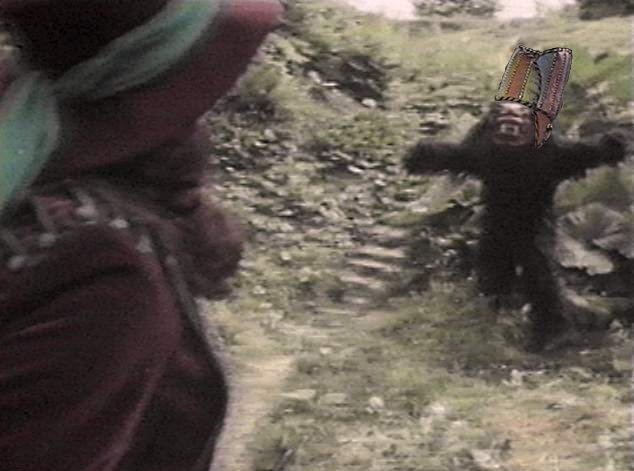
As a small-scale story of kingmakers and diabolical plotting, The Androids of Tara is not your typical monster story, which no doubt adds to its jolly atmosphere. "But we can't have that!" worried the producers. "Let's lump one in anyway!" So we get the Taran wood beast, universally acknowledged to be one of the worst Doctor Who monsters ever. Its only saving grace is the fact that it's barely onscreen for 30 seconds, unlike certain others I could name who occasionally had whole stories built around them. (Hint: the worst offender starts with a "d" and ends in "inosaurs".) With its grotesque plasticky mask-face, its wild mane of fake fur, and its impossibly large fangs, it looks like the love child of a troll and a gorilla — don't laugh, you don't know what troll biology is like, it might be possible! — and, while it actually looks decent when scrambling up a hill in the opposite direction, it attacks Romana and Grendel with its arms straight out from its sides, like it thinks it's in a basketball game and it's trying to keep Romana from passing the ball to her teammate. Thanks to its over-the-top ludicrous appearance and (blessedly) its brief screen time, the Taran wood beast is therefore utterly loveable, and in some ways a highlight of the story, as long as you're not watching with newbie friends who are easily put off by flubbed effects. Get in an MST3K mindset and you're good to go. As part of the same "please verify a scene that stuck in my head" thread on Outpost Gallifrey that I mentioned in my review of Mark of the Rani (or "will mention", if you're reading these in chronological order as opposed to the order in which I wrote them!), I drew this picture to represent The Androids of Tara. Personally, not to toot my own horn or anything, I think my wood-beast looks a little better than the genuine article.
The Taran wood beast is, to some extent, an indication of how the effects in this story will fare. Most are iffy: the matte painting of Castle Gracht is nearly convincing, but the painted-on extensions (especially the central tower) are obviously a darker color than the rest; the android props have skin that's nowhere close to realistic; and K-9's nose laser lags behind where the pavilion wall is actually burning (though Tom Baker helps to make the effect convincing when the Doctor nearly singes his finger in the beam). On the "good" side, the flap in the back of android-Reynart's head is convincingly integrated onto Neville Jason's actual human head.
The story's sets, in contrast, are as impressive as the effects are not. In particular, I love Madame Lamia's surgery / workroom, with its peculiar mix of "modern" computer banks (that occupy an entire alcove), sumptuous period décor (including leaded windowpanes, embroidered fabrics, marble columns and exquisitely-carved woodwork — everyone wave hello to Solon's chair again! Strella gets to sit on it too, in her cell.) and the occasional creepy detail, like the skull and face-mask on one shelf, and the bottles of unidentifiable powders in the corner. Even more creepy is the android-examining table, probably thanks to its crime-scene-reminiscent human outline. The restraints don't help either; they look easily escapable, but they also remind me of the frog-leg-severing scene in The Muppet Movie, which traumatized me as a child. (As if the chair and restraints weren't bad enough, then Lamia pulls out a ginormous syringe... oh help.) I really like the Pavilion of the Summer Winds, if for no other reason than its poetic name, but the oriental design is also quite appealing. And I really dig the clock outside the coronation room. That's a lot of hours! (even if they don't appear to go quite all the way around, and some of the numbers are repeated.)
Dudley Simpson's incidental music is typical for the period, and overall nice if not remarkable, though I really like the medieval-sounding music as Grendel rides Romana back to Castle Gracht, and the Taran pomp-and-circumstance fanfare as the android Reynart is crowned King.
I also really have to give a shout-out to costume designer Doreen James, who did a superb job on The Androids of Tara. Aside from Romana's spectacular purple-and-green outfit and the Archimandrite's stunning hat, I really love the cut of George's gold coat. I would so buy a coat like that. Assuming that it came in fabrics other than gold, that is.
Michael Hayes is blessed with a luxurious, summery story to film, and on both counts, he makes The Androids of Tara look great. I loved the deliberately-unsubtle shot of the Castle Gracht doors slamming shut with finality behind Romana; the freaky shot of Lamia turning around with a buzzing saw intended for Romana's neck; the pan across from the clock to Grendel looking smug; another quick pan after the Doctor attacks android-Strella, from the nobles' horrified gasps over to Grendel's cold fury; the fairly horrific shot of the android Romana repeatedly being shot from behind by K-9; and the clever use of the frame's edge to suggest, offscreen, the Doctor leaping onto Romana's horse. There are a couple of questionable shots, though: the crucial moment when Romana sprains her ankle barely registers, because the camera is focused on the wood beast and we only see Romana from about the shoulders up when she has her fateful stumble; and I'm not sure why Hayes decided to show us the entirety of K-9 cutting a hole in the pavilion wall, rather than editing the scene down somewhat.
Minor points:
Romana: "Materialization in fifteen seconds." (she looks at the Doctor and K-9's chess game) "Mate in twelve!"
Doctor: "Gosh! That takes me back. Or forward. That's the trouble with time travel, you can never remember."
Romana: "Well, how does it go? What makes it work?"
Grendel: "Good heavens, I don't know, my dear. ... I'm a knight, not a farrier."
Romana: "Er, Count, far be it from me to query this lady's competency as a doctor, but where I come from, you don't cut off the patient's head if you wish to cure their ankle!"
Doctor: "You look better without your helmet!"
Farrah: "Cooler, anyway."
Farrah: "A swordsman does not fear death, if he dies with honor."
Doctor: "Then he's an idiot!"
Doctor: "And by the time George is king, I'll be light years away!"
Zadek: "No, Doctor. You'll be with the android at all times."
Doctor: "Now look here, Zadek! I've got better things to do than meddle in the policies of your piffling little planet!"
(Farrah aims his sword in the Doctor's direction.)
Doctor: "On the other hand, I could be with the android at all times."
Grendel: (re: Strella) "In fact, Tara's most eligible spinster, shortly to become — in rapid succession — my fiancee, my bride, and then... deceased. Yes, it will be a tragic accident. A flower blighted in its prime."
Grendel: "I think I shall reject the crown once. Rejecting it twice might be misconstrued. Besides, I'm not sure I can trust the Archimandrite to offer it to me a third time."
android-Reynart: "I swear that I will uphold your rights, and devote myself to defending and... prrrrrooootecting you at all times."
Romana: "What have you got to lose?"
Lamia: "Grendel."
Romana: "Well, you haven't exactly got him now, have you? All he's doing is using you."
Lamia: "I know. But that is better than nothing."
Grendel: "What should I do without you?"
Lamia: "Find another peasant who understands androids, no doubt."
Grendel: "True. But I should not find one who pleased me so much!"
Doctor: "What's your reason?"
Lamia: "Do I need one?"
Doctor: "Well, no, but it would've been fun to hear it."
Romana: "Oh, this must be the android King!"
Doctor: "Yes, we call him George."
Romana: "And these gentlemen?"
Doctor: "Oh, they're real, I think."
Grendel: "Oh, Doctor! Well, there you are! I was glad you managed to escape safely."
Grendel: "Well, Doctor, you're a remarkable man."
Doctor: "I am?"
Grendel: "Yes, a man after my own heart!"
Doctor: (worried) "I am...?"
Romana: "Then what's his plan?"
Reynart: "To become legal, rightful King of Tara. You see, if you marry me, you automatically become Queen. But five minutes after the wedding, you would almost certainly be a widow."
Romana: (unaccountably surprised) "He'd kill you?!"
Reynart: "He would. And the moment you're widowed, Count Grendel, that well-known champion of widows and orphans, would step in and marry you, thus becoming consort of the rightful Queen of Tara."
Romana: "And then it would be my turn for an unfortunate accident."
Reynart: "Precisely."
Doctor: "Do hurry up! A hamster with a blunt penknife could do it quicker!"
Grendel: "Next time, I shall not be so lenient!"
There's something about The Androids of Tara that's just charming from start to finish, and it's probably Mary Tamm's best story. Another success from the pen of David Fisher!