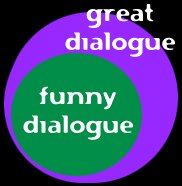
Holistic Review: Two words: Hilarious. Classic.
What is there to say about this story that hasn't been said a thousand times before? Probably not much. City of Death is a gold-standard classic of Who, not to mention a perfect illustration of how contemporary opinions can change over time. Once derided as a prime example of the worst excesses of the Graham Williams era, City of Death underwent a major reevaluation in following years, and now consistently ranks in the all-time top 10 of most Doctor Who polls.
I think it's fair to say that the major reason for its dramatic reassessment, and the main (but far from the only) reason I've always adored it, is ironically the very reason why it was bashed by fans at the time: the story's prodigious sense of humor. It's not often that you can describe a Doctor Who story with the phrase "a laugh a minute", especially during the classic era, but City of Death almost literally fits that description. In most stories, the humor is like a garnish; here, it's practically the main dish. Every single speaking character gets at least some funny lines, and practically every scene after the opening contains at least a couple of jokes. Many have far more, like the Doctor's introduction to Scarlioni, which packs at least 15 jokes into its 3-minute running time.
It's not just that the dialogue is funny, even though that is the main draw. City of Death is also very well written, and even when the jokes aren't flying around, the dialogue sings. Douglas Adams certainly has a way with words, and an ear for naturalistic speech. Practically every line in the script seems to be either funny or lyrical, if not both, to the point that I felt I was writing down almost the entire script while taking notes for this review. Adams is also one of the rare Doctor Who writers who scripts clever jokes across scene cuts, as in the cut from the the Doctor talking about a crack in time to Kerensky saying "Time, Count. It will take time.", or the dialogue that leads into the second time-slip ("What did she say?" asks Romana, to which the Doctor begins to reply "She said —" before the scene loops). This script has a sense of artistic flair that few others do.
If the only thing City of Death had going for it were funny dialogue, its reputation would be about as good as, say, Dimensions in Time, or your average Adam Sandler film. Fortunately, the humor quotient of City of Death is but one of its many strengths.
The character-driven nature of the plot also lends it some lovely emotional depth. Scaroth's motivation is completely relatable — he wants to save his people — which gives him a certain pathos and evokes at least some degree of sympathy, even if we don't agree with the murderous way he goes about achieving his aims. The Jagaroth may be an aggressive warlike race, but as Romana recognizes, that doesn't mean that their extinction should be encouraged. The tragic twist is that, in order to save the last remaining Jagaroth, the birth of the entire human race would have to be averted. One wonders whether the Doctor might have been able to come up with an alternative solution that would rescue the Jagaroth and produce an energy release sufficient to trigger life on Earth — perhaps Scaroth could persuade his earlier self to let the rest of his people board the TARDIS instead, while he remained on board to pilot the ship, in order to direct the Doctor to this spot in 400 million years' time — but since Scaroth never bothers asking the Doctor for his help, there's nothing that the Doctor could have done except attempt to stop his original genocidal plan. So, the integrity of the timeline must take precedence, and the extinction of the Jagaroth must remain unchanged in order for the human race to live.
The wonderful thing is, even Scarlioni's temporal machinations actually make total sense. I didn't expect that to be the case — at first, I thought his mention of a "side effect" was merely technobabble — but actually every detail of his plot winds up being thoroughly, and satisfactorily, explained. Initially, on his instructions, Kerensky creates a temporal bubble within which time can be advanced or regressed; the practical application of this invention, Kerensky believes, is to accelerate the maturation of food animals, thus solving the global hunger crisis. A side-effect of testing these bubbles is that the process causes local time to hiccup and repeat, like a record jumping a groove. However, the bubble is very small, the timeline inside is abbreviated (it appears to cover roughly 50 years), and it's impossible to break in or out of the bubble because the interface between the time continuua is unstable. So although Kerensky could grow food animals at lightning speed, they would be forever inaccessible. Likewise, even if Kerensky were able to lengthen the internal timeline and regress the bubble by 400 million years, Scaroth wouldn't be able to cross into it. Instead, Scaroth plans to try a potentially easier solution: supplying enormous amounts of energy to the time-field generator, funded by the sale of seven Mona Lisas, and expanding the bubble so that it (or, at least, the time-jumps that accompany it) envelops the entire world, thus eliminating the need to break into it. That way, if Kerensky can take it back far enough, the "side-effect" time-jump will loop the whole world back to 400 million years ago, at which point Scaroth will already be inside the bubble (or the zone affected by the time-jumps) and be able to rescue his people. The big problem: if the bubble regresses in time, everything in it regresses in time, including Scaroth. So he's going to have to find a way to make himself immune to the bubble's effect, which means he'll need a field interface stabilizer, which will allow him either to suspend his timestream while the bubble regresses around him or, failing that, to cross into the bubble once it's regressed. (There are, I admit, a couple of small hiccups that only become apparent under close scrutiny. First, it's not entirely clear why Scaroth even pursues the option of regressing the whole world inside the bubble. He's already got one option that would work with a time-field stabilizer — that device is, after all, what ultimately protects him from suffering the same fate as Kerensky — so why go to the bother of trying to invent an alternative method that would also require a stabilizer to work? Second, it doesn't appear that Kerensky has yet deciphered how to send the bubble back 400 million years, so how does Scaroth manage it even with the stabilizer?) For this complex yet well-plotted masterplan, I think I must thank David Fisher — continuing his streak as one of my all-time-favorite Doctor Who writers — as well as Adams, given that Fisher conceived the basic plot before Adams' rewrites.
City of Death is one of those stories where absolutely everyone, from the writer to the visual effects team to the actors, is doing their absolute best work. It's nearly impossible to find a flaw with the story, short of nitpicking. (Just about the only real flaw is the title. While it's true that the story does take place in a city — Paris — and there's potentially a lot of death — or, to be more precise, the nonexistence of everyone who ever lived on the planet — if the Doctor and Romana don't stop Scaroth... it's a wee bit of an overstatement to call Paris a "city of death". At least in 1979.)
If ever there were a story to showcase the talents of Tom Baker, it's this one. City of Death highlights his Doctor's bonkers sense of humor, which has always been one of his major selling points, but it counterbalances that humor with the Doctor's very serious concern for what will happen if Scaroth succeeds, plus of course his sometimes-fierce disapproval of Duggan's "hit first, think later" philosophy. The fourth Doctor has always been one of the most energetic incarnations, haring about alien landscapes and throwing himself unhesitatingly into the fray, and City of Death capitalizes on this tendency with its iconic scenes of the Doctor and Romana racing through Paris, his coat and scarf flapping in the breeze. On the subject of throwing himself into the fray, he does also get the chance to defend himself with his fists — perhaps Duggan's rubbing off on him — although he more commonly wields his wits and intelligence. Another strength of the Doctor's characterization is that City of Death makes him seem really alien, with details like his uncertainty about Countess Scarlioni's perceived attractiveness, and his ability to write backwards. Yet his love affair with the Earth continues unabated: I love that the Doctor is quite convinced that the Louvre is one of the greatest art galleries in the galaxy (even better than the Braxiatel Collection!), and his (figurative!) swooning over the Mona Lisa is a hoot! (For that matter, the literal swooning is pretty impressive too.) Baker gives so very many brilliant deliveries, including but far from limited to: "One of my funny turns? The whole world took a funny turn!", his "oof!" when he falls off the Louvre bench as Romana helps him up, "Uh-oh." when two more thugs menace them in the café, his dramatic pratfall when Hermann trips him, "I'm a thief", his beaming "Hello there!" which honestly must be seen to be believed, "No life to tidy it up... no life...", "Yes, well, I mean, quite honestly, when you think about all that... Jagaroth spaceships...", "Well, it's simple, I'm a Time Lord!", "What do you mean, time's running out? It's only 1505. All right, all right!", his about-face from grim to perky on "I'll tell you. ...There is one thing I'd like to know is, how do you communicate across time with the other splinters of yourself?", his suddenly-returning memory on " 'Take arms against a sea of troubles'? That's a mixed — I told him that was a mixed metaphor, and he would insist!", "I hope you're not making a time machine, I shall be very angry.", "I so much prefer the weather in the early part of the sixteenth century. Don't you?", the way he pats the amniotic sludge into Duggan's palm ("Are you putting your hand in the primordial soup?" asked my friend Nancy, disapprovingly), and "Well, not that soup exactly." Also, that paint-palette pin he wears on his lapel? Adorable, and oh so appropriate for a story about art theft. Probably my favorite of his lapel decorations, although the flying ducks in The Power of Kroll are a close second.
Speaking of a close second (har har), this is only the second story, in both filming and broadcast order, to feature Lalla Ward as Romana. If you didn't know better, you'd think she'd been playing the part for years, so assured is she in the role. I don't know whether The Creature from the Pit simply helped her find her feet and break away from Mary Tamm's interpretation, or whether City of Death is simply better-written to her strengths, but Ward's confident lighthearted-aristocratic performance seems effortless. To be sure, this story is very well-written for Romana. She doesn't even get that much to do, really, but she's awfully well characterized. She still retains some of the first Romana's snobbery ("Well, at least on Gallifrey we can capture a good likeness.") but she also allows her playful side to emerge. Better yet, there's never any question that she's completely the Doctor's equal — they converse as expert colleagues about the time-slips, she comes up with a perfectly serviceable theory about how Scarlioni got the extra Mona Lisas, she asserts her ability to look after herself, and Scarlioni is just as happy to have her (blackmailed) help with his time experiments — although her comparative youth and inexperience come into play when she takes Scarlioni's sob-story at face value. To her credit, once the Doctor fills in the key detail that she hadn't known, she immediately extrapolates the serious consequences of allowing Scaroth to rescue his people. I also love the scene in which Romana solves, in mere seconds, the intricate Chinese puzzle box which the Countess erroneously assures her that she "won't be able to open". I must also spare a word for Lalla Ward's costume, which is by far my favorite of her tenure. Straw hats aren't typically my favorite, but perched on the back of Ward's head, her boater looks really flattering (as does her hair), and frames her face like a halo. Her single-strap red shoes — these days they appear to be called "Lolita shoes"! (presumably after the Japanese fashion trend, rather than the book?!) — are a cute, bold accessory to her costume. I've always found it sweet that Ward requested a school-uniform outfit in the hopes that it might inspire little girls to be excited about wearing their own school uniforms. (It's not to everyone's taste, though; when I showed this story to Nancy, on 14 September 2013, she loathed Romana's costume: "She's dressed like a child, but she's a grown woman!" But then, Nancy was under the assumption that it was intended as an adult-male fantasy costume. She was mollified considerably when I explained why Lalla Ward requested it, but she still wasn't completely won over. I'm not telling her about the Lolita shoes.) I adore Ward's delivery of "Bouillabaisse, yum yum.", her little "your loss" moue when the artist crumples up his picture and throws it away, "Mmm, just a twinge. I didn't like it.", "Do you mean you stole it from her?", "Hmm! Oh look." when she opens the puzzle box, her slow thoughtful head-shake when Duggan says "It wouldn't?", "But without a field interface stabilizer, you can't cross from one to the other.", her quiet "Just tell me what you're trying to do, and I'll see.", and the moment when Romana nearly lets herself be won over by Scarlioni's charm before feeling slightly disquieted about it. She and Tom Baker play off one another so well in this story that, with hindsight, it's easy to read flirtation into some of the looks they give one another — like the way Baker teasingly nudges Ward with his shoulder, and she beams at him in return. It's rather sweet! I feel sure their onscreen rapport is due more to their skills as actors than it is to their offscreen romance — to suggest the reverse, I think, does them a bit of a disservice — but it's undeniably charming to know that their real-life love was just beginning to blossom during filming. Even though their relationship ultimately didn't work out, they truly make a great team onscreen.
Count Carlos Scarlioni (Julian Glover) must surely be one of the suavest, most charismatic villains ever in Doctor Who. I love his cool-as-a-cucumber exterior, with his breezy cream suit and unruffled air. I suspect that confidence derives from Scarlioni's knowledge that between his influence, his wealth, his knowledge, and his deadly alien weapons, he is untouchably powerful. That feeling of superiority and emotional detachment even extends to his wife, whom he seems to regard more with amusement than love. Given his callous treatment of her — most notably, giving her a bracelet primarily useful in art heists, but also enabling him to coldly murder her should it become necessary — it's pretty clear that love really isn't part of the equation, at least not from his perspective. Which is understandable, really. What bloodthirsty alien warlord would be content with domestic bliss to a provincial human woman? Glover is one of those actors for whom a "best lines" list would quote his entire contribution to the script, but if I limit it to my absolute top-favorite deliveries, I'd single out "Well, as discreetly as possible, Just do it, will you?", "I want to see it today.", "Yes, today.", "I am not paying Einstein, professor, I am paying you!", "What!", "From? It's not from anywhere. It's mine.", "Besides, I don't think our professor would be very amused.", "Yes." when the Doctor says that the paintings have been bricked up for a long time, "Me! Leave me!" as Tancredi, the drunken halting delivery of "The centuries — that — divide — me shall be undone!", his quietly menacing "So. The Doctor has the secret. The Doctor and the girl.", the way he indicates that Romana can lower her hands, "Oh, must we go into vulgar threats?", his wickedly smug reaction to Kerensky's death, "When I compare my race to yours, human, I take the word 'inhuman' as a great compliment.", "Ahh, so you do care.", "Doctor, I think we can dispense both with your interference and with your help! Your friend has done her work very well indeed.", and he's convincingly unbalanced as the splinters of Scaroth attempt to communicate. The amusing scene in which he and the Doctor answer one another's questions only in monosyllables is particularly well performed by Glover, who makes it clear that Scarlioni has no intention of divulging anything but the barest minimum of information, and fully intends to infuriate the Doctor in the process. The only moment I can't quite figure out is his weird posture on "I will change it!" (likely this was one of the scenes in which he was doubled by Richard Sheekey) but I suppose it does make Scaroth look more alien.
Countess Scarlioni (Catherine Schnell) — Scarlioni's "consort", as the Doctor puts it — is clearly in a subservient position, given how she obeys mostly without question when the Count orders her around. Even on her part, her attraction to the Count is arguably not love — and, as others have suggested, almost certainly not sexual, although you'd never know it from the chemistry between the actors. For the Countess, the excitement of their relationship appears mainly to lie in the thrill of illicit activities, which their wealth enables them to get away with. In return for her discretion (about their illegal activities, which she'd never divulge anyway, and about the Count's extracurricular pursuits, which — together with the aforementioned probable lack of sexual activity — almost makes you wonder if she believes him to be gay), the Count bribes her with expensive fancy baubles. And, for the Countess, power and wealth appear to be sufficient to keep her content. For all we know, she doesn't even have a social life, although it's hard to imagine them not entertaining in such a grand home; perhaps the Count wouldn't allow it. At any rate, well-kept trophy wife that she apparently is, the Countess strikes quite a figure as she glides around the château with alluring, dignified poise and sophistication, her perfectly coiffed hair wreathed by the smoke from her chic black-and-gold cigarette holder. In a way, she almost seems to idolize the Count, which makes it that much more fascinating when the Doctor begins to plant the seeds of doubt in her mind. In particular, I love the moment when the Doctor mentions "one eye and green skin", and her mirth over the Doctor's crazy accusations suddenly fades as his words trigger a vague memory of something she saw in a papyrus scroll. I love Schnell's faint laugh (as she dreads admitting the truth) when the Count supposes that the Doctor was "probably overcome by your charms", her delighted (and coquettish) "Oh!" when she learns that Scarlioni is on his own in the cellar, "You won't be able to open it, so put it down!", her doubt visibly beginning to creep in on "Tinkering. Every man must have his hobby.", her horrified reaction when she looks at the papyrus, that whole-body acting as the Countess nearly faints on seeing Scaroth's true face, and her two pièce de résistance lines during her dramatic confrontation with her husband: "What have I been living with all these years?" and "Stay away! Put it down!"
Fussy Dr Kerensky (David Graham) seems like a sweet guy; apparently being the foremost authority on temporal theory in the world actually hasn't gone to his head! What's lovely is that he wants to use his knowledge not just to increase mankind's scientific understanding, which would be an excellent goal in and of itself, but to directly and measurably help the whole world by curing hunger! How tragic that such a philanthropist wound up working for an alien overlord who perverted his brilliant inventions in an attempt to wipe out Earth's history. Certainly his drive to succeed seems to evaporate once he learns that his work is no longer philanthropic; in fact, he almost definitely wouldn't continue if he weren't under duress. Graham — and Tom Baker, when Kerensky introduces himself — is the only actor who pronounces his character's name correctly, as Kherensky. Honestly, you'd think all the fluent bilingual francophone characters in the story would've been a bit more sensitive to the nuances of a Russian accent. (And speaking of a Russian accent, Graham's sounds excellent to my ear.) Love his delivery of "But I will shortly need a great deal more!", "I- i- it's the Jagaroth who need all the chickens, is it?", "But — but, Count, this... this machine is... is precisely the reverse what... of what we — of what I have been working on!", "This is monstrous beyond imagining!", and "Even you, Count, could not afford such things."
Duggan (Tom Chadbon), a straightforward detective with more than a whiff of noir about him, is another standout character, characterized as a (literally and metaphorically) hard-headed oaf whose first resort is to hit things (and people). He blunders through the story like a bull in a china shop, sometimes saving the Doctor and Romana a lot of trouble (as when he bashes his way through the cellar wall), and sometimes nearly causing them a lot of trouble (by knocking Kerensky out, attempting to leave the château before the Doctor's finished investigating, and setting off the Louvre alarms). Which means, of course, that Duggan is a wonderfully unpredictable source of plot advancement, and an entertaining foil for our two more cerebral leads. He clashes with the fourth Doctor, who disapproves of his violent methods in much the same way as he disapproved of Leela's; Romana, on the other hand, mainly seems to regard Duggan's antics as faintly amusing, almost as if he were a rather naughty puppy. Duggan's practical, down-to-earth personality makes him the incredulous skeptic of the team, little inclined to believe the Doctor's tall tales of aliens and time travel, and assuming that the sonic screwdriver is of the most value as a blunt instrument. The moment when he bashes it against the door always makes me gasp in horror! (Then again, it does start working thereafter...) Even though Duggan constantly threatens to upset the apple cart, there's a certain satisfaction in seeing him save the day with a typically pragmatic solution, punching Scaroth's lights out when the Doctor's appeals to his better nature fail to persuade him. It's a nice redemptive moment for the character, and a humorous reminder that sometimes the best solution is the most direct one. Chadbon's performance is a tiny bit melodramatic (as when the Doctor points out that daytime is not an appropriate time for an art heist, and when Duggan spots the Countess aiming a gun at them) but it works because it suits the character. I enjoyed Chadbon's exaggerated-for-comedic-effect double-take when Duggan sees that the men behind him are holding guns, the moment when he thinks he can lower his hands too (but learns he cannot!), and "Oh, it would be an expensive gloat, but they'd buy it."
As I mentioned earlier, City of Death is a rare example of a story in which every single actor is on top form... with the possible exception of one. I have to admit that I find Kevin Flood to be rather unexciting as Scarlioni's manservant Hermann. Certainly part of the problem is that his delivery is sometimes uninspired (as on "It would not be in our best interest to draw too much attention to ourselves."), and occasionally odd ("No, my lady. Professor Kerensky is 'resting' in his room." makes it sound like Kerensky is... uh... doing something else), but perhaps more importantly, he's also the only main character who isn't imbued with panache. Hermann is simply a discreet, loyal bodyguard, and little more. That may not get Flood off the hook — it's probably just as much down to his portrayal as it is the character's scripting, because as we all know, some actors can make a huge impression with very few lines — but I'm willing to cut him some slack. Anyway, I did enjoy his delivery of "Sell a Gutenberg Bible discreetly?!" and "After that, you won't need any light."
Speaking of actors who can do a lot with a little, even the smaller parts in City of Death — Pamela Stirling as the Louvre guide, and Peter Halliday as the Renaissance soldier — are delightfully characterized. Stirling's guide is professional but easily startled, which makes me laugh almost every time she's onscreen. Her "oh!" when she nearly walks into the Doctor's elbow (sadly missing when the sequence is repeated in the time-slip), her gasp as the Doctor taps her on the shoulder, and one last horrified gasp when she thinks the Doctor's about to hit her, are so funny! I also loved her awed "ohh!" when the Doctor says he's got the human race to think about. Halliday, meanwhile, has such a droll sense of humor as the soldier. In fact, it's not at all clear that the soldier even realizes when he's being funny. As a good sensible straightforward military man, the soldier often plays the straight man to the Doctor, lobbing him the setup for a funny line, or himself being the punchline of jokes that poke fun at his uninquisitive nature. Halliday makes the most of the comedic potential in his few moments onscreen, and his "smile" when the Doctor takes his picture — more like a pained grimace — is hilarious! And of course the cameos by Eleanor Bron and particularly John Cleese are a highlight of the story. Cleese is surely the biggest casting coup — and of all episodes of Doctor Who for him to appear in, this is the most perfect fit — but it's one of Bron's lines that tickles me the most: "Exquisite. Absolutely exquisite."
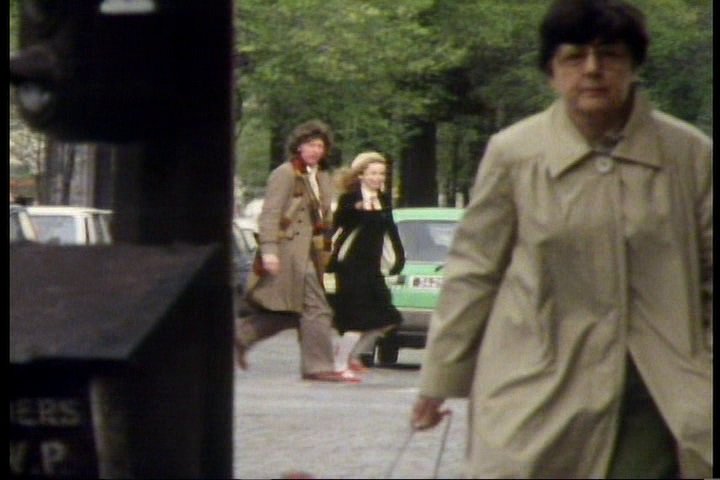
Apparently, flying to Paris put everyone in a creative continental mood, and nowhere is that more apparent than with Michael Hayes' direction, which at times resembles an artsy independent film more than Doctor Who. There are so many artistic shots: watching the train pull into the Dupleix Métro station; the camera aimed at a postcard on a rack, which is removed to reveal the Doctor and Romana walking behind it; the camera ducking around a pillar to show Duggan tailing them on the other side; Scarlioni considering his reflection while the Countess exults behind him; the lovely angle on the cobbles as Duggan and Romana run back to the chateau; Romana's reflection in a window as she runs down the street; and the TARDIS materializing on prehistoric Earth, framed by an overhanging rock ledge. People sometimes gripe about how many shots there are of the Doctor and Romana wandering around Paris — disembarking the subway, dodging traffic, running past tourist sites — but even though there's a sense of "pictures or the location filming didn't happen", I find that these shots do help establish a feeling of place — in this case, late '70s Parisian culture — and they allow the story to breathe in a way that feels organic rather than padded. They also contribute heavily to the story's artistic vibe — check out the shot of the Doctor's scarf flapping as he and Romana run past a wrought-iron fence at the Luxembourg Gardens, for example. Besides, what would be the point of setting a story in Paris without taking advantage of the local scenery? *cough*arcofinfinity*cough* We get the Parisian "greatest hits" in City of Death — the Eiffel Tower, the Louvre, the Seine, and glimpses of Notre Dame, the Place de la Concorde, and the Arc de Triomphe. I also loved the shots of the Doctor surfacing behind the Louis XV chair, the Doctor's reaction when he opens the cabinet door in the cellar (although it's a shame that he says "It's the Mona Lisa!" before we can see it), the fantastic angle on Duggan punching Scaroth's lights out, and the lovely final shot of the Doctor and Romana running off into the distance. Even aside from the cleverly-scripted cuts that I mentioned before, the direction benefits the script. For example, the camera stays on the Doctor on the lines "Romana, you know, I think something very funny's going on. You remember that man who was following us? Well, he's standing behind me, poking a gun in my back." and "I wouldn't make a very good criminal, would I?", which allows the sudden off-screen appearance of an adversary to come as an even greater surprise. Between the very creative direction and the story's lingering over its location filming, this episode is a visual treat.
The story's effects are perhaps the only area in which City of Death resembles standard Doctor Who. On the good side: the model landscape and painted backdrop of prehistoric Earth are impressively detailed and believable, as is the frankly spectacular spider-like design of the Jagaroth spaceship, with its foldaway legs and the rotating cuff around the middle. It doesn't exactly look aerodynamic, but it's really cool. The ship's explosion is utterly convincing, with showers of sparks that even set the ground on fire. The pivoting hoops of red energy around Kerensky's time experiments are an unusual, and memorable, way to represent them (and I've always liked that the angled arms of the field generator echo the legs of the Jagaroth spaceship). And I'm wowed by the holographic Louvre background pixellating and disappearing, which looks pretty near flawless. Just okay: the distortion effect before the Jagaroth ship explodes, which gets the point across effectively but looks strangely cheap. Also, while Kerensky's death throes look a bit ridiculous, and technology was nowhere near advanced enough to produce a seamless old-age morph, the net effect of his demise is dramatic, especially when his skull ages to the point that his glasses fall off. Iffy: the chicken-growing effect is pretty pitiful, but hey, 1979. Poor: the moveable styrofoam brickwork. The join between the bricks-that-cannot-be-budged and the bricks-that-can is about as obvious as a 1970s animation, in which you can predict exactly which object a character is going to pick up. Worse yet, when Duggan does bodyslam them, one of the "bricks" has an unpainted back, which totally shatters the illusion. And the entire set flexes as Duggan batters the wall. (Still, at least it sounds real when the Doctor chisels away at the mortar between them.)
The design of the Jagaroth is striking, with its wormlike green skin, frilled facial flaps (try saying that five times fast), and a single yellowish eye which looks as if the word "baleful" had been coined specifically to describe it. I think it's safe to say that the Jagaroth are one of my favorite alien races from Doctor Who; certainly I was obsessed with them as a child. The only flaw I can see is that his cheek-flaps appear to be misaligned, with the right one about two inches higher than the left! (And, speaking of his cheek-flaps, I've always wondered if that's how he eats? Since, similar to the Mona Lisa's eyebrows, he appears to have no mouth.) Doreen James also deserves major kudos for her costume design (as, I suspect, does Jan Wright, who apparently filled in for James after she regrettably felt she had to leave Doctor Who). I've already raved about Lalla Ward's outfit, and the Countess' black pantsuit is particularly flattering on Catherine Schnell, but the most successful are the various costumes she designs for Scaroth, all cohesively linked by a palette of emerald-green and white. Scaroth's Jagaroth uniform gets some visual interest from the elongated multicolored beads that form his breastplate and are threaded through the chest panels like an abacus, and as Scarlioni, he looks ever so dapper in his cream suit with a jade ascot and handkerchief. The suit makes for a wonderfully incongruous juxtaposition when he removes his human mask, and suddenly the suave gentleman in a neatly-pressed fine suit has the head of a grotesque monster. Tancredi, too, has a sleek green-leather outfit. But my favorite of the bunch is Scarlioni's dressing gown, made from a futuristic-looking fabric with green geometric patterns which straddles the fine line between "ugly" and "stylish". I have no trouble believing that the same insanely-wealthy man-alien who buys one of these outfits would buy all of them.
I never quite know what in City of Death is a set, and which is a location. Honestly, most of the château interiors look like a genuine stately home, and even the café could go either way if it weren't for the tinfoil stencils on the walls. Likewise, the René Denis gallery set is such a good match to the exterior shots that I always wondered if they were actually filmed inside the gallery. (They weren't!) The building used for the château exteriors was a great choice, too, with its Gorgon door carving echoing the vermiculate skin of the Jagaroth. And the prehistoric Earth sets, plasticky though they sometimes look, are still pretty stunning, with the distant mountains and craggy pools of sludge adding visual interest.
And oh, the music! After the witty script, I think Dudley Simpson's music might be my favorite thing about City of Death. It's unlike any other incidental music in Doctor Who; in fact, it feels like a proper filmic musical score. The main theme, as heard prominently when the Doctor and Romana leave the Métropolitain and stroll through Paris, is so jaunty and catchy. The score includes variations on that theme throughout the story, as when the Doctor and Romana are strolling by the Seine. Other lovely compositions are incorporated as Duggan starts to close in on the Doctor and Romana, as they sit down at another café, the sultry theme as the Countess saunters toward the mirror on the mantle, the airy Renaissance theme when the Doctor arrives in Florence, and as Scarlioni goes to confront the Countess. How I wish the complete score had been released on CD!
Minor points:
Romana: (inhaling Paris) "Mmm, that bouquet!"
Doctor: "What Paris has, it has a, an ethos, a life, it has —"
Romana: "A bouquet?"
Doctor: "A spirit, all of its own. Like a wine, it has —"
Romana: "A bouquet."
Doctor: "It has... a bouquet."
Romana: "Shall we take the lift, or fly?"
Doctor: "Let's not be ostentatious."
Romana: "All right. Let's fly then."
Doctor: (flips through a book) "Hmm."
Romana: "Any good?"
Doctor: "Not bad. Bit boring in the middle."
Doctor: "The Mona Lisa."
Music: "dun-DUN!!!"
Duggan: "Are you all right, sir?"
Doctor: "Yes. I just dented my head on your gun, that's all."
Kerensky: (pitifully) "Count, I would really like to get some sleep."
Scarlioni: (calling upstairs) "Hermann, cancel the wine. Bring the vitamin pill!"
Romana: "What, do you mean an alien's trying to steal the Mona Lisa?"
Doctor: "It is a very pretty painting."
Romana: "Are you all right?"
Doctor: "Yes, I'm just relaxing and enjoying Paris."
Doctor: "Are you suggesting those men were in my employ?"
Duggan: "Yes."
Doctor: (gawps) "I don't know if you noticed, but he was pointing a gun at me. Anyone in my employ who behaved like that, I'd sack him on the spot!"
Duggan: "What's Scarlioni's angle?"
Doctor: "Scarlioni's angle? Never heard of it. You ever heard of Scarlioni's angle?"
Romana: "No, I was never any good at geometry."
Duggan: "Everyone on Earth's heard of Count Scarlioni!"
Doctor: "Ahh, well, we've only just landed on Earth."
Scarlioni: "But not good enough. Kill them."
Hermann: "The detective and his friends, Excellency?!"
Scarlioni: (chuckling) "No, Hermann! Those two fools."
Hermann: (laughs, understanding now) "With pleasure, Excellency."
Doctor: "I say, what a wonderful butler! He's so violent!"
Countess: "I was rather under the impression that Mr Duggan was following me."
Doctor: "Ah, well, you're a beautiful woman, probably, and Duggan was trying to summon up the courage to ask you out to dinner, weren't you, Duggan?"
Countess: "Who sent you?"
Doctor: "Who sent me what?"
Scarlioni: "So, you stole the bracelet simply because it's pretty."
Doctor: "Yes. Well, I think it is, don't you?"
Scarlioni: "Yes."
Countess: "My dear, I don't think he's as stupid as he seems."
Scarlioni: "My dear, nobody could be as stupid as he seems."
Doctor: "Duggan! What are you doing, for heaven's sake! That's a Louis XV."
Doctor: "Now Hermann, if you'd just be kind enough to show us to our cellar, we'd be terribly grateful."
Doctor: "How long's the château been here, Hermann?"
Hermann: "Long enough!"
Doctor: "Really! That long!"
Here's a superb example from the section that doesn't overlap. Fantastic delivery by Tom Baker, especially on the last line.
Doctor: (kindly) "You're tinkering with time. That's always a bad idea unless you know what you're doing."
Kerensky: "I know what I'm doing! I am the foremost authority on temporal theory in the whole world!"
Doctor: "The whole world?!"
Kerensky: "Yes!"
Doctor: "Well, that's a very small place when you consider the size of the universe."
Kerensky: "Ahh, but who can?"
Doctor: "Ohhhh, some can, and if you can't, you shouldn't tinker with time."
Doctor: "I've got to go meet an Italian. Middle-aged Italian, in fact, late middle-aged. Renaissance."
Soldier: "He's engaged in important work for Captain Tancredi."
Doctor: "Captain Tancredi???"
Soldier: "You know him?"
Doctor: "No."
Doctor: "Oh, that box! I don't know, I've never seen that box in my life before — aaaahhhhhh."
Doctor: "Well, Jagaroth spaceships! Isn't it — ...isn't it?"
Soldier: "I'm paid simply to fight."
Doctor: "The Borgias? Yes. Yes, I see your point."
Soldier: "As I said, I'm paid to fight."
Doctor: (glancing at sword tip near his face) "Yes. As I said, I see your point."
Tancredi: "Just about to pop off through time again, Doctor? How very discourteous, when I had gone to all the trouble of fetching the thumbscrews."
Doctor: (sucks thumb worriedly)
Romana: "You should go into partnership with a glazier. You'd have a truly symbiotic working relationship."
Duggan: "What?"
Romana: "I'm just pointing out that you break a lot of glass."
Duggan: "You can't make an omelette without breaking eggs."
Duggan picks up a wine bottle and smashes the neck against the corner of the bar.
Romana: "If you wanted an omelette, I'd expect to find a pile of broken crockery, a cooker in flames, and an unconscious chef."
Duggan: "You know what I don't understand?"
Romana: "I expect so."
Duggan: "There are seven potential buyers, and exactly seven Mona Lisas."
Romana: "Yes."
Duggan: "And yet six of them have been sitting bricked up for centuries."
Romana: "What, buyers?!"
Duggan: "No, Mona Lisas."
Doctor: "Aah!"
Tancredi: "I haven't started yet."
Doctor: "I know, it's... it's just, his hands are cold."
Countess: "Ooh, think of the wealth that will be ours!"
Scarlioni: "The wealth is not everything."
Countess: (recalibrating) "Of course. The achievement! Yes, the achievement."
Doctor: "Is he often like this?"
Soldier: "I'm not paid to notice."
Doctor: "They can't have been mad enough to go back to the château."
He takes Romana's note, and reads it.
Doctor: "Thank you. 'Dear Doctor, gone back to the chât—"
Scarlioni: "My dear, it was not necessary for you to enter my house by — ...we can hardly call it stealth..."
Duggan: "Can he?"
Romana: "What?"
Duggan: "Destroy Paris?"
Romana: (mockingly) "With this lot?"
Duggan: "Yeah."
Romana: "No trouble."
Duggan: "You don't seriously believe all this time travel nonsense, do you?"
Romana: "Do you believe wood comes from trees?"
Duggan: "What do you mean?"
Romana: "Well, it's just a fact of life one's brought up with."
Scarlioni: "I shall keep him as an insurance policy, since it is unfortunately not possible to kill him twice."
Doctor: (turns around and spots the maid) "Ah! Someone in authority."
However, is it just me, or does the Doctor actually tell the maid "Good girl" as she leaves?!
Countess: "Oh, it's quite genuine, I assure you."
Doctor: "I know. I recognize the handwriting."
Countess: "Shakespeare's."
Doctor: "No, mine. He'd sprained his wrist writing sonnets."
Doctor: "How long have you been married to the Count?"
Countess: "Long enough."
Doctor: "Oh, long en— I like that. Discretion and charm. So civilized. So terribly unhelpful."
Doctor: "I can't let you fool about with time."
Scarlioni: "What else do you ever do?!"
Scaroth: "Goodbye, my dear. I'm sorry you had to die, but then, in a short while, you will have ceased ever to have existed."
Romana: "Doctor, there won't be any X-rays for it to show up on if he gets back to that ship."
Doctor: "No, because you supplied him with the vital component he needed."
Duggan: "That's a spaceship!"
Doctor: "Duggan. Duggan! I think that was possibly the most important punch in history."
Doctor: "Bye bye, Duggan!"
I will not apologize for quoting half the script in my review, because City of Death is quite simply the most quotable Doctor Who script ever. I sometimes think that the ratio in my reviews of quoted dialogue to nitpicking is a decent indicator of the quality of a story; if there's any truth to that notion, then I have ample evidence in favor of City of Death! With such a clever plot, rich thematic depth, stellar acting, snazzy direction, sumptuous location filming, a great new monster, and side-splitting dialogue during its entire runtime, it's really no surprise at all that City of Death is so widely regarded as an example of near-perfect Doctor Who.