

Holistic Review: The basic premise is brilliant, a novel twist on the usual Doctor Who format full of weighty moral issues that are actually well threaded throughout the story, but as usual for this era, its impact is diluted by swathes of padding and a surfeit of underdeveloped guest characters.
One of the things that I've enjoyed most about reviewing Doctor Who stories for this site is that, when I pop a new story into the DVD player, I often don't know quite how my review is going to turn out, especially for stories that I haven't watched ad infinitum. The Pertwee era, in particular, is a great unknown quantity for me; as a child, I generally disliked this period of the show for several reasons (UNIT and the Master are ubiquitous but not particularly fascinating, the stories tend to be longer than they need to be, and the third Doctor has never been my favorite), so I haven't often watched these stories, which means that in some ways I approach them with fewer preconceptions. For all these stories in my "middle tier", analyzing them with a critical eye might provide me with new things to love that I'd never noticed before, or I might find all sorts of ways to rip it to shreds. Of course, in most of these cases, the final analysis ends up being somewhere in the middle, and that's also the case with The Silurians. As a Pertwee seven-parter, I knew I was never going to re-evaluate it as a favorite, but I did find things to appreciate, and confirmed some things that I already kind of suspected were wrong with it.
The main success of this story — and it is a big success — is the Silurians, or Eocenes, or Earth Reptiles, or whatever they're properly called. My first thought was that this is another "why didn't they think of it earlier?" idea... but then, of course, we're entering a new era of the show, where the Doctor is now confined to Earth and can't go cavorting through all of time and space to fight monsters. Considered in that light, the Silurians crop up almost immediately, in the second story after his exile begins. After all, the production team were certainly aware that doing the "extraterrestrial invasion of the week" would probably start to feel humdrum, and the obvious alternative is for the invasion to originate from within the Earth. Here, they put an interesting twist on that idea, as the invaders are beings who are older than mankind and have been living underground for millennia. We've seen similar concepts before (in stories like A Journey to the Center of the Earth or Tremors, not to mention the extradimensional superbeings buried throughout the planet in the Lovecraft oeuvre), and we'll get another menace-from-beneath-the-surface in the upcoming Inferno, but the twist here is an entirely ethical one. The Silurians' longstanding, if hidden, inhabitation of Earth brings up some challenging questions when they awaken. Chief among them: who has the rights to the planet? Its original inhabitants, or their successors who populated it in the years since the original settlers relinquished their claim? Particularly in this age of post-colonialism guilt, with nations occasionally feeling quite sorry about having plundered land and resources from other groups, the idea that we might have stolen the entire Earth from an indigenous people who have a prior claim to it is pretty potent.
So, for our "aliens are invading but they've really been here all the time" monster-of-the-week, we get the reptilian Silurians, an ancient-but-advanced species with sophisticated technological and biological knowledge, an affinity for hot climates, a third eye that also functions as a weapon, naughty pet dinosaurs, and the ability to regress human beings into terrified cave-dwellers apparently through the power of race memory alone. They're also relatable; to give one example, they only abandoned the Earth out of self-preservation, believing that the approaching Moon was going to pass by and rip away the planet's atmosphere. It's not such an outlandish idea in our age of disaster movies involving asteroids, supervolcanoes, ice ages and other planetwide disasters. Better yet, although the Silurians clearly consider themselves to be superior to any species who are descended from their pet apes, they're not in any way evil. They react to their situation in the same way that humans would — and, indeed, in exactly the same way that the humans do. Each side is wary and somewhat afraid of the other, with some members opting to extend a hopeful hand of peace and others hotheadedly rushing to annihilate the other group without delay or second thoughts. That makes The Silurians one of Doctor Who's most deeply sad tales, in which there's every possibility that the hostilities could be worked through diplomatically, but the darker sides of human/Silurian nature and xenophobia ensure that peace is never given a chance. It's tragic to watch the humans' immediate overreaction (and the Young Silurian's) escalate the situation beyond repair. If not for the Doctor's presence, the human race would surely have been wiped out within a week, but the corresponding eradication of the Silurians is hardly a happy ending.
Most of what's interesting about The Silurians comes from this conflict: the terror of the unknown lurking in the caves, human beings turning into gibbering wrecks after catching sight of them, the sort-of-sweet-but-really-pretty-disgusting way that Quinn befriends the Silurians only so he can use their scientific knowledge to advance his own career, the Doctor's desperate but ill-fated attempts to broker a peace between the two sides, and the unimaginable scale of the plague the Silurians unleash on humanity. Everything else? Meh.
Throughout these seven episodes, the action is mostly confined to two locations: the nuclear power research centre with its cadre of scientists (the first of three such facilities we'll be spending time in this season), and the caves that are home to the Silurians' base. The scientific team mostly seem offended by UNIT's presence (despite the fact that UNIT seems to be their best hope of returning to normal operation), which leads to lots of arguing, posturing and withering put-downs from both sides. When the Silurians turn up, the threat of annihilation leads to yet more infighting in the human camp, as well as in the Silurian camp. Add to this the fact that when the scientists aren't arguing with UNIT, they're engrossed in the task of checking their readings (which gives us lots of fascinating dialogue, like "28 over 2? ... Well, no wonder, the T-1-4's not working", "Close down sector two!" and "Power still fluctuating."), and you begin to see that we get a whole lot of dull and/or repetitive scenes involving people talking very purposefully at one another.
Now, I don't consider The Silurians to be one of the worst-ever offenders in the padding department, but at the same time, it definitely doesn't justify its seven-episode length. I was pondering the duller stretches of this story, and wondering whether The Silurians really is as uneventful as it sometime seems, and suddenly I had an idea — why not chart out the crucial points of this story and how they're linked? Once we can see the scaffolding that has to be there, the padding ought to stand out in stark relief. So, I took a look at the plot structure of The Silurians, starting from the ending and working backwards to figure out precisely which events had a direct impact on the outcome. Below is the result (with thanks to Gliffy for the fun flowchart toy):
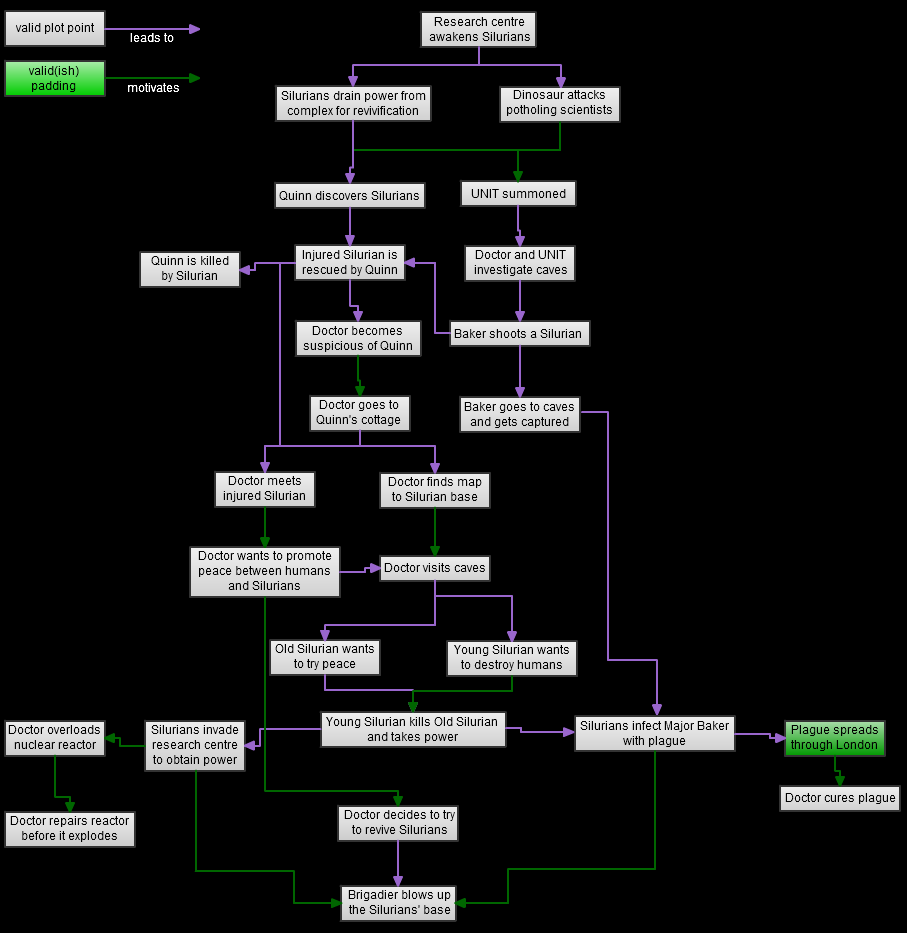
What's obviously left out of this chart? Well, for starters, most of the research centre scenes. Its only real plot function is to provide a catalyst to wake up the Silurians, and a power source for them to tap into. Otherwise it could just as well have been an ice-cream parlor. This renders most scenes involving Lawrence, Meredith and Dawson redundant, given that their scenes mostly involve arguments of the sort I mentioned above, or pointless control-room scenes. The same could be said of Marsters, since the threat that he might shut down the centre never amounts to anything, nor does he ever reach the Minister to report on the presence of the Silurians. He does carry the plague to London, but as I indicated in the chart above, the entire plague sequence is basically filler since it's completely forgotten about the moment that Liz phones in the Doctor's cure, and there are apparently no lasting effects. The entire farm sequence is likewise unnecessary; it perhaps puts the Doctor in the right place for his suspicions about Quinn to unfold, but otherwise it's just a waystation for the Silurian on its way to Quinn's, and a chance to put Liz in peril (her up-close look at the Silurian doesn't seem to help, short of confirming the Doctor's suspicions). Then we have the strange scenes of the UNIT troops trapped in the caves; there's no explanation given for how the Silurians are able to move cave walls to fence them in, so it smacks of convenience. Once they're set free, they beeline straight back to the research centre, without having fulfilled their original mission of making contact with the Silurians (or whatever it was they went down there to do). Then we have a whole episode devoted to the Doctor experimenting to find a cure, which is great for those of us who enjoy watching the scientific method in action, but probably deadly dull for those who don't. And when he's abducted, the cliffhanger is even more tense because we know every second counts if UNIT is going to stop the plague; but the impact is deflated when all Liz has to do is rifle through his papers for a few minutes and she finds it fully copied out (which is odd because, first, it's all balled up, so you would think she'd assume it was one of the Doctor's dead ends [maybe it got crumpled in his hand when the Silurians eye-beamed him?], and second, she only has to glance at it to instantly know it's the strain they gave the ambulance driver). Finally, and most obviously, we watch the Doctor using a magic potion to fix Bessie for the sole unnecessary purpose of having him stopped on the hillside when the bombs start going off. Presumably this was meant as a way to keep the Doctor in the area long enough to witness the Brigadier's attacks, but it looks like the Doctor's only just broken down when the explosions start, so the Brigadier couldn't have waited that long before setting them off.
We also get locations being visited multiple times, in an apparent attempt to stretch the plot out. The Doctor climbs down into the caves seven times (the first time, he sees a dinosaur; the second time, he brings UNIT back, and they injure a Silurian; the third time, he and Liz find the Silurian base; the fourth time, he tries to warn the Silurians that the Brigadier is bring an armed party to the caves; the fifth time, he's dragged back by the Young Silurian; and the sixth time, he goes back to check on the Silurians, and is saved from the Young Silurian by the Brigadier). That's almost one visit per episode. Then we have Quinn's cottage, which does serve a useful plot function — it enables Quinn to sequester one of the Silurians in a "secret" place away from the research centre — but the very fact that it is so far from the centre means that characters keep having to drive miles back and forth between the two locations any time they need to interact. This starts to look rather silly when there's more traffic at Quinn's cottage than there is at the research centre.
| episode 2: | Quinn apparently goes home after meeting with the Silurians. |
| episode 3: | Dawson arrives, to update Quinn about the Silurians. Quinn (and presumably Dawson) leaves. Quinn returns with the injured Silurian. The Doctor arrives, to investigate, then leaves. Dawson arrives again, to let Quinn know the Doctor was searching his office, and leaves again. The Doctor arrives again, to try to win Quinn's trust. |
| episode 4: | The Silurian and the Doctor leave. Dawson apparently visits, finds Quinn's dead body, and leaves. |
In only the second story of his tenure, Pertwee is great. Between his entreaties to the Silurians to extend the hand of friendship to humankind, and his railing against the narrow military mind and bureaucratic pomposity, he comes across as a very practical, humanitarian crusader who's just trying to make sure the right thing gets done. For example, the Doctor is very cautious about revealing the Silurians' existence to the Brigadier, fearing that he'll go off half-cocked and start an interspecies war. He's also irreverent, to-the-point, and rather charming when he wants to be. The Doctor is open-minded and clear-headed enough to realize that if there is a second species of life in the caves, it might not be hostile. He devises a clever plan to send the reactor critical so that it overloads the Silurians' disperser and sends them scuttling back to their caves to hibernate, and I love that he's so determined to see peace win out that he's going to try reviving the Silurians one at a time until he succeeds. And, it must be said, wearing just a T-shirt, Pertwee gets to show off how surprisingly fit he is at 50! Among his great moments: "What a charming place!" as he forces his way into Quinn's cottage; the hilarious moment when Quinn catches him spying around the cottage, and the Doctor gives him a friendly little wave through the window; "Unless you Silurians tell us what you want, the humans will destroy you!"; and "Yes, well, I've got no time to chat to undersecretaries, permanent or otherwise."
Perhaps part of the reason that I find Pertwee so likeable in season 7 is that he's bouncing off Caroline John, who already seems so confident as Liz and makes a really great counterpoint to his Doctor. It's really hard to put my finger on exactly why, but I just find Liz to be a really unique companion. Maybe it's the fact that she's more mature as a character than the Doctor's usual companions, so she doesn't run around screaming and cowering behind the Doctor, but I think it's due more to her rather quirky blend of personality characteristics. As a scientist with multiple degrees, Liz is obviously a highly intelligent woman, but counter to the stereotype, she's got perfectly good social skills and doesn't seem to have an attitude about her smarts, although by the same token, she's certainly near-impossible to intimidate. Going hand-in-hand with that confidence is the fact that she's always poised and professional, the very model of a successful career woman. Impressively, this professional intelligent scientist also has a strong sense of humor, which actually seems mostly to manifest in her being snarky at people who she thinks are deserving of it. And, on top of it all, she's in touch with her humanity, and her feminine side — rather than being a detached academic, she's a warm and friendly human being (behind the stern front she puts up at the first sign of trouble) who likes to let her hair down and wear totally impractical miniskirts. It's a pretty beguiling set of traits and it makes Liz seem like a really complex woman... I just wail and gnash my teeth that she only wound up with four stories in which to develop. Thinking about it, it occurs to me that her nearest analogue in the companion roster is probably the first Romana, with whom she shares a cool façade and an academic mindset, although Liz is by far the more mischievous of the two. Perhaps the reason that she works so well with the third Doctor is that their relationship is more like colleagues who share a great deal of mutual respect, rather than the uncle/niece relationship that he develops with Jo and, to an extent, Sarah; the nature of their relationship means that he can't (and indeed wouldn't) patronize Liz the way he does to poor clumsy Jo. With the Brigadier, she not only forcefully stands up for herself, but she also ends up explaining scientific concepts to him, which is a lovely reversal of their usual hierarchy.
John also gets some rather nice costumes — I'm particularly fond of her green jacket — and I love her hairstyle in this story, mostly because it's the only really flattering (and naturalistic) one that she gets; the bun in Spearhead from Space is rather severe, and the next two stories give her an overly-fluffy bob. At the start of part 2, Caroline John somehow manages to look gorgeous with her hair mussed up, full of hay, and blood smudged on her face. But I'm not just looking at her, I'm also listening to her, and she has some absolutely fantastic line readings that really demonstrate what a great actress she is: "Better, thanks. Head aches a bit, though.", "Doctor, it attacked me!", "I know all about your different biochemistry, but we don't know if it makes you immune.", "Yes, of course!" when the Brigadier asks her to "stay here", and "No!" when the Doctor asks if she knew the Brigadier's plans. Her reaction upon touching the hot door outside the Silurians' base is great, and I like that she's the only person who immediately obeys the Doctor when he tells everyone to move away from Major Baker, as well as her annoyed hand-wringing when Lawrence refuses to admit the existence of the Silurian epidemic. Thanks to her fascinating character and her many great line deliveries, I have to say that I find Caroline John to be pretty mesmerizing whenever she's onscreen. In fact, she's a very definite highlight of the story, and one of the few actors who really stands out. So it's a good thing she's able to make the most of the airtime she's given, because to my great distress, The Silurians under-utilizes her terribly. Hence, I must take a closer look at her story arc by episode, with purple representing the plot points where she actually gets to do something relatively useful. (You may notice, as you peruse my reviews, that I seem to have a particular need to do one of these analyses during the Pertwee years...)
| episode 1: | Persuade the Doctor to go to Wenley Moor. Investigate personnel problems at the research centre. Have sudden headache. Interview Dr Meredith. Examine personnel files and post-mortem report. |
| episode 2: | Be left out of spelunking expedition. Watch the Doctor look at some blood. Examine some hay. Get slapped by a Silurian. |
| episode 3: | Recover from slap. Notice Quinn's detour. Chat with Baker. Help search Quinn's office, but find nothing. |
| episode 4: | Chat with the Brigadier and the Doctor. Explore the caves and Silurian base with the Doctor. Return to research centre and chillax. |
| episode 5: | Be evasive about the Doctor's whereabouts. |
| episode 6: | Administer antibiotics to staff off-screen. Fetch blood sample. Take notes while Doctor does science. Suggest potential research direction. Help the Doctor test his cure. |
| episode 7: | Answer telephone calls. Track down the Doctor's formula. Help the Doctor overload the reactor. Go for a drive with the Doctor. |
It could be worse — I mean, at least she does pretty well out of episodes 1 and 6 — but in 2 through 5, she might as well not be there for all the contribution she's allowed to make, and even in 1 and 6, she's onscreen a lot doing proactive-sounding things, but she really never gets to advance the plot in any meaningful way. I mean, if you've got a great regular character, why not write them a really juicy plotline that plays to the character's strengths, instead of just paying lip-service to their talents and shunting them off into a marginal plotline where they do little more than spin their wheels? There's no fun in writing for Generic Companion; it's so much more interesting for the writer, and rewarding for the audience, to utilize their character to the full. This happened a lot more regularly once we reached the eras of Leela, Romana and Ace, where the characters evidently screamed out to be written for, and I'd point out that Pip and Jane Baker strove valiantly to do the same for the companions in their stories, as well. But here, it just seems like a crime to have such a superb fascinating companion and not make the most of her, particularly when her tenure with the series turns out to be so brief. It also makes me suspect that the lion's share of the credit for Liz being such a well-rounded character belongs to Caroline John's performance rather than the way Liz was scripted.
At this point we're still in the early stages of the friendship between the Doctor and the Brigadier, and their relationship is clearly spiky, thanks to the Brigadier wielding his UNIT authority to rein in the Doctor's habit of taking charge and doing whatever he pleases. Working for a paramilitary organization is clearly not at all the Doctor's cup of tea, but you have to assume that he enjoys the challenges it presents him with, not to mention the resources to tinker with the TARDIS in his spare time. (Having said that, there's a lot of contempt for the military mind in this story.) Courtney does get one particularly nice moment, when the Brigadier quietly goes behind the Doctor's back to blow up the Silurians' caves, knowing full well that the Doctor's going to be furious but not particularly caring. One can only imagine the blazing row they had, the next time they met. However, aside from that moment, the Brigadier doesn't really get much to do, a problem that I think affects most of his Doctor Who stories, and perhaps part of the reason that I'm not all that fond of the character, even though I love Nick Courtney to pieces. Here, he's an instrument for exposition when the Doctor and Liz show up at the research centre; he verbally spars with Lawrence, Baker, Meredith, Hart, a tabloid reporter and even Liz; he keeps the Doctor on a tight leash; he orchestrates UNIT's actions; and he leads raiding parties (to the caves twice, and to Squire's farm). Otherwise, the biggest contributions he makes to the plot are his bullheadedness in believing the Silurians to be hostile, which leads to him blowing up their base, and his off-screen quarantining of the hospital. Compensating for his relatively minor role in the plot, Courtney manages to give a variety of interesting line readings for his fairly standard dialogue, and I like his subtle smile after "Uh, Doctor, I suggest you start by just looking round."
And now we get to the guest characters. Of these, I come away from this story with respect for two: Fulton Mackay as Dr Quinn, and Dave Carter as the Old Silurian. In both cases, it's probably because they're interesting characters who are, on the whole, morally good, and played by talented actors who can deliver the lines naturally. Quinn, in particular, immediately comes off as the most likeable of the research centre staff. He's talkative, good-natured and has a sense of humor... and, as we soon discover, he's hiding a secret. While we're initially led to suspect that this secret makes him a villain, it actually just pitches him into a moral grey area. On one hand, he's trying to befriend the Silurians; on the other hand, he wants to use the injured Silurian as leverage to pump his species for information, which Quinn plans to pawn off as "his" scientific discoveries. Fulton Mackay gives an appealing performance as Quinn, even when we're not quite sure if we're supposed to like him as much as we do. I particularly like his delivery of "What do you mean? Eh? What do you mean?", in which all pretense of innocent friendliness suddenly flies out the window. Meanwhile, Dave Carter's Old Silurian represents the voice of reason of the Silurian tribe. He's wary of mankind (and with good reason), but he's willing to listen to the Doctor and try making overtures of friendship and cooperation. He's tolerant, wise and rational, in contrast to the Young Silurian's hotheadedness, and it makes him a character we can root for. I must also give an honorable mention to Geoffrey Palmer as Masters, who is introduced as yet another character at odds with UNIT (and even with Lawrence), and should therefore be the nastiest guy around, yet Palmer's performance makes him likeable. Masters is, in fact, one of the most fair-minded people at the centre, even keeping a relatively open mind when Lawrence tells him that the Doctor believes in monsters, despite the Doctor's shocking rudeness to him at their first meeting. It's just a pity that his main contribution to the plot is spreading the plague to London. Really, he gets automatic points just for being Geoffrey Palmer; I'd even forgotten he was in this story, so it was a pleasant surprise to see him. (And if this story had aired in the following season, his character would have had a completely different name.)
Aside from those two or three performances, there's not a lot of greatness on display. Among the research centre staff, we've got Peter Miles as head honcho Dr Lawrence, and while Miles will go on to play a similarly dislikeable character in Tom Baker's first season, Nyder has the advantage of also being amoral and therefore scary, whereas Lawrence is just a jerk who refuses to believe anything that doesn't fit his idea of how the world should work, no matter how much evidence is stacked against his opinion. Even after the Silurian bacteria has killed Baker, he maintains that it doesn't exist, and he persists in believing it to be a conspiracy even when he himself is covered in plague boils! What would it take for him to finally admit that the Doctor is right? If he got any kind of character growth, I might like him more, but for the entire duration of the story, he resents UNIT's presence, is openly hostile to UNIT even as he claims to be willing to help them in any way possible, tries to undermine the Brigadier and the Doctor, and in general makes as much of a nuisance of himself as he possibly can. You would think if his career were on the line, he'd be a little more open to alternative possibilities! Although the intention seems to be for him to represent your average flawed (self-important) human being, he comes across as a thinly-veiled villain, and Miles delivers every line with an unpleasant, annoyed, patronizing tone. He does at least get a great death scene. Dr Meredith (Ian Cunningham) isn't much better; he doesn't seem to care one whit for the Doctor and Liz' opinions, and seems to want to oppose them merely on principle, even going so far as to ignore Liz' warnings about the virulence of the Silurians' plague. You'd think that any doctor worth his salt would know better! I was really confused about Major Baker (Norman Jones), who I eventually decided must be a member of UNIT rather than the research centre, after I started to wonder why he had a military title and why he was going potholing with a gun. But no, he's just the security chief of the centre, and initially he seems even more hostile than Lawrence. He never really develops into an interesting character, and before long he's been plagued to death. Miss Dawson, in my opinion, suffers from a less-than-believable performance by Thomasine Heiner, who never seems to be quite fully committed to the role. For example, Dawson continues to ponder spilling all her secrets to the Doctor for a full 3 seconds after the Brigadier barges in and interrupts them, which is almost a full second after the Doctor shushes him. And, poor thing, Dawson could have been completely excised from the plot without it making one iota of difference. Heiner and Mackay both have pausing problems during their first scene together in Quinn's cottage (for example, Mackay's line "It must've come up from the cave opening and made its... way straight to the farm."). Speaking of Dawson and Quinn, one nice facet of Dawson's character is that you get the impression that her devotion to Quinn is rooted in more than just professional concern. The way she's his trusted confidante who keeps his secrets, covers for him at work, mourns his death with sadness and fury, and... has a key to his cottage... well, it's almost undeniable, although pleasantly it's never made explicit.
We've also got several supporting characters among the centre staff. Spencer is relegated to a fairly minor role, but John Newman does put in a nice performance, conveying his terror and slightly-insane behavior. Roberts likewise gets little to do, mostly shoving Dawson to the floor, but Roy Branigan plays him well enough. Davis (Bill Matthews) gets all of 4 words ("Nothing." and yelling "Spencer!" 3 times); needless to say, it's difficult to evaluate Matthews' performance. Finally, there's Travis (Ian Talbot), who appears out of nowhere, doing Dawson's job (even Masters asks "Where's Miss Dawson? Isn't this her shift?"), and disappears after one scene. Heiner evidently wasn't ill that day, because Dawson appears later on in part 4, so it would seem that Travis was part of the script from the beginning. For his one scene, Talbot does a nice job, but the character is so short-lived and the scene itself isn't even necessary; its only function is to let us know that Masters has arrived, but as Masters himself promptly walks right into the scene, I don't see why we couldn't have just skipped Travis' setup and started with Lawrence greeting Masters.
On the UNIT side, we have Captain Hawkins, played by the genre-famous Paul Darrow, who gets saddled with more of the same boring military dialogue that tends to afflict the Brigadier. Having not yet made a name for himself, nor learned how to entertainingly chew the scenery, Darrow gives a very understated performance here, which is good but (owing largely to the way Hawkins is scripted) not really memorable. Sergeant Hart (Richard Steele) gets a total of 10 lines in part 4 (9 of which include, and two of which consist entirely of, the word "sir") and another 3 in part 6 before getting offed by a Silurian. He does get one moment that makes me think of him as "likeable", as he helps Baker off with his coat, but aside from that, there isn't much that can be said. Private Robins (Harry Swift) suffers much the same fate as Spencer, spending his limited onscreen time acting like he's off his rocker, but doing a convincing job of it. Private Wright (Derek Politt) is set up to look like a comedy character, with his gum-snapping and the "ha ha silly" incidental music, but he only gets 3 lines (two of which are identical) and one scream before his swift demise by Silurian third eye. Finally, there's Corporal Nutting (Alan Mason), whose blink-and-you'll-miss-him mostly consists of him answering the Brigadier's questions about the plan to bury the Silurian base. Why so many disposable characters, Mister Scriptwriter???
Aside from the Old Silurian, we meet two other members of his race: the Young Silurian (Nigel Johns) and the Silurian Scientist (Pat Gorman). Personally, I always find the Young Silurian to be annoying. I appreciate the idea of having a hotheaded xenophobic revolutionary youngster among the aliens; most alien races seem to be represented by characters who appear to be in their late 30s and up, so it's nice to see a character who's probably just graduated from Silurian university and thinks he can, literally, change the world. But Johns' vocal performance just gets under my skin; he doesn't sound youthful, he just sounds hyper and kind of silly... and at times, I've suddenly realized, distinctly American, in a Peri sort of way. (A perfect example is the line "But they were carrying weapons, like this one! They can no longer harm us!") Even the dialogue doesn't make him seem young, just impetuous and inclined to overreacting. There are old people like that too! (Having criticized the Young Silurian's voice, I also feel compelled to point out that the Old Silurian occasionally sounds like Cookie Monster, particularly on the line "But now they will send others!" This is not in any way bad. Although I would like it even more if he had said "Nom nom nom" at least once.)
The other incidental characters include the Squires, played by Gordon Richardson and Nancie Jackson, who really only get one scene each and don't make that much of an impression.
Caves, in my opinion, are almost always a very good element in Doctor Who stories. Think Earthshock, The Green Death, The Caves of Androzani, The Creature from the Pit, Death to the Daleks, Frontios, and to a lesser degree The Abominable Snowmen and Snakedance. (Ignore Revenge of the Cybermen, Underworld and Mindwarp, please.) They invariably have scary monsters hiding in them, and either way the atmosphere is just creepy. The Silurians scores on both counts. In general, the Silurian base sets are nice, and I particularly like the design of the cell; as in the upcoming Mara stories, the cell is angled, which provides for some interesting shots. There's a nice paint job used to indicate a burned-looking patch on the research centre wall after the Silurians rebuild it.
I can't say I was really wowed by Timothy Combe's direction. When the off-duty scientists are attacked in the caves, the camera gets way too close to them, and has to swing around wildly to follow them as Davis falls over and particularly when Spencer runs away. The same problem occurs in episode 6, as plague victims drop dead to the ground far too fast for the close-up camerawork to follow them. There's an odd cross-fade from the Doctor and Liz in the garage to a shot of them driving through town in Bessie. The shots of people falling dead all over London, however, are shocking and horrifying, and there's a nice shot of the Doctor and Liz sitting sadly in Bessie as the hillside explodes in the distance. And I do really like the Silurian eye-view shots, which perhaps also fall under the category of "special effects".
There actually aren't a lot of other effects to speak of, although the dinosaur is the obvious one. I'd say it's just okaaaaay... it's not terribly convincing, but then it's not as horrifically unconvincing as the dinosaurs we'll be getting in another four years. The monitor in the Silurian base is a decent effect. (These are, apparently, the first uses of CSO in the series... oh joy? At least they're not over-pushing their boundaries, yet.) The makeup on the plague victims is great; Baker's wrist looks genuinely horrific. And the Silurians themselves are really well-designed, particularly their distinctive round mouths and their cool red third eye. The Silurian voices are well done, distinct and alien-sounding but easy to understand. The sound used to indicate the forcefield over a doorway is really convincing (and Pertwee helps to sell it with his very accomplished miming), and their summoning device has a neat musical chime.
And then we have Carey Blyton's incidental music. It's memorable, I'll give him that. As his first Doctor Who commission, I suppose he wanted to do something different from the norm, and admittedly it makes an interesting companion piece with the electronic Sea Devils score... but I just can't warm up to a honking, squawking kazoo. At times, the kazoo is joined by what sounds like a plonking xylophone, and the sound effect that accompanies people knocking on doors in childrens' TV shows. There's also some strange jaunty music as the Doctor and Liz drive through the countryside, the music gets overly dramatic when all we have is a shot of Quinn standing in the caves, and there's a particularly atonal segment as Robins is trying to contact the UNIT base.
I seem to have a odd love-hate relationship with Malcolm Hulke. On one hand, I find his scripts often have a great moral, and they wrestle with complex issues; but on the other hand, they often come across as lengthy and dull, particularly during the Pertwee years. And, indeed, The Silurians is a prime example of both these tendencies. He's generally pretty good with dialogue, but there are some right clunkers in the script too (like the Old Silurian's line "I gave you no orders to do this!"). There are, however, some things that I particularly like which are (I suspect) his influence alone. There's a nice bit of scripting as the Brigadier explains UNIT's remit... it really makes The Silurians feel like the second episode of a brand-new TV show. For all I've complained about his script-padding, there are also moments (such as the Doctor's decision to investigate the caves in the first place, and his subsequent unexpected return) that are scripted with maximum efficiency. He's quite good at cliffhangers, particularly episodes 1 (as the Silurian sneaks up behind Liz, although I think it would've been more effective if it had cut the moment that the Silurian grabbed her face), 3 (the zoom into a reveal of the Silurian), 5 ("He's dead?" "Yes, the first one.") and 6 (the Doctor is abducted before he can deliver the cure). And the ending of the story is certainly one of the all-time classics; even in the abridged Programme Guide descriptions, it made an impact.
Minor points:
Doctor: "My dear Miss Shaw, I never report myself anywhere, particularly not forthwith!"
Liz: "Or we could visit the caves!"
Doctor: "Caves? What caves?"
Liz: "Well, that part of the country's famous for them."
Doctor: "Oh!"
Liz: (encouragingly) "Mm!"
Doctor: "Is it?"
Liz: "It is!"
Brigadier: "Now, the Doctor here — what is it, Doctor?"
Lawrence: "You are not proposing to dismantle a piece of equipment worth 15 million pounds with a screwdriver?!"
Doctor: "It's not worth 15 million pins if it doesn't work, is it?"
Meredith: "I take it you're yet another member of the UNIT team?"
Doctor: "Yes. Depressing, isn't it?"
Doctor: "Well, it was certainly some kind of dinosaur. Certainly nothing that I've ever seen before, though."
Baker: "In museums, you mean?"
Doctor: "No, I do not mean in museums! ...Well, on second thoughts, perhaps... perhaps I do, yeah."
Liz: "Have you never heard of female emancipation?"
Doctor: "Liz. This time, I think he's right." (smiles at her patronizingly)
Oh yeah? Care to back that up with an actual reason, Doctor? (It probably would've been something like "Caves are no place for a girl." Harrumph.)
As for the summoning device, I like the way that the tempo speeds up when a Silurian approaches (or is it the Silurian? Do these devices work on any Silurian that happens to be nearby, or are they keyed to something like an individual DNA pattern?). Although there is a moment in part 4 where the summoner momentarily stops, and when it re-starts, it keeps the same (relatively slow) tempo even when the Silurian is almost on top of the Doctor.
Doctor: (re: Mrs Squire) "She was found in the barn, paralyzed with fear. She may have seen something."
Dawson: "What discoveries?! You — they haven't told you anything yet!"
Liz: "Why, why, why didn't you... tell the Brigadier?"
Old Silurian: "You must answer our questions."
Baker: "I am not refusing, am I?"
Old Silurian: "Is your species the only intelligent lifeform?"
Baker: "Only intelligent lifeform? Oh, I see what you mean. Yes, of course we are."
Young Silurian: "You were carrying a simple projectile weapon. Do all your species carry these weapons?"
Baker: "Of course not! Only soldiers."
Young Silurian: "What other weapons do your soldiers carry?"
Baker: "I refuse to answer that sort of question!"
Old Silurian: "You must answer!"
Baker: "You will - can do what you like, I will not tell you anything. I will not tell you anything!"
Doctor: "A small planet? Yes, of course! Well, don't you see, that small planet was drawn into the Earth's orbit and became the moon. Your catastrophe never happened!"
Aside from that annoying old "yes, of course!" thing — which I really ought to be counting for this site too! — I must take issue with the Doctor saying "Well, don't you see?" What, does he think the Silurians are dense? They've been underground for millennia, and asleep up until very recently. Aside from the injured Silurian who took shelter with Quinn, there's no indication that any of them have been aboveground since they awoke, so how would they even know about the moon's existence?
Liz: "Did it hurt?"
Doctor: "Did what hurt?"
Liz: (holds up syringe)
Doctor: "Ooh yes, it was agony."
Liz: "Have you considered the addition of A37 in the presence of Z19 might well be effective?"
With The Silurians, I find that I like the idea of the story much more than the execution. The basic concept is so brilliant, but it's just not translating to the screen as well as it could, despite an engaging performance by the two leads. On the upside, the existence of more Silurian bases means that Doctor Who can always give it another shot. (On the downside, the classic series did attempt it twice more, with diminishing returns.) Ultimately, though, even though I'm still not going to be putting The Silurians on a pedestal anytime soon, I do feel that I've begun to appreciate its merits more than I used to. It may be seven overpadded episodes, but it's seven overpadded episodes with a great nuanced morality play at its heart.