Holistic Review: It takes its sweet time getting there, but the Atlantis segments are really fun, and the central concept of the story is a fascinating addition to Doctor Who mythology.
The Time Monster comes under a lot of fire from fandom. It also happens to be one of those rare Pertwee stories that, as a child, I actually looked forward to watching. Out of his entire tenure, I'd say there were probably only six or seven that I really liked, and The Time Monster was probably in my top two. Even the presence of the Master didn't put me off it, because — if you'd asked me to describe it in a word — the word I would have used was "fun". There's a sense of jolly lighthearted adventure to The Time Monster that many other Pertwee stories, with their action sequences and serious messages and dawdling pace, seem to lack. Or at least, that's how I would have interpreted it as a child. Looking at the story through a reviewer's lens, well... it tends to highlight flaws that I'd never noticed. It's safe to say that I've revised my opinion somewhat, but I still think The Time Monster is one of the more entertaining stories of the era.
Apparently my six-year-old self was really fascinated with the Atlantis segment of the story, because that's what prompts my most vivid memories. I always was fascinated with Poseidon / Neptune and subaquatic mythology, no doubt because at that age I was a massive fan of Aquaman, who of course ruled undersea Atlantis and wielded a trident. So it's not a stretch to imagine why I would've been most engrossed by the ancient Cretan elements of the story, including most especially the trident-wielding guards. On this viewing, I was surprised to realize that Atlantis is only the setting of the final two episodes, ish. I was under the impression that the majority of the story was set there, but this is indeed not the case; they just pack a lot of event into those two parts.
No, for the first three-plus-change episodes, we're actually stuck in the Newton Institute, where the Master is conducting research into his pet teleportation project, the risibly-named TOMTIT. This plot thread yields some great moments, namely the teleportation experiments, and Kronos appearing in the lab like an enraged bee trapped in a jar. The concept, too, is very clever; Ruth explains it with an extremely clear and comprehensible molecule/bead analogy, which also helps to illustrate the frightening prospect that creatures living outside time could use TOMTIT to slip through into our reality.
However, three episodes is really more time with TOMTIT than we need. Where the teleportation-experiment thread fails to engage is in two areas.
First, it's far too padded, particularly during the relatively-uneventful parts two and three, although to give it some credit, the padding is less obvious than in certain other stories. I found myself frustrated because, in order to move the story on to more interesting things, the Master needs to succeed in his experiments and find a way to Atlantis. This ought to be relatively straightforward, since the Master is an engineering genius and nobody at UNIT has the faintest clue he's even there. Unfortunately, the story feels the need to postpone this plot advancement.
Mind you, there's an opportunity for some delightful French-farce-style comedy in the setup of the UNIT men making a surprise appearance at the Master's dull business lunch — can anybody else imagine the Master showing up in a Lucy Ricardo style disguise of a kerchief and extra-long fake nose, which he accidentally sets on fire while attempting to discreetly light his cigar? — but, perhaps wisely for its reputation, the story decides not to be quite that outright comedic. Instead, rather than show his face to UNIT over a lunch of pheasant, the Master cleverly (if boringly) disguises himself as a radiation lab technician. So far so good, but rather than quietly playing along until the UNIT officers go away, the Master not-at-all suspiciously overloads the machine while screaming out for some dude named "Kronos" to "come!" which only makes him look unhinged. Of course, it also calls a tiny bit of unwanted attention to him, and his project. So, between UNIT turning up, the Master rubbing his evil plans in their face, and the Doctor sussing out the Master's involvement with TOMTIT in record time, the Master is forced to go into hiding, sort of. After vanishing before he can even see if his attempt to summon a soldier-devouring chronovore was successful, the Master is then forced to lie low for an entire episode, until he can get back to the lab and finish his calculations.
For ages, it appears as though the Doctor is just as bad. Rather than confronting the Master before his experiments are complete, the Doctor seems to purposefully stay out of his way, dilly-dallying around with time-flow analogues rather than marching straight into the Master's lab. It's not until part four that we finally learn that the Doctor was worried about TOMTIT's time field, and required his TARDIS in order to approach the Master. But it's not even clear what danger the time field poses. Stu seems to think it'll turn him into an old man again if he dares go near the Master's lab, but from what we see, the worst that'll happen is that it'll slow them down when they get close.
The second issue that I take with the TOMTIT thread is that it features an unfortunately high proportion of project-maintenance dialogue. While TOMTIT and its effect on the ambient flow of time are interesting, I could have done without so many scenes like this:
Gobbledegook like that may eventually result in an exciting scene, like TOMTIT overloading and throwing time out of whack, but it's so meaningless that it makes it difficult to get engaged in the plot. Still, at least the technobabble is consistent across these scenes.
While the plot isn't so riddled with holes that it becomes infuriating, there are a few thorny issues (ranging from minor to major) that really muddle the plot:
Happily, the story really starts to look up after part three. Finally events begin to move forward, rather than staying in hover mode, and part four benefits by the addition of TARDIS intrigue, which is always welcome, and by limiting the cast to primarily the regulars. I'd forgotten that The Time Monster did TARDIS-recursion well before Logopolis, yet it's portrayed in a virtually identical way, which is pleasing to my obsessive fan heart.
The switch to an Atlantean setting makes parts five and six particularly rivetting. The legend of Atlantis offers a broad canvas for the show to explore, and I really like that the result mixes genuine Minoan culture with legend and myth. It makes the setting feel exotic and realistic, yet appropriately fantastical. Not only does the story become more engrossing in the last two episodes, but it wraps up in a way that doesn't feel at all contrived. The time ram, which has already been signposted back in part four, provides a clever solution for destroying the crystal of Kronos, and the scene leading up to it, in which the Doctor threatens to go through with his time-ram, is very tense. Destroying the crystal naturally frees Kronos, whose gratitude toward the Doctor and Jo leads to an interesting moral dilemma involving the Master's fate.
It's also perhaps worth mentioning that, at least during the Atlantis scenes, The Time Monster turns into one of Doctor Who's sexiest stories ever. Between Queen Galleia heaving her décolletage at every attractive male in sight, and Hippias (not to mention all the other Atlantean lads) striding around bare-chested wearing little more than a loincloth, there's a lot of skin on display for a children's television show. Even innocent little Jo wears a daring low-cut dress, while gallant Sergeant Benton has a scene of implied full nudity! Nor is the adult nature of the story limited to the costumes (or lack thereof). Galleia all but admits that she and Hippias have been intimate in the past, presumably while she was still married to Dalios.
The story's unabashed sexuality does, however, dovetail in often-problematic ways with one of its major themes: feminism. Jo has always been a strong advocate of women's lib, but it must be admitted that because of the way the character's scripted, she's never going to be the poster child for "women are just as smart and just as capable as men". She's gutsy and enthusiastic, but perhaps a bit too ditzy and clumsy to convince any misogynists who weren't paying attention to Liz Shaw, or Zoe, or Polly, or Vicki, or Barbara. So in The Time Monster, a year before Sarah Jane Smith storms on screen, we're introduced to equally-outspoken Dr Ruth Ingram. Even though Doctor Who has featured numerous feminist characters in the past, change was clearly in the air, and the series was ready for its first self-proclaimed women's liberation activist. Unfortunately, Ruth — like early Sarah — goes a bit overboard. She makes her point beautifully in two or three particular exchanges, but beyond that, she continues to pursue the topic so doggedly, in a one-note ranting kind of way, that she risks becoming unsympathetic. Still, I can handle being bashed over the head with a topic that someone is passionate about, particularly when I share the same passion. The real trouble comes when Ruth's lecturing turns into blanket, exceptionless man-bashing, the worst characteristic displayed by stereotypical feminists. While it's fantastic to have a character who not only advocates feminism but confronts misogyny head-on, my opinion has always been that it's difficult to ask for respect when you don't give it yourself. Or, to put it another way, you can't vilify people for being sexist when you're being sexist too. I came away from my last viewing of The Time Monster with the impression that Ruth belittled men non-stop. In actuality, her dialogue isn't quite so bad — we've got the gender-insult "That man!" at 04:14; "Men! It's their conceit that bugs me." at 10:43; "You know, Stuart, for a so-called member of the dominant sex, you are being remarkably feeble." at 1:17:22; and "Oh, why are you men so spineless!" at 1:17:52 — but that's still four anti-male jibes that didn't need to be there. Surely if you're trying to persuade the audience that women's lib is a worthy ideology, you don't want them to walk away from your story thinking "gosh, that crazy feminist was unbearable."
Even weirder, Ruth's double standards extend beyond her own bouts of sexism. For a start, she's quick to snap at obviously patronizing remarks like the Master's, but she seems quite happy to be patronized in slightly less obvious ways, as when she takes no objection to Stu praising her with the phrase "That's my girl!" Surely if one is offensive, the other should be too? Ruth also walks smack into the unflattering female stereotype of crying at minimal provocation, and using it as emotional leverage ("Look, don't bully me, Stu, or I think I'll burst into tears."). Worst of all, she's a complete hypocrite: not only does she engage in anti-male sexism, she spouts misogynistic dialogue right along with the men she claims to disdain. First she unapologetically accuses Benton and Stu of "standing about moaning like a couple of old women!" and later tells Benton to "just stand there and look pretty." So it's okay if you're the one saying it, eh, Ruth? The take-home message is, if you're going to write a character who stands up for inequality, it's critical to make sure that they're sympathetic and that they have integrity. Otherwise, it makes the audience wonder whether the writers are really supportive of the issue, or if they're just paying it lip service while actually undermining it.
Then we have Queen Galleia, who is an extremely independent Greek woman. Her version of feminism, despite living in ancient times, is much less abrasive than Ruth's. When the Master insists that she needs to learn to obey him, she simply refuses to submit. Not only does she have power through her marriage to the King, she's also a sexually liberated woman, and has apparently had several lovers before and after marrying Dalios. This isn't as shocking as it would have been in Ian and Barbara's time — we've had the swinging sixties and free love since then — so it shouldn't reflect poorly on Galleia that she's in control of her own sexuality. Unfortunately, though, Galleia is portrayed as mostly-wicked, narcissistic and selfish, since her disloyalty to Dalios — partly motivated, of course, by her obviously insatiable lust — leads directly to the downfall of Atlantis. She's not content with just one lover, and her man-hungry nature is matched only by her hunger for power, which prompts her to ally herself with the Master. This alliance ultimately gets Dalios killed, at which point we finally see a more caring side of Galleia, but by then it's too little too late. If the implied moral message of Galleia's story is any indication, The Time Monster seems to be yet another in the long line of TV and film examples of a woman being punished for her interest in sex. In a story that claims to be promoting women's lib, it's a shame that neither of the main female guest stars — nor, arguably, Jo — are unequivocally positive feminist role models, free from character deficiencies that might erode their credibility with (or relatability to) a potentially skeptical audience.
Kronos, at least, subverts this trend somewhat, when the creature turns out to be "a girl!" whose mercy is as heartfelt as her vengefulness, and who grants wishes with liberal interpretations as well as any genie. She is enslaved to the crystal and coveted by corrupt men like the Master, but she's also one of the most powerful beings in the universe. Sure, she could be interpreted as evil or cruel, but that's attributable to her entirely alien nature rather than any "feminine" characteristics, and her inclination toward merit-based justice balances out her harsher side considerably. Is she a superb feminist role model? Perhaps not, but she does effectively hammer home the point that power, and the ability to wield it effectively and fairly, is not exclusive to the male domain.
I've often had my issues with the third Doctor, but in The Time Monster, he's great. Perhaps due in part to the lighthearted nature of the story, he maintains his sense of humor throughout, and he and Jo have, on the whole, a lovely rapport. Still, there are a couple of exceptions that I have to grumble about first. I'm not entirely happy with the scene in which Jo demonstrates that the Doctor often lets her conversation go in one ear and out the other, partly because Jo makes light of it even though it's actually quite a serious issue. Then, when Jo tries to get the Doctor's attention, he tells her that he's "busy" until he finds out that Mike has brought over something he himself asked for. To me, all of this dismissive behavior signals a lack of respect for Jo on the Doctor's part. Still, he does voluntarily give Jo a sandwich in part 3, which helps to make up for the Sea Devils fiasco, but it is perhaps of significance that the Doctor himself wasn't hungry at the time. Thereafter, though, he's on top form. To his credit, despite his treatment of Jo, the Doctor is one of the only people who doesn't belittle or patronize Dr Ingram. One of his most Doctorish moments is his construction of the frankly adorable time-flow analogue, in an attempt to remotely jam the Master's temporal-manipulation equipment. Adding tea leaves to the device, although deeply silly, is literally the crowning touch. What else would be integral to the Doctor's version of Gallifreyan technology, if not tea leaves? The story's temporal shenanigans give the Doctor some lovely moments to shine; along with the previous example, his Time Lord nature proves useful when TOMTIT freezes Jo (and others) in time, but the Doctor remains unaffected. I also adore the fact that he can put aside his personal grudges (and, you know, the safety of the universe) and ask Kronos to release his archenemy. It's heartwarming, even though it probably shouldn't be! The story about his rivalry with the Master, ruining one another's time experiments, is an engaging peek into their shared history. And, speaking of history, there's a tantalizing hint about "the blackest day" of the Doctor's life up to that point. I'm just dying to know what it is. Pertwee gets a fun moment of action, all the more rewarding because they're so rare in this story, when the Doctor steals Krasis' key and snaps a guard's trident in half. I love Pertwee's delivery of "Yes, I know.", and I'm floored by how well Pertwee mimicks backwards speech. If you played it forward again, I have a feeling you'd get something relatively normal-sounding!
Poor Jo, though, as is so often the case, is completely wasted during the first three episodes of the story. Not only does she do absolutely nothing of consequence, she also utters the horrific line "Look, I know I'm exceedingly dim, but would you mind explaining?" Goodness gracious, Jo, there's no need to denigrate yourself like that. Especially since Jo does successfully deduce the purpose of the Doctor's time sensor, so clearly she's got good deductive skills even if she's not all that book-smart. In the latter half, though, she sparkles. How the Doctor thought he could talk her out of a potential trip to Atlantis, I've no idea, but Jo demonstrates in this scene how strong-minded she is. Likewise, it's fantastic to watch her stand up to the Master after she thinks he's killed the Doctor. Despite her gaffes with informal language and overly-familiar greetings, Jo manages to win over almost everyone she meets in Atlantis, and uses this to her advantage when she spies on the Master and Galleia's conversation, and solicits Lakis' help. She takes the initiative to follow Krasis and Hippias, and once in the labyrinth, Jo is resilient, darting through the maze and keeping away from the minotaur without once screaming. Her escapology background gets brought up again, even though it proves to be no match for Atlantean chains. Against the Master, she's formidable, first launching herself at him in an attempt to keep him away from Kronos and his TARDIS (I was sure it was a murderous Galleia jumping on him, not Jo!) and her willingness to sacrifice herself for the greater good, yet again, makes it clear that selflessness is one of Jo's most defining character traits, which makes her a most excellent role model for the kids. Her innocence, too, is endearing, as she assumes that she and the Doctor have died and gone to heaven. Sartorially, I appreciate what they were trying to do with Jo's yellow-trimmed brown dress — the front panel, with its stripes of green triangles, lends it some visual interest — but it's just ugly. I'm on the fence about her Atlantean wig, too, which is ornate and gives her a very different look, but it also looks awfully heavy. However, her yellow calf-length boots rock. As for Katy Manning, she gives a superb performance throughout, never giving less than 100%. Her enthusiastic, naturalistic line deliveries help Jo come across as loveable, well-meaning and determined. Jo may not be the poster child for feminism, but she's its strongest ambassador in this story.
A highlight of the story, as often seems to be the case in Doctor Who, is the Doctor and Jo's quiet heart-to-heart conversation in their cell. It's just magical to watch the Doctor open up to Jo, and relate a very personal story from his childhood, which he very rarely discusses with anyone, in a successful attempt to cheer her up. For her part, Jo is a wonderful listener, hanging on the Doctor's every word and warmly encouraging him. And occasionally teasing him, which is cute. Both actors deliver the scene beautifully, and along with giving us a charming glimpse into the Doctor's life and personality, it helps to remind the audience just how fond the Doctor is of Jo, even though he occasionally patronizes her. Pertwee's delivery of "It was the daisiest daisy I'd ever seen!" is rightfully legendary.
It's no secret that, in most Pertwee stories, I typically find the Master to be a detriment rather than an asset. However, The Time Monster is most definitely an exception. For once, the Master has hit upon a scheme that really seems worthy of a Time Lord. Sure, he's still trying to ally himself with an evil power that seems as likely to destroy him as obey him — apparently he still hasn't learned his lesson from the Nestenes, the Keller Machine, Axos or Azal — but in order to access Kronos' power, he has to skilfully penetrate time, and that's something that most Doctor Who villains just can't do.
Even better, this story really plays to Roger Delgado's strengths, particularly in parts five and six. He's always made the Master more interesting than the character was on paper, but in The Time Monster, he gets a chance to show off his range. The word most often associated with Delgado's Master is "charming", and in no story is that more apparent than The Time Monster. His seduction of Galleia is virtuosic, as he convinces her purely through his words and ideas, with no resorting to hypnotism at all. Another of the Master's rare talents on display is vocal modulaton; he's adept at perfectly mimicking the Brigadier's voice, and nearly fools Benton with his attempt. Along with his impersonation of lighthearted Professor Thascales, and his good-natured teasing of Ruth, the Master almost becomes a likeable comic figure at times. However, the story never forgets his darker side. The Master displays wicked delight as he gloats about Percival being such a good hypnotic subject, and his absolute glee when he thinks the Doctor has finally been destroyed is utterly genuine and, perhaps surprisingly, not dampened in the slightest by any regret. It's clear, too, that in his pursuit of Kronos, he's blithely unconcerned about the repercussions to humanity, individually or collectively. Roger Delgado's performance in the story is flawless, milking nuance out of every line without ever going over the top. His reaction when he finds the Doctor alive is a believable mixture of surprise and exasperation. Love Delgado's performance of the sarcastic line "Oh, fortunate Atlantis, to be blessed with such a courageous high priest.", and the pitiful way the Master grovels for his life before Kronos.
It's a very good story for Sergeant Benton (John Levene), who gets to be UNIT's "man on the scene", thereby giving him a great opportunity to get the best of the Master. Benton is shown to be not only affable, but possessed of more smarts than the Doctor usually gives the military credit for. The fact that Ruth's explanation of TOMTIT is remarkably clear doesn't detract from the fact that Benton immediately understands it. All too often, characters are written to be dense in order to facilitate exposition, so it's well within the realm of possibility for Benton to have been given a line like Jo's "exceedingly dim" remark, and I find it very gratifying that he wasn't. He gets to demonstrate his cleverness again by not only realizing that the Master is trying to pull a fast one on him (how perfect that the Master makes the mistake of calling him "my dear fellow", and that Benton catches the gaffe), but then turning the tables on the Master by capturing him! And his scheme would have worked, too, if it hadn't been for that meddling Stu. (Although how long he would've been able to hold the Master is a matter for debate. He really should have called for backup immediately after the Master telephoned him.) Although his regression to infancy is played for laughs, it's actually quite a frightening moment when we realize what TOMTIT has done to him. I love that Benton's reaction to the Doctor asking if there's been any trouble in the lab is "I've been a bit lonely, but that's all." What an adorable guy.
Sadly, the Brigadier (Nicholas Courtney) doesn't get to be as quick on the mental draw as Benton is. Ruth's simple explanation of TOMTIT sails right over his head, and he hits on the right answer for Stuart's aging, but only by accident. It is, however, wonderful to watch him take charge of the situation, and so calmly assert his authority over Dr Cook.
Thank goodness, Ruth (Wanda Moore) does have some strong moments of genuine female empowerment. For one thing, even if her academic research job wasn't enough of a clue, she's clearly smart and perfectly capable of operating TOMTIT without the Master's supervision. I was cheering her on when she took the Master to task for patronizingly reassuring her that "There is no need for you to worry your pretty little head" about doing a trial run before meeting with the grants committee. (And then Stu, who really should know better, has the audacity to roll his eyes and say "Here we go!" rather than backing her up, as any sensible equality-minded person would do!) Stuart Hyde (Ian Collier) fits the "sarcastic graduate student" character type perfectly, but he's just so much fun. I love the scene of him dancing excitedly with Ruth, until he spots "Professor Thascales" in the doorway and self-consciously stops. He's an entertaining, witty character, and as much as he tries to wind Ruth up, it's clear that he respects her as an intellectual mentor. I like Collier's delivery of "No." when Ruth asks Stu if he's willing to take the risk of being exposed to radiation.
After my own experiences in graduate school, I found myself really warming to Dr Percival (John Wyse), who agrees with fandom that the Master should have chosen some other acronym, any other acronym, than TOMTIT. Plus, he's done his academic homework and attempted to verify the Master's CV, an important step which has gotten several US universities in trouble recently when they failed to do so for their recent hires. Up until the Master turns him into a mesmerized lapdog, it's clear that Percival, as perceptive and dogged as he is, could've been a real threat to the Master's plans.
The Atlantean cast is largely impressive. I was bowled over by George Cormack as wise, intelligent King Dalios, who gives a thoroughly naturalistic performance. Dalios is one of those rulers whom you trust implicitly, and aside from being trustworthy and loveable, he's also a very interesting character. His stories of being alive for over five hundred years are practically begging for followup, and his confrontation with the Master demonstrates that even though he's an easygoing ruler, he's become shrewd and strong-minded during his many years on Earth. I love that Dalios is wily enough to be unswayed by the Master's attempts at hypnotism. It's just a shame that his mental prowess makes him a threat! I was so hoping that he'd survive Kronos' rampage to reclaim his throne and restore order to Atlantis, so it was a shock when the cell guard dealt him a fatal glancing blow to the neck.
Queen Galleia has a pet kitty cat. I like her! Although I feel I really shouldn't, given the way she gleefully throws her ex-lover Hippias to the minotaur. She does, at least, attempt to protect Dalios, so she's not totally self-obsessed. Even though she sorta-accidentally betrays him, it's clear that Galleia truly does care about Dalios. The scene in which she learns of Dalios' death, and attempts to attack the Master in her fury, is a powerful one. Ingrid Pitt's performance is fascinating; it's understated, which is probably for the best when your clothing really isn't, and she delivers her lines in a most ethereal way. Plus she has a great ancient-Greek hairstyle.
Hunky Hippias may have his looks going for him, but even as a child, I knew that Aidan Murphy's performance was not the strongest. His eyes seem completely devoid of emotion, and there's not much nuance to his delivery. A good example is the line "Dalios, will you have me believe you are... [over 500 years old?]" which he ends, not with hesitation, but with finality, as if "you are!" is the end of Hippias' thought. (I'm reminded of how annoyed I used to get, in high school performances, that nobody seemed to realize that an interruption meant you were actually supposed to talk over one another. If I was the one being interrupted, I had to plan out at least five or six more words off-script just to be sure there wasn't a pause, because the other person would never deliver their line when they were supposed to. Naturalistic delivery, people! Naturalistic!) As a child, I remember being very sad when Hippias was killed, but as an adult, I didn't warm to the character at all, so I wasn't really sorry to see him go. Krasis (Donald Eccles), likewise, isn't the most interesting character, even though he copes surprisingly well with being pulled into a state-of-the-art laboratory in the twentieth century. I do love his floaty gold-edged robes. And although the character is a bit of a wet blanket, Eccles knows how to deliver a line with interesting stress patterns, like "Most Venerable, I have seen him! I have seen the mighty one!" Lakis (Susan Penhaligon), on the other hand, is an entertaining character. Despite being Galleia's handmaiden, she seems sweet and obedient, and as such she's a good foil for Jo, who can coax her into breaking the rules when it's really important.
The Minotaur makes for an excellent second-tier monster, and it's portrayed as quite frightening, the way it slowly stalks the maze with evidently-deadly intentions. It's given a great origin story that handily explains not only its existence, but also Dalios' great age. Back in the days when Doctor Who was a fringe TV show in the US, I found it very helpful to be able to entice friends by pointing out that the minotaur was played by Dave Prowse, aka Darth Vader (despite the fact that I never was a Star Wars fan myself). Not that it did much good in convincing them to watch, but hey, street cred is street cred.
One of my favorite elements of The Time Monster is the introduction of the titular Chronovores. I realize now that they appeal to me for one of the same reasons that HP Lovecraft does: the idea of an unknowably alien creature that lives outside our universe, trying to force its way in and consume people (or, to be more precise, to consume their remaining lifespan). It's a chilling concept that adds a lot of weight to the story, and beefs up Doctor Who mythology in interesting ways. In keeping with the way The Time Monster explores different facets of many of the main characters, we're also shown the different aspects of Kronos, although I'm surprised that a chronovore has any interest in being a healer or a creator! Nevertheless, it seems to flip from one to the other almost on a whim, granting the Doctor any wish his heart desires in the same breath as it anticipates torturing the Master for all eternity. Clearly it's simply an unpredictable force for chaos. As such, Kronos enlivens events whenever she shows up.
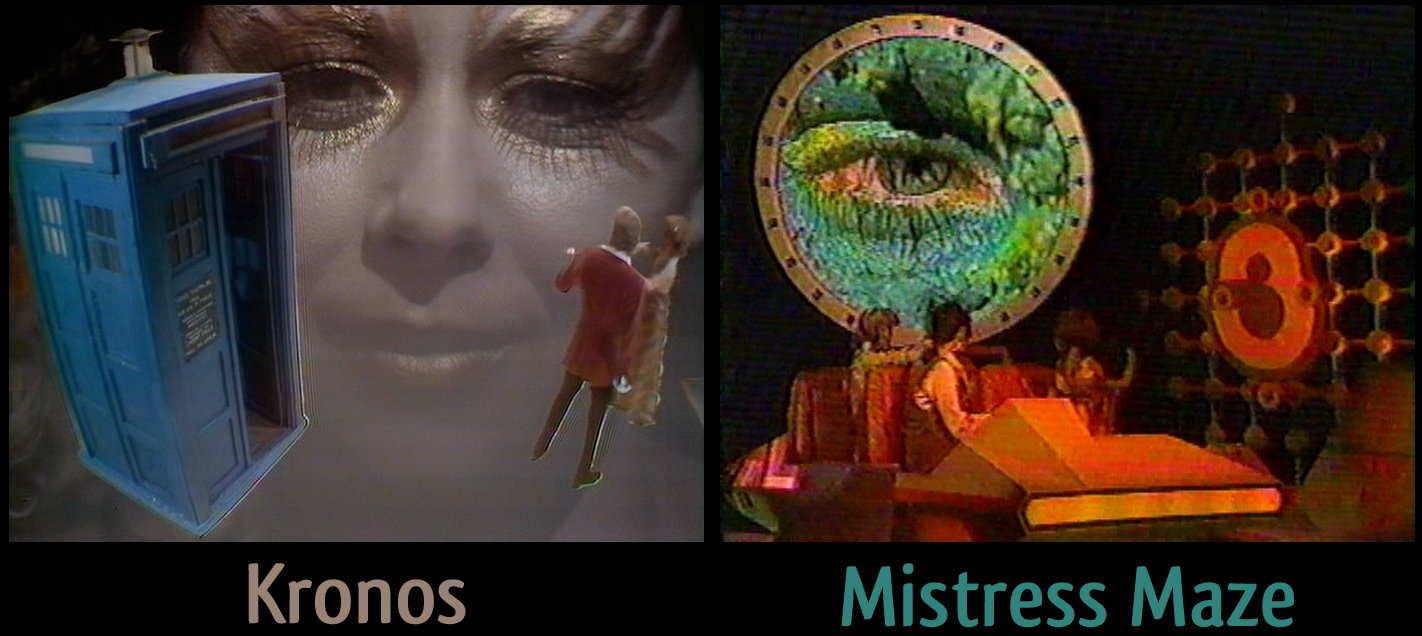
While we're on the subject of Kronos, The Time Monster has occasionally received a lashing from fans on the strength (or lack thereof) of its effects. I believe the word most often associated with Kronos is "budgie". While my adult mind can reluctantly admit that, yes, they do face an uphill battle in attempting to make the costume look menacing as it flaps around the lab ceiling, my childhood nostalgia means that I love it nevertheless. There's something about the costume that I do find scary. I think it's a combination of the beautiful graceful body with the angular, helmet-like head. On the whole, I think the costume's limitations are successfully overcome, particularly the way it glows (which makes it look unearthly, and helps to hide any perceived deficiencies in the costume) and the way it's generally kept to the top of the frame, swooping in and out of the screen from just out of sight, like a circling ravenous buzzard. These brief glimpses make it look much more formidable than the full-length shots of Kronos flapping its wings. Ingrid Bower is enjoyably flippant as Kronos, particularly on the line "You asked for him to be given his freedom. He has it!"
The other effects are, likewise, a bit of a mixed bag. The vase-thing that Ruth and Stuart use for testing TOMTIT looks great as it starts to materialize, up until the camera decides to pan away and the materializing outline wants to go with it. The old-age makeup on Ian Collier actually looks quite good, even in close-ups, although he's oddly unwrinkled for a man of 80. It's really that shock of white hair that sells the idea. The TARDIS separation effect is excellent, but is almost immediately followed up by a badly locked-off dissolve as the Doctor reappears in the console room. Even the walls shift position! The crazy CSO background in Kronos' realm is peculiar, but oddly fitting, and I love the unusual effect of Jo fading out as she crosses between TARDISes. As a child, I remember thinking that Kronos' giant head was creepy, probably because she reminded me of the heavily made-up woman from Read All About It episode 1.18 (1980) that I mentioned in my reviews of The Web Planet and The Mind Robber. (Apparently that show had a huge effect on my childhood too!) On the downside, the Master's CSO watch is laudably Bond-like in concept but dreadful in execution.
Director Paul Bernard has some real highs and some real lows. I really like his transition to Atlantis in part two, and the way he films these scenes through a light-scattering lens (or spray) makes them look ethereal and mysterious. There's an unusual overhead shot of Jo walking around the TARDIS console in part five (which also reveals a suspicious-looking wire leading from the console back to a join between the walls). The zoom into Jo's frightened face makes the cliffhanger to part five even more dramatic. There are quite a few clever shots in The Time Monster involving things that move really quickly (ie, Bessie parking in front of the Newton Institute) or things that move really slowly (ie, everyone under TOMTIT's influence). Bernard does a great job of creating a time-differential effect in the shot of the Doctor overtaking a slo-mo running Ruth. On the downside, the shot framing sometimes takes you right back to the 60s. As the dreaming Doctor sits up on his chaise longue, the camera zooms in too quickly and then has trouble finding him again. A similar problem besets the shot of old-Stuart bolting upright in bed to scream "Kronos!", and the camera has to rocket around to find him. He also makes the odd decision, as the UNIT men are returning from lunch, to open the shot with a racking focus on a thrilling and relevant... hanging globe lamp. But the missteps are few, and always in the service of pursuing a dramatic or visually interesting shot, so I commend him for taking risks and choosing the creative, kinetic route.
Dudley Simpson's incidental music is good, if not outstanding. The one moment I noticed was the cheesy nautical sting, as the Doctor and Jo salute one another in the TARDIS.
Set design in the story is stunning, even in the segments that aren't set in Atlantis. I really dig the central spiral staircase in the Doctor's UNIT lab. The Master's lab at the Newton Institute is a fairly unadorned research area, but the island in the center gives the camera some flexibility in composing shots, and I really like that the radiation area is slightly raised, which gives the set some visual interest. The beautiful Atlantis sets are appropriately adorned with Cretan motifs, like the double-headed (or, in this case, quadruple-headed!) axe, and the bull's horns ornamentation atop sacred buildings. There's a great background painting in the set of Dalios' rooms, featuring one of those bull-horned buildings, which really helps to sell the idea that the Doctor and Jo have landed in Atlantis. The only exception is the new TARDIS set, which for understandable reasons never appeared again. Still, props to them for trying something different, even if it is horribly ugly. (I was amused by the ambiguous wording of this sentence in the Wikipedia entry for The Time Monster: "Producer Barry Letts was unhappy with the redesign, and the set was damaged shortly after recording on this particular serial wrapped." Mhm, anything you wanna tell us, Barry?) I do, at least, like the lighted metal sculpture on the Master's central column, the interesting design choice to have the roundels double as scanner screens or frosted windows around the door, and the way the Master's TARDIS door swings shut. Again, thumbs up for creativity!
Props designers, though. Really? Of all the possible design choices for the Doctor's "TARDIS sniffer-outer", you had to put the lewdest possible one into a story that already contained TOMTIT and a bevy of near-naked Atlanteans? When the sensor at the end starts to spin, it's almost too much! I'm half-surprised the Master didn't disguise himself as Benny Hill.
Minor points:
Doctor: "Thank you, I enjoyed that."
Ruth: "Simmer down, Stu, for Pete's sake."
Ruth: "I'm perfectly capable of constructing a simple circuit, Professor."
Master: "I am sure that you are equally capable of devouring a tough pheasant on my behalf."
Yates: "And, er, when, sir? I mean, how soon? Over."
Brigadier: "Oh, the usual, Captain Yates, about ten minutes ago."
Doctor: "Right, Jo, I want you to keep a close eye on this. As soon as you see the slightest reaction, you let me know."
Jo: "Ooh. Ooh, I think I've bruised my tailbone."
Doctor: "Sorry about your coccyx, Jo, but these little things are sent to try us."
Jo: "My what?!"
Master: "Once he realizes that he's talking to himself, he'll be out here like a shot."
Jo: "But that's... that's the most cruel, the most wicked thing I ever heard!"
Master: "Thank you, my dear!"
Dalios: "Tell me then, what of great Poseidon? What did he have for breakfast? Fish, I suppose."
Doctor: "Can't think of anything to say?"
Jo: "How about, 'Curses, foiled again!' ?"
Dalios: "Who are you?"
Doctor: "This is Jo. Jo Grant, your majesty."
Dalios: "You are welcome, Jojo Grant."
Jo: "Look, I'll be as quiet as a — do they have mice in Atlantis?"
Lakis: "Yes."
Jo: "Well, that's what I'll be as quiet as! An Atlantean mouse. Okay?"
The TOMTIT segments are long and drawn out, and the women's-lib message is sadly more grating than convincing, but the last two episodes are enthralling, and it has a sense of fun that many other Pertwee stories lack. Thanks to Kronos, the Atlantis scenes, the Master's entertaining portrayal, and the touching scenes between the Doctor and Jo, The Time Monster gets more and more engrossing as it develops, with an ending that's rewarding and satisfying.