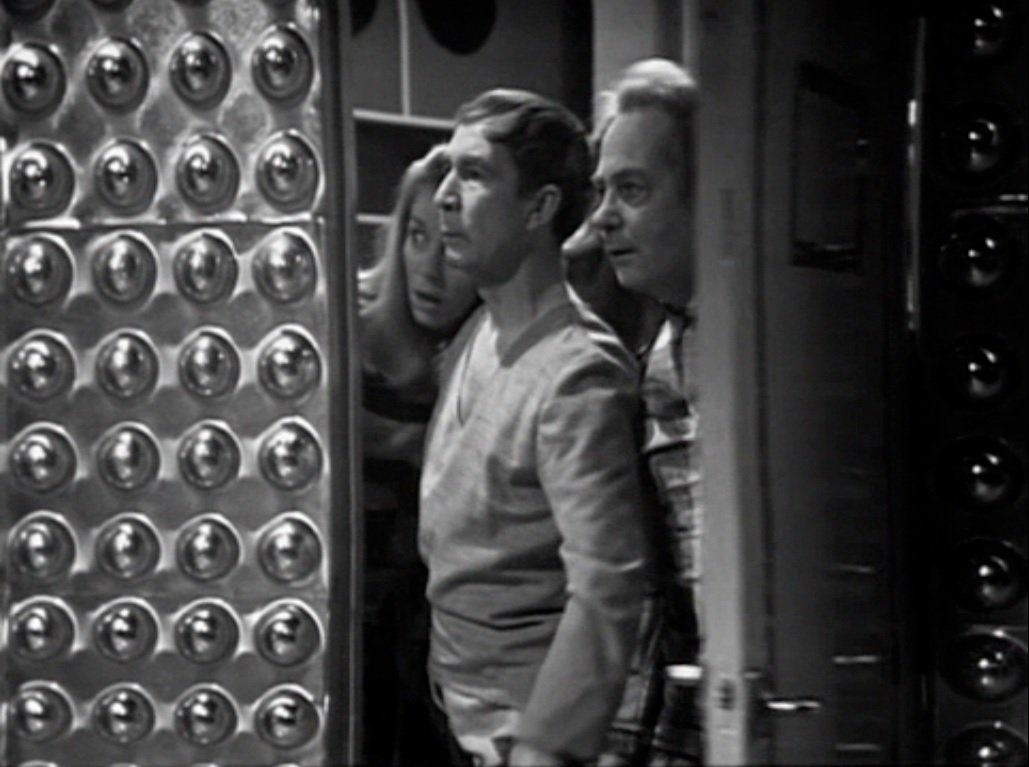
Holistic Review: Steady tension, engrossing action sequences and a dual role for Patrick Troughton are hobbled by an excess of plot conveniences and an overshadowed villain.
I can't quite believe that I'm actually getting to review The Enemy of the World. Someone pinch me! Back when I reviewed Tomb of the Cybermen in 2005, I expressed my regret that I hadn't really fully grasped the magnitude of its return in 1991: "I'm sorry that I didn't appreciate it enough at the time, and pretty please, could we have another one back so I can do it right this time?" Well, this time I did it right.
Rumors, of course, had been going around about a haul of missing episodes since June 2013. The number bandied about at the time was 90 rather than 9, so my brain went into overdrive imagining the reappearance of nearly every missing story ever. So while it appears that we've "only" received nine missing episodes (...NINE MISSING EPISODES!!!), it's impossible to be upset. Having two stories returned simultaneously is pure bliss.
In an unbelievably perfect coincidence, my cousin Gray and I had already planned a visit for the second week in October. He arrived on October 13, a mere 3 days after the rediscovered episodes were announced and made available on iTunes, so we waited until we were together that evening to dive in and enjoy the story together.
For me, this is a new experience: I've only ever reviewed brand-new stories and classic stories that I've seen, in most cases, dozens of times. This is totally different: a classic story that I've never seen, and barely experienced in any medium. Oh, sure, I've watched episode 3 a few times, and I've read the novelization and the transcript, but I don't think I've ever even listened to the whole story (although I do have the recent "Lost Stories" CD release, which is now delightfully redundant). So, for me, this is a strange cross between reviewing a classic story that I know well and a brand-new story that I've never seen. It's almost too cool for words. But I'll be using a lot of them anyway.
At this point, I feel the need for a disclaimer: The Enemy of the World has never been one of my favorite stories, or one of my most-missed. (My top-three most-wanted missing stories, if you're curious, are The Macra Terror, Fury from the Deep and The Celestial Toymaker. The day one of those three gets returned, I will hit the roof.) However, just because the novelization and episode 3 didn't make a huge impact on me when I was younger doesn't necessarily mean that I'm going to feel the same way when I finally get to see the story in its entirety. So I was really curious to see how I'd re-evaluate it, after — seriously, pinch me! — actually having the opportunity to watch it.
I was somewhat surprised to find that, putting aside the euphoria of getting to watch a brand-new/old story, my reaction to The Enemy of the World was more or less the same as what I had expected, based on my childhood impressions. I like it, but it's never going to make my echelon of all-time favorites.
The Enemy of the World has always been cited as the lone monster-free story in the Monster Season, but what makes it stand out even further is the fact that it's also one of the relatively rare Doctor Who stories that pushes the boundaries of the show's typical genre trappings. For a non-historical story, there are very few science-fiction elements, aside from Salamander's hinted-at (but never really seen) Catastroph-o-Matic machine and various background details, like the rapid global transit system and the sun store. The story is perhaps best described as a villain-centric futuristic thriller, which alone isn't that unusual, but it also fits squarely into the mold of jet-setting international mystery, espionage and explosive action-adventure. At the time, and even today, this was a very uncommon style for the show to emulate, although with hindsight it's easy to think of The Enemy of the World as even more of a prototype for the Pertwee years than The Invasion, the Troughton story on which that particular credit is usually bestowed. It's a particularly apt comparison when you consider the number of gadgets in the story (a hovercraft, a helicopter, and an underground shuttle), which I'm sure was very impressive at the time, although in retrospect, it rather pales by comparison to the numerous impressive gadgets of the Pertwee years (though it's probably the only story until Planet of the Spiders to pack quite so many high-tech vehicles into its runtime). While a political spy thriller does make for an attention-grabbing shake-up from the show's usual format, my tepid reaction to action-adventure plots probably explains in large part my lack of enthusiasm for The Enemy of the World.
For an action-adventure story, it's mostly successful. The first three episodes are jam-packed with pulse-pounding action sequences, while the story as a whole contains lots of risky subterfuge, chases, fights, and explosions. The story's aim is clearly to keep you on the edge of your seat, and it succeeds well enough that it nearly stops you from realizing when the plot isn't quite holding together. But we'll get into that issue later.
Fittingly for a globe-trotting epic, the story is very multicultural. Not only is the action divided between Australia and Hungary, both rare settings for a Doctor Who story, but a high percentage of characters are non-English, some even speaking a first language other than English. It was a clever idea to have Salamander hail from Mexico, and the actors in the Eastern European Zone all sound authentic to my untrained ear. Unfortunately though, in the rest of the story, the multiculturality of the characters doesn't quite filter down to the actors' accents, which dilutes the effect somewhat. Surprisingly, in the Australasian Zone, only Anton (Henry Stamper) actually has an Australian accent. Kent mostly sounds semi-American (at times I thought I heard a slight hint of an Australian accent that comes and goes, but after rewatching, I think I only heard it because I was expecting to! Although apparently Kerr really is Australian, so what do I know?), whereas Astrid is plainly English, as are all of the shelter inhabitants, who were presumably flown to Kanowa from the UK specifically for Kent and Salamander's "endurance test". You could almost excuse it away, until the moment that the very English Griffin moans "Why did I ever leave Woolloomooloo?" Was he meant to be Australian, despite the complete lack of an appropriate accent? His character isn't even one of the Australasian Zone gang. What, are we meant to believe that Griff moved from England to Australia before being recruited by Salamander to work for him in Hungary? (Maybe Salamander hired him to travel with the team as his personal chef?) All in all, it gives you the impression that Salamander is surrounding himself with an unlikely number of Brits for no logical reason. I begin to suspect some apathy on the part of the casting team.
More problematic is the fact that The Enemy of the World was designed to be a showcase for Troughton, enabling him to play both the Doctor and power-mad dictator Salamander, but rather than taking full advantage of the opportunities this scenario provides, Whitaker's script seems hesitant to let these two characters mingle in one another's world until the last possible moment. In the meantime, the script strives to keep them completely apart. The Doctor's resemblance to Salamander embroils the TARDIS crew in the plot, but thereafter — aside from a brief attempt to fool Bruce in episode 2 — their physical similarity has next to no impact on the plot, except that it forces the Doctor to stay sidelined and in hiding, while Salamander goes about his business like normal. I could understand if the Doctor needed to wait until Salamander were isolated and unreachable before impersonating him, to lessen the chance that his deception would be uncovered, but they never explain what motivates the Doctor to wait outside the research centre for so long, if that's the one place where he thinks he can get proof either way as to Salamander's intentions. (And what makes him think that this is the best place to get the truth about Salamander, anyway?) Given the way the Doctor witters on for nearly four episodes about requiring proof of Salamander's misdeeds, I expected to see him stride into the research centre without delay, and use his Salamander-accent, along with a healthy amount of bluffing, to gain access to all manner of confidential information. Instead, the Doctor twiddles his thumbs until part five, and when he finally takes action, he only manages to bluff Benik (out of panicked necessity) and Kent (premeditatedly, for once) for a few minutes each. Mind you, he completely manages to bluff me too, when the Doctor unexpectedly appears in the records room posing as Salamander. Once this plot element finally comes to fruition, it really enlivens the last episode and a half. The ending is rather alarming, if you don't realize that it's actually Salamander who's somehow found the TARDIS, as the Doctor appears to be in terrible health. But, given that the entire story is structured around this close resemblance, it feels like it should have been brought into play earlier and more often. (Can you imagine if Buffy's "Doppelgängland" had involved Willow hiding in the school library from her evil vampire self until the last ten minutes?!)
From an acting perspective, though, this plot element was a great decision. Since we're missing so many of Troughton's stories, it's a delight to have the one story restored in which he plays a duplicate role. The Doctor and Salamander are very different people, not only in how much they like to murder the innocent, but also in their backgrounds. They appear to share a love of science, but Salamander has apparently gotten drunk on the power that world-saveage confers. Salamander could have been yet another Englishman, so his Mexican background is a breath of fresh air. Not only does it make him unique among Doctor Who villains, it also enables Troughton to immerse himself in a role which is all the more different from the Doctor. The only downside is that the Doctor and Salamander are quite similar in temperament, so even though their accents, dialogue and likelihood of pratfalling differ greatly, Troughton's delivery does not.
Still, I can't even express how amazing it is to have additional episodes of Patrick Troughton as the Doctor. Like many fans, I've always felt that his episodes suffered the most from being missing, because Troughton's physicality always enlivens his performance. I actually laughed out loud, like Jamie, at the sight of the Doctor suddenly flinging his clothes aside in order to run into the sea in his long johns, then frolicking around and flopping backwards under the waves. So cute! His Doctor really gets to indulge his childish side more than most; I can't even imagine Tom Baker performing this scene. Maybe Matt Smith! Alas, overall this is a fairly serious story for the Doctor, so Troughton doesn't get as many opportunities for hilarity as he does in, say, The Mind Robber. Still, that beach scene alone pretty much makes up for it. The Doctor's absolute refusal to condone any form of violence gives him some very strong scenes in this story, as in the extremely Doctorish moment when he hands the guard's gun over to Bruce. Among my favorite Troughton moments: "Come on, run. No, don't argue. Run. Come on. Come on!", his polite but suspicious smile when he refuses Astrid's offer with "I don't think so, Miss Ferrier.", his attempt to puzzle out Salamander's accent, "But that's ridiculous! I couldn't possibly do that!" and "Oh, I'm afraid it is!"; his delivery, as the-Doctor-posing-as-Salamander, of "Sometimes I like to deal with matters in my own way." and "That's interesting, but not important."; and his delivery, as Salamander, of "Lies... truth... who knows? But we won't like to put them to the test, will we, huh?", his 'weary' performance after returning from the surface, and "Because I am right and you are wrong!"
Almost as exciting as having additional Troughton episodes is the knowledge that we now have two complete stories featuring Victoria Waterfield. Overall, The Enemy of the World shows off her character well. Mercifully, Victoria seems to have recovered from The Ice Warriors, after spending practically the entirety of that story in a perpetual state of near-hysteria. There are a handful of lines in this story on which Watling's voice again threatens to quaver into the upper registers, mostly when they've just fled for their lives from trigger-happy hovercraft men ("But why would they want to harm us?" and "Well, at least we're safe now, aren't we?"). And she does have a couple of moments that make you want to shake some sense into her. Victoria's response when Astrid tells them to run — "I can't! I can't!" — is infuriatingly annoying, when the alternative is certain death. (If she doesn't trust Astrid, fine, but she appears to be petrified simply because she doesn't know what a helicopter is!) And you could argue that she's perhaps a bit incompetent not to notice Fedorin palming the salt shaker that he then claims she's left behind in the kitchen. But these are rare isolated moments, and on the whole, Victoria is more composed, more useful, and far more difficult to intimidate than in certain previous adventures. I love the scene in part 5 in which plucky Victoria isn't frightened in the slightest by the man she believes to be Salamander, and gives him an earful, before attempting to physically assault him! She's endearingly chipper in part 3, as she attempts to impress Griff and win Fariah over. I especially liked Watling's eager delivery of "Oh, and take him to the Doctor? He'd believe Dénes."
The sad thing is that both companions, Victoria in particular, are dreadfully under-utilized. Victoria remains on the periphery of the action until episode 3 — which, as it turns out, was one of the best episodes of the story to judge her from anyway — at which point her work in the kitchens helps to gain Fariah's confidence. After that brief moment of glory, both she and Jamie get rendered unconscious for an episode and a half, until 13:54 into part 5. They enjoy a brief resurgence of plot centrality until 5:26 in part 6 (and a brief reappearance up to 9:37), at which point they're packed off to the TARDIS, not appearing again until the very end of the story.
Frazer Hines, at least, is given lots of heroic action moments. Jamie attacks Curly from the hovercraft and renders him completely unconscious, later knocks out one of Benik's guards, and even launches himself at Salamander. His efforts to 'save' Salamander's life are a definite high point for the character; the way he calmly takes control of the situation makes him seem extremely confident and capable. So does the way he coolly stands up to Benik by telling him "Aye, well, for all the answers he's gonna get, he might as well have just left us there." and, later, enrages Benik by pointing out "You'll get nowhere by shouting." Jamie's knowledge of tactics comes to the fore as he infiltrates Salamander's Hungarian palace and offers a knowledgeable critique of his guard complement. The Enemy of the World doesn't overlook his brains, either, as Jamie immediately realizes that Salamander's sun store works along the same lines as the ionizer. Jamie plays the hero rescuer very cleverly, even appealing to Salamander's ego ("Without you, the Earth hasn't much of a chance, has it?"), and he's smart to refuse Salamander's offer initially ("You owe me nothing. ... And I am on holiday.") which makes his involvement in the incident look that much less suspicious. Nor does the story forget his unique outlook as a native of the eighteenth century. I'm so used to seeing Jamie in his later adventures with Zoe, by which point he's become a seasoned time traveller, that it's lovely to see him at a more naive time, when the hovercraft causes him to react with disbelief and Victoria with mild fright. His spy-mode doesn't always engage properly, though, which perhaps should come as no surprise, given how often he nearly blurts out secrets that the Doctor doesn't want him to tell. In part two, Astrid is very careful not to be obvious about talking to Jamie and Victoria, but Jamie keeps turning to her and addressing her directly... grrr! And speaking of character tendencies, Frazer Hines throws in a couple of subtle hints that Jamie appears to be falling for Astrid's charms. Jamie's the first to want to believe that she's on their side, and he grins at her like a mook when he sits next to her on the bench, much to Victoria's apparent exasperation when she notices. Love his delivery of "Ah, well, I'm here on holiday with a friend, er... she's very pretty, so the guard didn't see me slip past him."; "Redhead. Is that your wife?"; and Jamie's surprise that the Doctor is actually asking him to fly the TARDIS.
When I first read the novelization of this story, Fariah was my favorite character, and seeing it 'live' has not changed my opinion in the slightest. Carmen Munroe delivers a great performance, imbuing Fariah with confidence and a rather wicked sense of humor. Lamentably, classic Doctor Who's track record was not always so great with actors of color. When the series tried for diverse or color-blind casting, they often seemed to have difficulty finding talented actors to fill the parts. So, in this case, it feels really great to be able to say, yes, Doctor Who cast a black actress in a part that didn't require a black actress, and yes, she's so fantastic that you wonder why the series didn't do it more often. Again, it's regrettable that the story's only black character also happens to be one of Salamander's servants, but then most of the people we see in this story are in Salamander's employ, so at least she's not unique in that position. Even better, Fariah, with her close access to Salamander, seems to have a degree of freedom that the others lack. I love how fiery she is, completely dedicated to her job by all outward appearances, but seething with buried hatred toward Salamander. I'm really curious to know more about Fariah's background. She speaks Spanish, Salamander says she came to him because she was hungry, and we know he's blackmailing her for a reason that she never admits, but that's all we ever really learn about her. Is she from Mexico, like Salamander, or another Spanish-speaking country? (Guyana, perhaps, like Munroe herself?) She seems like a very useful ally for the Doctor, so it's exceedingly sad that she's killed in part 4. Love Munroe's delivery of "That's why it's very nice to have help for a change." (eep!), "You can't threaten me now, Benik. I can only die once... and someone's beaten you to it." along with the rest of her very convincing death scene, the way Fariah slaps Benik (woohoo!) before she dies, and the twinkle in her eye whenever Fariah gets sassy. Wouldn't she have made an interesting companion? I bet she's got some unrevealed fighting skills, and that potentially-shady background of hers could've been teased out gradually... ahh, missed opportunities!
Astrid Ferrier (Mary Peach) is another of the story's best characters, a pseudo-companion who's mostly on the Doctor's side, although early on, at least, you get the impression that things could change if her superiors took a dislike to the TARDIS crew. At first, I was actually suspicious that Astrid was up to no good. When the Doctor calls Kent out on being able to get travel visas despite having no official position, Astrid's reaction ("We have a contact there"), stiffening and looking shifty, set off alarm bells in my head. Another scene in part two deepened my suspicion; I think it was Astrid's far-too-deliberately offhand comment, and the accompanying sly grin, on "Yes! Oh, it was nothing!" which implied that she was hiding something. Happily, I was wrong! It's clear that Astrid is a woman of great moral backbone, not to mention righteous zeal. She's laudably fervent in her belief that Salamander is a threat to the world, without tipping over the edge of fanaticism. Astrid also complements the Avengers-style vibe of the story by embodying the "action woman" character type. While Victoria is letting her backbone take control, and Fariah flat-out refuses to be subservient or intimidated, Astrid completes this feminist trifecta by flying helicopters solo, rescuing the TARDIS crew, calmly coping with the possibility that her helicopter might explode mid-flight, enduring bullet wounds without complaint, disabling guards with judo, confronting Kent at gunpoint, and single-handedly rescuing all of Salamander's prisoners underground. As with the very best female role models, Astrid isn't a woman who only enacts traditionally masculine roles. She's a fully-rounded character who also embodies traditional femininity, and isn't ashamed to tap into her emotions, as in her caring for the injured Swann, and her deep concern over the survival of the people in the shelter. She even gets in a few good screams to rival Victoria (who, surprisingly, only screams once during the entire story), although it's up for debate whether that strengthens her character or undermines her typically stiff-lipped resolve. I appreciate that Astrid is also shown to be highly competent and intelligent, as best demonstrated when she immediately figures out that Salamander's radiation-detecting cubicle was designed to give a false reading. Peach's delivery sometimes comes across as slightly over-insistent, but aside from that, she's thoroughly enjoyable. I love her delivery of "No, not radiation. Salamander killed him!" and "Yes, I know! To try and convince you for some reason or other that there's radiation above ground!" My favorite of her scenes, I think, is when Astrid tries to find out exactly which kind of doctor the Doctor is. Their dialogue sparkles with playfulness and the tentative formation of a rapport built on trust.
Taking in turn the rest of the Australasian Zone characters... Giles Kent (Bill Kerr) is an interesting man, by all appearances an ethical crusader against Salamander who's determined to expose his evil to the world, but his façade slips on more than one occasion. Right from the start, it's obvious that he's primarily concerned with getting his way no matter what the cost. He endangers the Doctor's safety by forcing him to impersonate Salamander, and later he emotionally manipulates the Doctor into helping him, by bargaining with Jamie and Victoria's well-being. Besides, as the Doctor points out, Giles unapologetically advocates for Salamander's assassination, which is a huge red flag about his ethics. I very much appreciate the scene in which the Doctor uses his leverage to keep Kent from committing any further violence... and that Kent then dangles Jamie and Victoria over his head yet again, as a way to force the Doctor's hand. While Kent is absolutely correct that doing nothing might result in harm coming to the Doctor's companions, he phrases it as if the Doctor has to cooperate with him if he wants to save their lives, which makes you just that little bit more suspicious of his character. In part 6, when Kent's true colors finally come out, Kerr unleashes a memorable performance as a man with nothing to lose. He clearly relishes playing the villain role!
Unless we've just caught him having an off day, Anton (Henry Stamper) seems like a bad-tempered fellow, given how many of his lines are delivered angrily and at above-average volume. This does, at least, help to justify his single-minded determination to assassinate Salamander and anybody who gets in his way... and I must give Stamper credit for being solely responsible for making the Australian setting believable through his accent. Mustachioed Rod (Rhys McConnochie) gets three lines before being shot in the back, while Curly (Simon Cain) only gets two, so there's not much to judge their performances by (or their accents, although at most I could only pick out about one possibly-Australian vowel each).
In the Central European Zone, Dénes (George Pravda) is a kindly gentleman, with a light-hearted sense of humor and a righteous sense of ethics that enables him to stand up even to Salamander. He seems so sweet that it's a shame to see him killed, although it's obvious, from his refusal to kowtow to all of Salamander's wishes, why he wound up with a target on his back. On first viewing (well, of the entire serial), I kept forgetting that Fedorin had backed out of the plan to poison Dénes, and was expecting him to drop dead at any second! About the time I realized "oh yeah, he's in the clear!", he got shot in the back.
Fedorin (David Nettheim) is also a relatively sympathetic character. It's clear by his inability to poison Dénes, his general horror at Salamander's plans, and the fact that Salamander had to fabricate the accusations of swindling against him, that he's a conscientious man. However, his inability to put his foot down with Salamander leads to his undoing; if he had just trusted the justice system to expose Salamander's lies about him, perhaps things would have turned out differently. Nettheim's performance is fantastic. I love the way that he starts to drink from his water glass, then regards it warily and sets it down again; and the way his face crumples when he realizes that he's going to have to betray Dénes. Nettheim gives the performance his all; the line "This powder, I couldn't use it!" is a good example of the way he imbues every one of his lines with totally believable emotion.
Turning to those in Salamander's employ, I swing back and forth on how I feel about Donald Bruce (Colin Douglas). Partly this is because of the way his character is portrayed: in the early episodes, he's little more than a self-important bully, but in episode 4, he suddenly gains a good side, and even becomes one of the Doctor's staunchest allies by the story's end. However, the other reason for my ambivalence is Douglas' performance. The man is responsible for a couple of the most memorable moments of Horror of Fang Rock, but throughout The Enemy of the World, he delivers his lines in a choppy fashion that's reminiscent of William Shatner. Take, for example, the lines "I'd like to hear you... say it" and "It's amazing! ...how alike you and Salamander are." Yet, despite the excessive pauses and some odd stress patterns, his voice has a plummy boys'-club ring to it that, aside from being pleasant to listen to, hints at Bruce's privileged background. Although initially it seems that Bruce is going to be one of those foolish idiots who blindly follows questionable orders, he's very smart to insist on being the only person to accompany the Doctor into the research station. That way he's only responsible for one person; if the Doctor's right about Salamander, Bruce will be the first to know; if he's a traitor, Bruce can claim that he brought him into the station to isolate him from his equally-traitorous colleagues; and either way, there's no risk that Kent and Astrid will give away the game or endanger the research station's mission without cause.
Theodore Benik (Milton Johns) nearly steals the story out from under Salamander. Both Salamander and Benik are collected and mild-mannered, but where Salamander is easygoing, Benik is tightly-wound. Where Salamander is calculating, Benik is sadistic and vindictive. Where Salamander is genial, Benik is haughty. His murderous proclivities remind me a bit of Sil, as when he orders the soldiers to shoot Kent and his associates on sight not because it's legal, but because he can. His gleeful delight at the thought of torturing Jamie and Victoria demonstrates perfectly well what kind of man he is, and the scene in which he threatens to shoot them somewhere painful, but not fatal, in order to get them to talk, ratchets up the story's tension. And yet Benik doesn't seem completely unlikeable, which actually makes it even more unnerving to watch his total enjoyment of other people's suffering. How can I sometimes almost like a man who would behave the way he behaves? The trouble is, he's entertainingly sarcastic ("Do you mean, did I stand there waving my handkerchief?"), he has quite a strong sense of humor, and at times he even seems charming, like the way he smiles at Salamander after handing over Fedorin's folder. And he has an interestingly combative relationship with Bruce, as the two characters squabble in a power play for the upper hand. At the point in the story when Bruce seemed like the enemy, I found myself rooting for Benik, whose intelligence and wit seemed likely to mop the floor with his opponent. Even though Benik is given the most clichéd lines of any character in the story, Milton Johns has absolutely no problem making them sound natural. In fact, Johns' performance is one of the most naturalistic of the lot, even when he sometimes delivers his lines with wickedness practically dripping off them. He can even pull off lines like "oh, such pretty hair, don't you think?" without sounding lascivious. There's not a boring line reading to be found, but among my favorite of his deliveries were "Yes." when Bruce demands a response from him; his vindictive "Good!" when the captain tells him that Fariah is dead; and "That's good. I like that. Spirit. Resistance." As if all that weren't enough, he's one of the most convincing evil-laughers in the history of Doctor Who. In fact, I'm so enamored with Johns' performance that I couldn't help thinking that he's almost squandered in the role of Benik. Not that he's wasted in the story — he's one of the most watchable things about it — but his interpretation of the character as creepy yet likeable is so memorable that I think he would've been superb as the lead villain in a story.
Griffin (Reg Lye) is another scene-stealer, perpetually grumpy but in an entertaining wisecracking way. I'm not sure one serious statement passes his lips in the entire story. Victoria interprets this sarcastic behavior as dislike, but I'm not so sure... Griff seems like one of those guys who's only going to tease you if he does like you. I enjoy the character detail that Griff, belying all of his complaining and self-deprecation, is actually a brilliant chef, and Lye plays the gruff but amusing curmudgeon to the hilt. Pretty much all of Lye's deliveries are worthy of being cited here, but my favorite is "Peel those spuds, yeah, now!" The palace also boasts two speaking guards, the Guard Captain (Gordon Faith) and Janosz (Bill Lyons), the guard on Dénes. Neither character is as all-business as one would expect of professionals providing security for the most powerful man in the world, which is just as well, because it makes them both more interesting. The Guard Captain is remarkably jolly, all smiles with Dénes even as he lays down the law. Janosz, meanwhile, is rather cute as he chats up Astrid, and Lyons imbues his brief role with considerable nuance.
I'm not quite sure how I feel about Guard Captain #2 (Elliott Cairness). Initially I thought I was really going to like him, because he actually stands up to Benik, and protests about being ordered to shoot on sight, following along only because he's given no choice. Even more to his credit, he's very kind when Fariah is shot, sincerely apologizing to her and protesting the brutal way Benik treats her. But in episode 5, it's hard to tell if he's concerned for Jamie and Victoria's welfare or if he's on board with Benik's plan to torture them, and by episode 6, he's turned into a toady who does absolutely everything that Salamander and Benik ask, without question. Still, I really enjoy Cairness' performance, even if his character shifts around like the Cape Arid sands. Sergeant to Benik (Andrew Staines), as he's called in the credits, is a fairly unmemorable role, even though he's the character who shoots Fariah dead. Staines isn't given many lines that aren't functional in nature, and the few that he does have are delivered in a somewhat flat manner.
Of the approximately eighteen shelter inhabitants, we get to know three. Swann (Christopher Burgess) seems like a good guy by nature, who's been completely swept up into Salamander's lies, and accepts everything that the man says on faith. So I didn't expect the twist that Swann would be the one to learn that Salamander was lying, even if Salamander does wriggle out of the situation very neatly. To his credit, Swann doesn't just swallow Salamander's story. When Salamander tries to convince him that they haven't been murdering innocent people with the disasters they've caused, by claiming that "Swann, they're not fit to live.", Swann's conscience, and possibly his intuition about anyone who could utter a sentence like that with total conviction, won't let him simply accept that assertion. Despite Salamander's increasingly-desperate attempts to dissuade him, Swann objects most strenuously, and insists on seeing this irradiated world for himself. I value that strength of character, even if Swann's suspicions don't extend to the possibility that Salamander might be willing to protect his position through murder. Because Swann is usually so mild-mannered, his anger and feelings of betrayal are all the more affecting, as on the line "Tell me how!"
I really want to like hotheaded Colin (Adam Verney), who seems both ethical and brave, most notably when he rescues Astrid from being beaten with mops, mallets and baseball bats. Colin's impatience to go to the surface is relatable and well-realized, particularly when he thinks Salamander has given Swann the honor rather than him. But Verney's performance just isn't so great. Mind you, he's not bad, but he has a tendency to stare off into the distance when he's saying his lines, rather than connecting with the actor to whom he's meant to be speaking, and he sometimes veers toward overacting. To give an example, both tendencies are evident on the line "I've got to see the surface, Mary, I've got to! I want to see the sun again, walk on top of the earth, not hide like a rat underground."
Throughout part 5, Mary (Margaret Hickey) isn't so much a character as she is a plot device for calming Colin down when he goes off on his rants, but in part 6, her personality begins to come out as she and Colin confront Giles Kent. Unfortunately, this burst of individuality doesn't occur until immediately before the plot has no more use for her, so it's a shame that the character wasn't developed more, or written out altogether. And I must say, it's just a good thing that she and Colin love one another, because he appears to have been her only option for an underground boyfriend. Here's hoping their relationship lasts once she learns how many other non-radioactive fish there are in the sea.
And now I feel I must turn to the actual plot of the story. It's relatively engrossing, and it's certainly exciting and suspenseful, but it feels ill-thought-out, particularly at the beginning and at the end. I just have so many questions, and I don't quite understand why everything happens the way it happens. To begin at the beginning...
As I mentioned earlier, rather than committing to impersonating Salamander in an effort to learn more about the man — which could have made the plot quite gripping — instead, the Doctor cools his heels on the outskirts of the research station for three and a half episodes, while Kent rages impotently when all his attempts to cajole the Doctor into cooperating prove fruitless. An unfortunate side effect of structuring the plot this way is that the pace of the story becomes an issue, and to some degree, the storyline feels tortured into behaving as the scriptwriter requires. The Doctor barely even appears in part 2, being too busy dilly-dallying about to move the plot forward, and he doesn't wind up infiltrating the research station until 16:37 into part five, exactly when he's needed in order to rescue Jamie and Victoria (who were absent themselves for part 4, putting both plot threads on hold in order to take a holiday). To soften my criticism a bit, I do think that one of the best things about The Enemy of the World is the fact that Salamander is portrayed so ambiguously, and with such extremes. Is he the savior of the world, or a cold-hearted self-serving mass murderer? In truth, he's a balance of the two, but the Doctor — very wisely — refuses to be swayed to one side or the other until he's learned the absolute truth, so as to make an informed decision. It makes a nice switch from the Doctor immediately knowing who the bad guy is, and it's a very applicable real-life lesson for the kiddies to learn. Even Benik's vengeful massacre of innocent plates, clearly intended as an intimidation tactic, isn't enough to convince the Doctor of Salamander's malevolence. However, the Doctor's refusal to take action without hard proof, as laudable as it is, causes his thread of the storyline to drag severely.
What really helps the story maintain its momentum is the completely unexpected revelation in part 4 that Salamander is keeping a bunch of people prisoner underground, under the mistaken belief that they're sheltering from the aftermath of a nuclear war. Not only does it pique the viewer's interest and provide an entirely new plot thread to explore, it also engages the audience by introducing a group of highly sympathetic characters. Poor Swann, Mary and Colin, and the rest of their fellow prisoners, are completely oblivious to how they're being used by Salamander, regarding him instead as the man who saved their lives, which makes them utterly ignorant of the depths of his corruption, not to mention much more vulnerable to his manipulation. Had they known what Salamander was really planning, I feel quite sure that no members of their group would have been led to the slaughter under the false pretense that Salamander was taking them to the surface. (I imagine that part of the reason Salamander periodically ventures down to join them must be because they're so thoroughly devoted to him, with even the skeptical Colin never questioning Salamander's saintliness, so Salamander must come down to recharge his hero batteries.) This plot twist also provides a satisfying explanation for how Salamander knew about the volcanic eruptions: not only was he using the instability they caused for his own personal political benefit, he was actually engineering the disasters and causing the deaths of an untold number of innocent people. It's very well scripted, too, with the exposition incorporated naturally, and for maximum effect. The only downside is that we're never told exactly how Salamander causes the disasters, but he has a lot of futuristic machinery in the bunker, so it's not a very problematic omission.
I suppose I should take a moment to mention Ramón Salamander's role as the villain of the piece. In the news broadcast, it's easy to see why Salamander is so beloved by the public... he's very charismatic, and his speech is very well-written, with great rhetoric. Thanks to Troughton's persuasive delivery, Salamander absolutely sounds like the savior of the world. In person, he's rather less charming, but devilishly manipulative. The way he blackmails Fedorin into attempting to murder Dénes, then tries to spin his resulting conquest of the Eastern European Zone to Fedorin as a partnership rather than a takeover, is impressive enough... but to then learn that he's kept a dozen people underground for five years, persuading them to cause global disasters under the mistaken belief that the world is at war, makes even his previous crimes seem negligible in comparison. He's very adept at finding all kinds of ways to distract them from wanting to go to the surface, whether he's offering them wine or faking a sudden attack of illness. Salamander is one of those frightening villains who puts on an act of being reasonable and chummy when he's getting his way, but can turn cold-blooded and threatening in an instant. That flash of temper shows itself, for example, when he yells at Fariah to wait, before calmly correcting himself and making the request more politely, but his demand for total control isn't limited to mere whims. He also wields his power to force other people to commit horrible acts — possibly so that he can blackmail them, and possibly so that his hands are technically clean — as when he outright admits to Fedorin that he's going to have Dénes killed, and then confidently asserts: "I think I can ask you to do anything I want!" His murder of Kent, too, is chilling, if not unexpected; what's more unexpected is that he doesn't execute Jamie and Victoria on the spot, the moment he finds out about their treachery.
However, in some ways, I think it's precisely Salamander's ambiguous villainy that presents a problem. We know he's done great things for the world, and saved probably millions of people from starvation thanks to his sun store, so as misguided as he is, he can't be all bad. The Enemy of the World gives a great deal of lip-service to this idea, with the Doctor's inability to take action until he has hard proof, and his very nice line to Bruce, which acknowledges that Salamander isn't utterly evil and that the Doctor is being very cautious about accusing him: "We do hold evidence that Salamander isn't quite so pure and white as he's painted." But at other times, the story wants us to believe that Salamander is black-and-white evil, and must be removed from power at all costs, even if that cost is the life of one of the generation's most brilliant scientists. (The Doctor refuses to consider this idea, but the story seems to want to convince us that, even though he brings it on himself, Salamander's death is just and necessary.) It's hard to buy completely into this idea, even when Salamander starts murdering people right in front of us. Part of the problem may be that Salamander is portrayed by Patrick Troughton, who we know and love, and the overlap in his performance of the two characters makes it difficult for us to completely separate the two. Another issue might be that Salamander isn't even the most bloodthirsty of the bad guys; that honor would seem to belong to Benik. Even though we never see Benik murder anyone, he comes across as a more potent threat, because he seems like a man who would murder someone for pleasure rather than simply as a means to an end, like Salamander. Yet another issue may be that Salamander's background doesn't really explain his current ambitions. What motivated Salamander, presumably a scientist by trade, to develop aspirations of world dominance? Wouldn't you think he'd be content with benefiting mankind through scientific research? And how did a scientist wind up in the political arena, in charge of anything (or is he?), unless he was just so revered by the world that they were ready to give him anything?
Given that the story takes place in our very-near future — definitively set in 2018, when Swann refers to Friday, August 16, 2017 as "Last year's date!" — it's a lot of fun to see how David Whitaker and the designers imagined technology 50 years in the future. Impressively, they got a couple of things right, or at least made appropriately futuristic guesses: Astrid appears to be Skyping with Kent. Video projectors are not dissimilar to those employed by the Jagaroth, with what appears to be a wristcuff-shaped device inserted into the machine. Long-distance travel is conducted, in a quaintly retro-futuristic way, by rocket. However, they completely failed to anticipate other technological revolutions: Even the telephones in the hovercraft are attached to cords, and Salamander's cordless intercom must therefore be a "radio" telephone. News broadcasts in 2018 have reverted to 1960s-style newsreels, and in his caravan, Kent catches up on the latest news using a portable television with an antenna, rather than his laptop. Big bulky walkie-talkies are trotted out for confidental cross-continental discussions. The futuristic computer in Salamander's research station still utilizes gigantic reel-to-reel tapes. Oh, future! In a delightfully amusing coincidence, 2013 — the same year this story was restored to the archives — is also the year that Giles Kent imprisons Swann's group underground. Heads-up, people: just say no to "endurance tests" this year! (Also, I feel duty-bound to mention that 16 August 2017 is a Wednesday.)
It's rather a surprise to find Barry Letts behind the camera in the Troughton era. How lovely that his very first association with Doctor Who has now been recovered. There are some very nice shots across the six episodes — the Doctor, Jamie and Victoria running for the dunes; the hovercraft crew being left behind on the beach as the helicopter flies away; the fade, after Bruce declares "It was you! Or... someone like you", from Salamander's face to the Doctor's; the fantastic cut from Salamander following Swann with a lead pipe in his hand, to Astrid smashing in a windowpane with a bottle; the surprisingly effective zoom-by-jump-cut when Benik appears in the doorway behind Jamie and Victoria; and of course I'm thrilled that we get one shot of the Doctor and Salamander together ("Now I'm going to kill you!"), and it's framed very interestingly. But aside from these examples, the rest of the story is filmed with relatively little flair. I'd have theorized that maybe the talky scenes failed to inspire Letts, except that The Enemy of the World is fairly crammed with action scenes. There are a couple of technical issues, as well. In part 3, there's an unfortunately abrupt cut from Victoria hurling the cart at the guards to them all standing in front of Salamander, which leaves you going "wha...? what just happened?" In part 4, the camera doesn't do a very good job of following the Doctor as he rises from his seat on the line "Dead?! But how?" Still, despite the occasional problems and the fact that it's more functional than fancy, Letts overall demonstrates a good eye for framing shots and an ability to convey the story through carefully-chosen visuals, as when Astrid realizes that the window is open by noticing the papers rustling next to her.
I have nothing but praise for the creative team who were working behind the scenes. There's a clear sense that they're paying close attention to the requirements of the script. I found this especially notable with the sound effects, which are used to great effect to convey what's happening outside the frame of the shot, as when Curly's bullet shatters a window off-screen, or when Benik and his guard fly away from Kent's camper in a hovercar in part 3. I also like the sound of Salamander's shuttle ascending and descending the shaft. The Enemy of the World features some excellent music, notably when Astrid clandestinely meets with Dénes, and the creepy music as Salamander arrives in the bunker.
One real strength of The Enemy of the World is the costume design. There's a real sense of cohesion in the costumes, all of which are sleek, slightly futuristic, graphically bold, and form-fitting. Yet there are points of character divergence: Astrid's is practical and action-ready, with numerous accessories to help change up her look; Salamander's guards are armored and formidable; and the group underground are comfortable and artistic, as if to make up for their lack of natural sunlight. I'd love to see a color photograph of their uniforms. Across the board, they're really spectacular, with not a dud costume in the bunch, so I must tip my hat to Martin Baugh. Astrid's outfit, in particular, is spectacular, and it looks great on Mary Peach. Her fitted color-blocked jacket is stunning, and has rapidly become one of my all-time favorite Doctor Who costume designs. Likewise, Frazer Hines looks transformed in the rubber fetish uniform of Salamander's guards.
I cannot help but conclude that the set designers hashed out a deal with their friendly neighborhood wallpaper warehouse, because just about every wall in the story is emblazoned with a striking pattern. My favorite is the freaky-deaky optical-illusion design in the cottage kitchen, but the luxe vintage diamond-patterned botanical wallpaper in the Hungarian palace also deserves special mention. Wallpaper aside, I also really like the sets in general. Kent and Astrid's base in Australia has a nice minimalist futuristic look, and it's much more spacious than I had expected. From the novelization, and probably subconsciously from my previous viewing of episode 3, I'd pictured it as a tiny little room, more like Kent's camper van. The design of Salamander's underground shuttle is nifty, as it makes good use of a small space by pivoting on its axis between 'boarding mode' and 'travel mode'.
As is fitting for a political thriller, various things explode in The Enemy of the World, and somewhat unusually for Doctor Who, they're very well done, with the helicopter explosion in part 1 being impressively realistic. The model shot of the shuttle rapidly descending underground looks fantastic, as does the shot of it abruptly coming to a halt.
Finally, a word of praise for the team who safely returned The Enemy of the World so that we could all enjoy it again. To think of all the disasters that could have befallen this rare film even after its recovery, it makes me unendingly grateful to Paul Vanezis for his in-depth knowledge of film handling safety, and the extreme care that he took with the negatives. Peter Crocker, meanwhile, performed a superb restoration job which has made The Enemy of the World look absolutely pristine. He's cleaned up the prints to the point that you can't spot a single flaw. It feels nothing short of miraculous; and, speaking of miraculous, how's about everybody's new favorite Doctor Who celebrity, Philip Morris? Back in June 2005, I took part in a letter-writing campaign to TV archives around the globe, in an effort to ferret out any missing episodes they might not realize they had. I sent my letters to a batch of television stations in Venezuela, and I vaguely recall that I did receive a very nice response from one of them, although my letter had been completely fruitless. It's difficult to imagine that any of those campaign letters met with any more success because, as Morris points out in his DWM 466 interview, the staff don't have the time or the resources to hunt through every canister of film they've got. Knowing that there is now someone systematically cataloguing these archives who's not only as dedicated to recovering missing Doctor Who episodes as we are, but also a qualified professional to boot, fills me with enormous hope and an almost overwhelming sense of gratitude. I actually found my eyes filling with joyful tears when I read this quote from Morris: "I hope I can do it again. I'd like to think this isn't just a one-off. TIEA are on the case, searching for lost episodes of Doctor Who! Rest assured, the search for missing episodes is in the right hands." I am utterly convinced of that, Mr Morris, and thank you from the bottom of my heart.
Minor points:
| Character | Character | |||||||||||||||
| Doctor | Doctor | |||||||||||||||
| Jamie | Jamie | |||||||||||||||
| Victoria | Victoria | |||||||||||||||
| Astrid | Astrid | |||||||||||||||
| Kent | Kent | |||||||||||||||
| Bruce | Bruce | |||||||||||||||
| Benik | Benik | |||||||||||||||
| Fariah | Fariah | |||||||||||||||
| Dénes | Dénes | |||||||||||||||
| Fedorin | Fedorin | |||||||||||||||
| Swann | Swann | |||||||||||||||
| Colin | Colin | |||||||||||||||
| Mary | Mary | |||||||||||||||
| Guard Captain (1) | Guard Captain (1) | |||||||||||||||
| Guard Captain (2) | Guard Captain (2) | |||||||||||||||
| offscreen guard | offscreen guard | |||||||||||||||
| newsreel | newsreel | |||||||||||||||
| Total | Total | |||||||||||||||
Conclusions? First-syllable stress is more than twice as common as third-syllable stress; however, almost no character pronounces Salamander's name consistently, often even switching back and forth within a single scene. Regrettably, Salamander himself never demonstrates the proper pronunciation, although the Doctor attempts it three times while pretending to be the man, settling on first-syllable stress each time, for what that's worth. My theory is that everyone went through rehearsal putting the stress on the first syllable, and they weren't informed until filming began that — because of Salamander's Spanish-speaking Mexican background — the stress was meant to be on the third... so sometimes they remember, but usually they fall back into the pattern they rehearsed with.
So far, so good. Well, more or less, anyway.
Jamie: "Hey, where are we, Doctor?"
Doctor: "We're by the seaside, that's where we are! That's all that matters."
Jamie: "Aye, but where?"
Victoria: "Yes, Doctor, we must know!"
Jamie: "Buckets and spades? Is he gonna dig for worms?"
Victoria: "No, he wants us to play sand castles."
Jamie: "Sand castles?!"
Victoria: "Yes."
Jamie: "What does he think we are, a couple of children?"
Doctor: "Who are these men? Why are they so determined to kill us?"
Astrid: "Kill you. They hate you."
Doctor: (taken aback) "Me? I'm the nicest possible person."
Doctor: (re: Salamander) "He seems to be a public benefactor! Quite a speaker, too, and remarkably handsome, didn't you think so, Jamie?"
Doctor: "Of course, I... I always was interested in phonetics."
We were doing just fine with the first half, but then it all goes a bit weird. Is "perplexing" really the most enticing word they could have chosen? Who is this Kerr person? (Ahh! I get it. He's not Giles Kent, he just plays one on TV.) Is there a single one of Kent's staff who even vaguely hints at a possible betrayal? And at this point in the plot, the question should be, "is Salamander truly the heroic saviour that he is made out to be?" Although I do appreciate their attempts to cast doubt on his villainy.
Bruce: "Macrimmon, you said?"
Jamie: "Aye."
Bruce: (apropos of nothing) "Well, you just watch your step, that's all!"
Victoria: "I like eating, and I'm hungry!"
What? That doesn't happen! I mean, yes, it does, but not until part five! Although I'm struggling to figure out what action of the Doctor's, in either part three or five, has a "trickle-down effect" on Jamie and Victoria.
Bruce: "Captain, why is Mr Dénes being kept in the corridor here?"
Guard Captain: "It's easier to guard him here."
Mrs Beeton's Everyday Cookery Ingredients. —
Method. —
Time. — 2 hours.
|

|
This looks like exactly the recipe Victoria was talking about. (I believe, Griff, that Kaiser "pudding" would be a dessert. Ahem.) I wonder what one does with the orange-juice. (It must get added to the yolks with the sugar and cream, don't you think?) And what kind of sauce would be suitable? Although I think I did see, in my searches, some results that associated kaiser pudding with "wine sauce". Ahh yes, "Kaiser pudding wine sauce or ice cream" appears on the menu for Cafe Boulevard (in New York, I think) on 29 October 1899. I wonder if Mrs Beeton has a recipe for that too? ...why, she sure does!
Mrs Beeton's Everyday Cookery Ingredients. —
Method. —
Time. — About 15 minutes.
|
I sense a baking experiment in my future. Actually, this would lend itself really well to being a macaron flavor too...
(several weeks later) I've now attempted to make kaiser pudding twice. As written, this recipe yields sweet scrambled eggs flavored with candied peel. Not un-delicious, but not exactly appetizing either. So for my second attempt, I made a few changes. Because the batter was so liquid, I tried whipping the cream, to see if that might change the consistency. (I think it did, but the pudding also deflated a lot more while it steamed.) Because the first pudding completely fell apart when I tried to unmold it, I added a little bit of extra almond flour and steamed it in a bundt pan rather than a bowl, in the hopes that the interior would firm up. This was slightly more successful, as the second pudding (pictured above) maintained enough integrity to come out of the pan in several large chunks, but I was still hoping for something more akin to a baked custard than grainy scrambled eggs. Mind you, it does have a much nicer consistency once it's been chilled, so perhaps that's the critical missing step! Clearly, much more tinkering needs to be done. On the upside, the wine sauce is really quite nice, if you boil it until it becomes syrupy (much longer than the recipe suggests) and then, once it's strained, chill it to thicken. (I used homemade rhubarb jam, yum!)
Doctor: "You say it's... it's coming from the research station, Salamander's research station, eh?"
Benik: "Well, there's not much point in your staying here now, is there?"
Doctor: "Sad, really, isn't it? People spend all their time making nice things, and other people come along and break them."
Astrid: "I have an urgent message for Leader Salamander!"
Jánosz: "Your pass?"
Astrid: (unzips the front of her jacket)
Okay, this is an accurate description... of the last eight minutes of part 6. Where can the descriptions go from here?! Plus: hello, whacking great spoilers! I'm glad I wasn't paying attention to these the first time we watched it.
Doctor: "Well, I suggest we give her another hour, and then if she doesn't contass us by then, we'll move out and find out what has happened."
Doctor: "What you really want me to do is to kill him, isn't it?"
Kent: "What else do you do when someone is evil?"
Doctor: "Private justice, eh? Hmm. Oh no. No. I'll expose him, ruin him, have him arrested, but I won't be his executioner. No-one has that right."
Kent: "Sometimes it's necessary."
Doctor: (decisively) "No."
Kent: "Now look, just relax and you won't feel a thing!"
Leaving aside that horribly worded final sentence, this is an accurate depiction of the last THREE MINUTES of part six. Now they're going to have to start making stuff up! Unless the description for part 6 is "Salamander is flung out of the TARDIS." Or "The London Underground has been invaded by the Yeti."
Doctor: "You two were sent to the Central European Row — Zone to start trouble."
ASTRID: "Oh, we're not going to attack the guard... but there is going to be an attack!"
GRAY: "With sex!"
To my surprise, the description for part 6 does not involve Yeti or the London Underground. It is, however, a nice summary of a brief moment in the very last minute of the episode. Who on earth wrote these things, and why did they apparently skip watching episodes 4 and 5?!
Bruce: "What is this TARDIS?"
Victoria: "Well, it's a sort of spa-"
Jamie: (nudging her) "Shh!"
Victoria: "— h... house! House we live in."
Astrid: "Give me some men!"
Up until now, aside from episode 3, The Enemy of the World was very poorly visually-represented. We had basically one stock photo each of Astrid, Salamander and Fariah, and that's it. Having the whole story back is a miracle, and what a delight it is to finally see Astrid in action in her iconic helicopter outfit, and to see what the underground dwellers look like. From a plot standpoint, it's a relatively engrossing story, but at times the storyline feels ill-thought-out, and despite Patrick Troughton's dual role, the regulars are extremely under-utilized. Interesting for its fresh take on the series, and worthy of praise for the mere fact of its existence, but I wouldn't call it an all-out success.